






 Portuguese
  Spanish


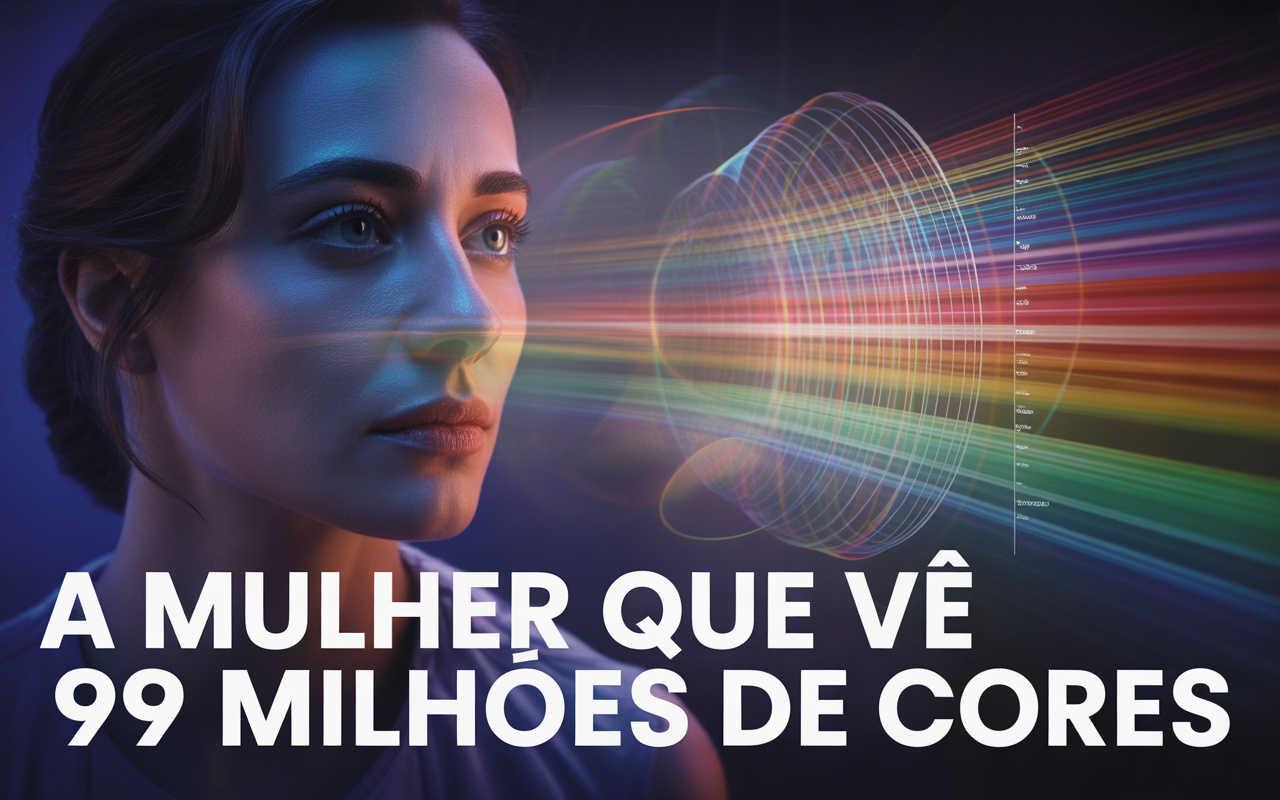

The Tetracromat Woman Who Sees Up to 99 Million Colors Challenges Science and Reveals a Level of Visual Perception Almost Impossible for the Common Human Eye.
In a field of science where it was believed that everything had already been mapped, human visual perception emerged as such a rare case that it became the subject of study for ophthalmologists, neuroscientists, and genetics specialists. This case involves Concetta ANTICO, an Australian artist and carrier of a biological phenomenon called tetracromacy, a condition documented by research published since the 2010s and confirmed by clinical examinations and laboratory chromatic tests.
While the average human sees the world through three types of cones – light-sensitive cells that detect specific ranges of the spectrum – ANTICO possesses a fourth functional type, responsible for radically enhancing her ability to distinguish hues, brightness, and microcolor variations that are impossible to perceive for “trichromatic” individuals. The result is impressive: she can discriminate up to 99 million colors, compared to approximately 1 million perceived by most people. The difference is not merely quantitative. It is sensorial, profound, and alters the way she interprets textures, shadows, reflections, and even small details of everyday life.


How Tetracromacy Works and Why Almost No One Knows They Have It
The discovery of the condition came through studies conducted by specialists like Professor Jay Neitz from the University of Washington, and other international groups dedicated to the genetics of vision. Tetracromacy occurs primarily in women because it is linked to the X chromosome. In simple terms:
-
World’s Most Powerful MRI Machine in France, Weighing 132 Tons and Generating 11.7 Tesla Magnetic Field, Offers Unprecedented Clarity of the Human Brain

-
Hong Kong Converts Former Coastal Landfill into Desalination Plant Producing 135 Million Liters of Drinking Water Daily
-
Texas Teens Win $50,000 at World’s Largest Science Fair for Developing Non-Surgical Brain-Controlled Bionic Prosthesis with 98% Accuracy
-
Samsung Galaxy A27 Launches with 6.7-inch Super AMOLED Display, Full HD+ Resolution, Android 16, Six Years of Updates, Snapdragon 6 Gen 3, and Dust and Splash Resistance; Available for Pre-order in the US for $350


- men have XY → less likely to carry multiple variations;
- women have XX → can transmit and manifest additional combinations of visual pigments.
Although up to 12% of women may have the genetic potential for this condition, only a tiny fraction estimated between 0.1% and 1% — exhibits functional quadrupling of the cones, resulting in real enhanced perception.
Antico is one of the few clinically confirmed cases.
Research shows that the tetracromat brain not only receives more visual information: it processes, organizes, and interprets these stimuli, creating a level of detail superior to conventional human perception.
It is as if she sees hidden nuances in seemingly identical surfaces — small changes in heat, microtones of light, subtle pigment variations, reflections invisible to others.
The Impact in the Real World: When Each Object Gains Thousands of Additional Colors
For ANTICO, a white wall is never truly white. According to her own reports, confirmed by laboratory analyses, neutral surfaces fragment into dozens of microtones:
- bluish shadows
- yellowish reflections
- pink granulations
- greenish contours blending into the varnish
What is a single tone for most, for her it is dozens.
The same occurs with simple objects:
- a dry branch shows earthy variations invisible to the common eye;
- a cloudy sky presents hidden palettes among gray, lilac, and navy blue;
- still water reveals shades that appear and disappear depending on the incidence of light.
That’s why many researchers claim that tetracromat individuals don’t just “see more colors,” but live in a different visual spectrum, denser, more complex, and less understandable for those with conventional vision.
Why Science Is Still Trying to Understand How She Sees So Much
One of the most intriguing points is that having four cones does not automatically guarantee functional tetracromacy. The brain needs “natural training” to learn how to utilize the additional information. This is where Antico’s trajectory makes a difference.
She has been a professional artist since childhood, which has exposed her brain to intense exercises in observation, paint mixing, tonal perception, and shadow analysis for decades. Researchers believe that this constant habit may have “unlocked” the full use of the fourth cone.
The phenomenon demonstrates that:
- genetics: provides the potential;
- visual experience: activates advanced processing;
- brain plasticity: organizes the new spectrum of perception.
It is the combination of these three forces that explains how she achieved a capacity so far removed from the average population.
What Laboratory Tests Revealed About Her Vision
Advanced ophthalmological tests, such as variations of the Anomaloscope, the Munsell 100 Hue Test, and tetrachromacy-specific color separation, showed that:
- she distinguishes microvariations of less than 1 nanometer in some chromatic gradients;
- her tonal perception field is up to 100 times more refined than that of an average person;
- stimuli that seem identical to other individuals appear to her as totally distinct colors.
The capability is so uncommon that researchers recorded differentiated reactions in the visual cortex during exams, suggesting an amplification of the neural processing associated with color vision.
What This Means for Science
Antico’s functional tetracromacy has opened a deeper discussion within neuroscience:
Are there other people with this capacity at similar levels?
Possibly, but without being identified.
Can the human brain expand its perception spectrum with training?
Ongoing studies are investigating this possibility.
How far does the capacity of the human eye go?
The condition suggests that the known limit may not be the real limit.
Additionally, the phenomenon offers clues about:
- evolution of vision in mammals;
- development of light-sensitive receptors;
- impact of genetics on neural processing;
- possibilities of sensory enhancement in the future.
Daily Life in a More Colorful World
Tetracromacy also comes with challenges. Antico reports that very colorful environments can cause sensory overload, leading to visual fatigue and excessive stimulation. Fluorescent colors are too intense; saturated environments seem “visually noisy”.
On the other hand, she perceives beauties that no one else notices, and this characteristic has become the foundation of her artistic work. Her paintings, full of layers and nuances, are studied by specialists to understand how tetracromacy translates into painting.
The case of Concetta Antico is not just a scientific curiosity. It reveals that the human body, even in its most basic form, still holds capacities not fully understood by science. Functional tetracromacy proves that there may be people experiencing a completely distinct visual universe that is broader, deeper, and more complex.
As researchers continue studying her condition, Antico continues living in a world with up to 99 million colors, carrying a powerful reminder: humanity still does not know all the limits of its own body.
To learn about her incredible work visit: https://concettaantico.com/


