Portuguese
  Spanish


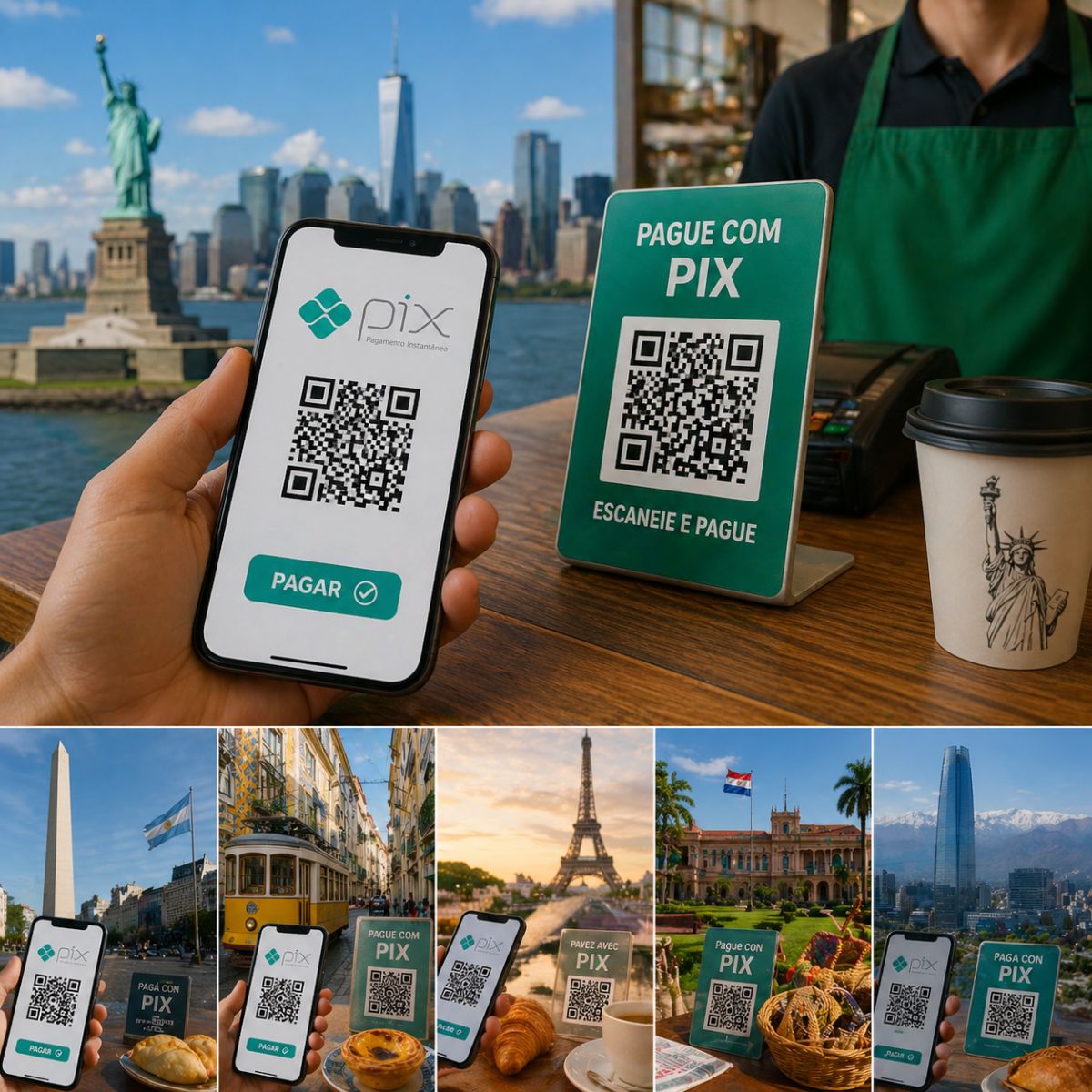

International Pix already works in partner stores in at least six countries: United States, Argentina, Portugal, France, Paraguay, and Chile. Brazilians scan a QR code through their bank’s app, see the amount converted to Brazilian Reals with a 3.5% IOF tax included, and authorize the payment. However, coverage is still limited, the exchange spread varies according to the intermediary fintech, and the system does not replace international cards in all scenarios.
Pix has crossed Brazil’s borders and now allows Brazilians to pay for purchases abroad using the same banking app they use daily. The system works through fintechs that act as intermediaries between the Brazilian Central Bank and foreign merchants: the shopkeeper generates a QR Code with the purchase amount in local currency, the customer scans it through the bank’s app, checks the amount converted to Reals with IOF included, and authorizes the payment. In the statement, the operation appears as a common Pix, although it involves exchange, spread, and tax.
The list of countries where Pix already works includes destinations frequented by Brazilians. In the United States, Verifone machines in cities like Miami and Orlando accept international Pix. In Argentina, Banco do Brasil has partnered with Banco Patagonia and the local clearing house Coelsa. In Paraguay, its use is concentrated in shopping centers in Ciudad del Este. In Portugal and France, the system appears in shops and tourist spots visited by Brazilians. In Chile, acceptance is gradually growing in accredited establishments.
How Pix works outside Brazil in practice
According to information released by the Exame portal, Pix does not connect directly to banks in other countries. For a payment made by a Brazilian to reach a foreign merchant, a fintech needs to bridge the gap. Companies like PagBrasil receive Pix in Reals, convert it to the destination country’s currency, and transfer the amount to the shopkeeper. The process is transparent for the customer, who scans the QR Code in the bank’s app and sees the total cost in Reals before confirming.
-
Former Marketing Agency Owner Thrives on Foraging for 250 Days, Sampling Over 170 Plants, and Says He No Longer Remembers Supermarkets

-
IKEA’s AI Handles Nearly Half of Customer Calls, Company Reassigns 8,500 Staff as Design Consultants, Boosting Revenue by €1.3 Billion
-
Owner of Havan Visits Paraguay to Discuss Lower Taxes, Local Suppliers, and International Expansion with President

-
Brazilian Construction Retail Chain Closes After 60 Years, Begins Liquidation Sale Across Five Cities




The difference compared to Pix between Brazilian accounts is that international operations involve currency conversion and IOF incidence. The exchange rate is locked at the time of purchase, meaning Brazilians know exactly how much they will pay before authorizing, unlike international credit cards, where the final amount only appears on the statement days later, subject to exchange rate fluctuations. There’s no need to notify the bank before traveling or activate any extra functions: the system recognizes the exchange operation and applies the rules automatically.
How much does it cost to use Pix abroad and how does it compare to cards?
Every purchase with Pix outside Brazil incurs an IOF tax of approximately 3.5%, the same rate charged on international credit card purchases. The difference lies in the exchange spread: for cards, the spread is usually between 5% and 7% over the commercial exchange rate, while for international Pix, it varies from 2% to 3%. In practice, this can represent a saving of 2 to 4 percentage points per transaction.
Pix has another advantage: the total cost appears on the phone screen before confirmation, allowing Brazilians to decide if the purchase is worthwhile at that moment. With an international card, the customer only finds out the final amount in Reals when the bill closes, which can lead to negative surprises during periods of exchange rate volatility. The spread rate, however, varies according to the intermediary fintech, so it’s advisable to compare before paying at establishments that accept both methods.
In which countries and cities is Pix already accepted?
The acceptance of Pix abroad is neither widespread nor standardized. Everything depends on commercial agreements between Brazilian fintechs and local acquiring networks, which means coverage varies from city to city and from store to store. Still, some destinations already concentrate a good part of the operations.
In the United States, Miami and Orlando are the cities with the highest presence of machines enabled for Pix, reflecting the flow of Brazilian tourists who visit these regions. In Argentina, the partnership between Banco do Brasil, Banco Patagonia, and Coelsa has enabled Pix in accredited establishments, especially in Buenos Aires. In Paraguay, the system works in shopping centers in Ciudad del Este, a classic border shopping destination. In Portugal and France, Pix appears in stores and businesses aimed at the Brazilian public, and the tip for travelers is to look for signs or stickers with the system’s QR Code at the counter.
What Pix still doesn’t do outside Brazil
Despite advances, international Pix has important limitations. It is not possible to send Pix directly to a foreign bank account, and those who live outside Brazil without an account at a Brazilian financial institution do not receive transfers through the system. There is also no Pix Saque (withdrawal) at ATMs abroad, and transfers between people from different countries do not work.
To send money to someone abroad, the way remains through remittance companies like Wise, Remessa Online, or Western Union, where Pix can only be used as a form of payment for the exchange operation, not as a direct transfer method. Pix between Brazilian accounts, on the other hand, works normally anywhere in the world with internet access, with no additional cost or IOF (Financial Operations Tax), as the transaction occurs within the Brazilian system.
Pix or international card: when to use each
The answer depends on the location and context. In stores that accept Pix, the system tends to be more advantageous due to the lower spread and cost transparency at the time of purchase. The international card, on the other hand, works on any machine in the world, offers points or cashback programs, and does not depend on agreements with specific fintechs.
For Brazilians traveling, the practical recommendation is to diversify. Use Pix abroad in partner stores where the savings on the spread compensate, and reserve the card for places where Pix has not yet arrived. The trend is for Pix‘s international coverage to grow in the coming years as more fintechs form partnerships with acquiring networks in new countries, but for now, acceptance is still too punctual to rely exclusively on it for an international trip.
Have you ever used Pix abroad or do you still prefer an international card for your trips? Tell us in the comments which country you paid with Pix in and if the cost was worth it compared to the card; we want to know if the experience was as simple as promised.