Portuguese
  Spanish


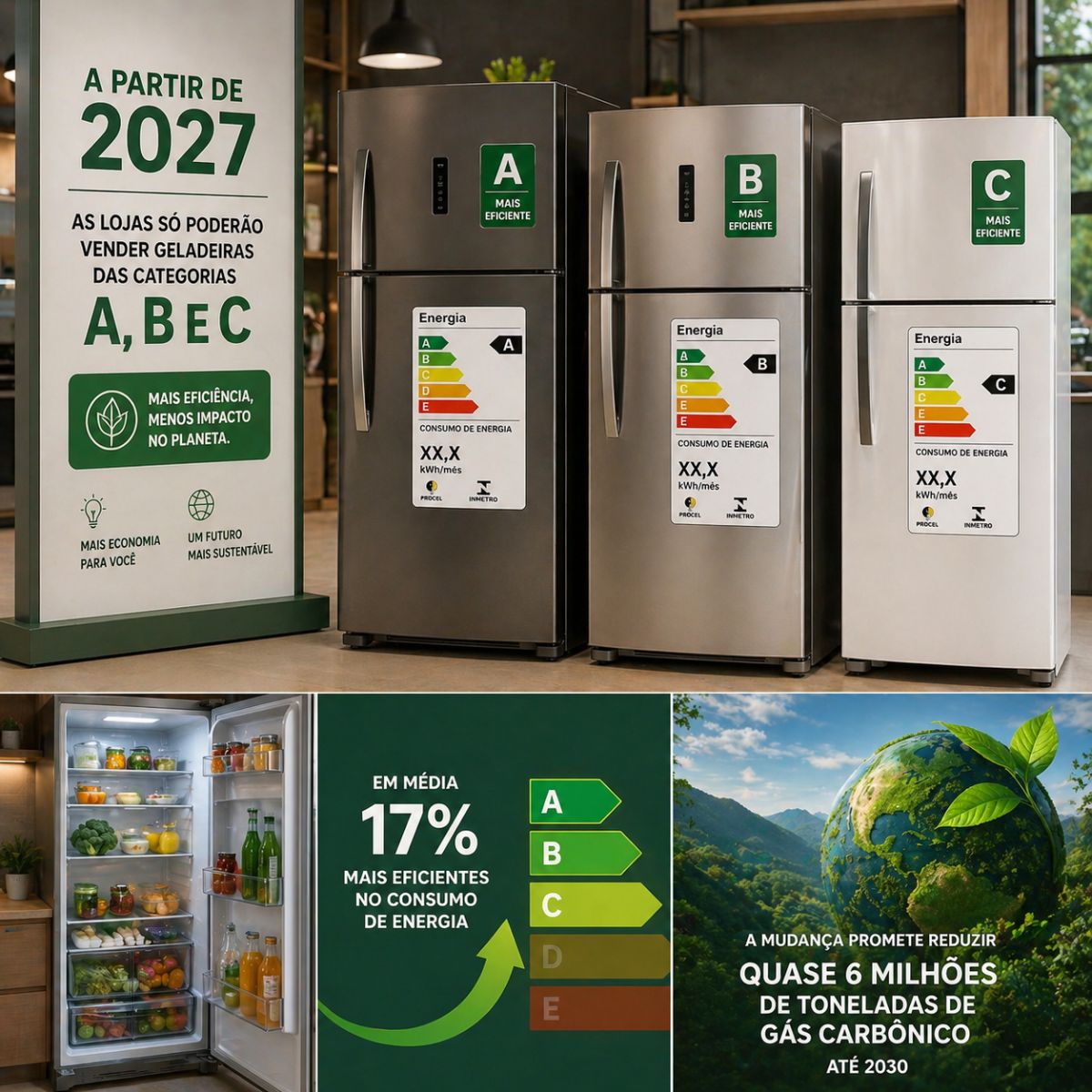

The Brazilian government simplified the energy efficiency classification of refrigerators from six to three categories. Starting in 2027, stores will only be able to sell refrigerators from classes A, B, and C, which reduce energy consumption by an average of 17%. Appliances from the extinct categories can no longer be manufactured since December 2025, and the official estimate is that the measure will prevent the emission of almost 6 million tons of carbon dioxide by 2030.
Choosing a new refrigerator has become simpler and, in the long run, cheaper. The Ministry of Mines and Energy reduced the number of categories on refrigerator energy efficiency labels from six to three, eliminating classes that did not meet the new maximum consumption standards. Refrigerators with the old classification can no longer be manufactured since December of last year, and the new label in effect since the beginning of 2026 features only three categories: A, the most economical, B, and C. The rule also applies to imported products.
The change has a direct impact on the consumer’s wallet and the environment. According to Inmetro, refrigerators in the new categories are, on average, 17% more efficient in energy consumption than models from the extinct classes. For those who pay an electricity bill every month, the difference becomes apparent over years of use, as a refrigerator operates 24 hours a day and is one of the appliances that most impacts the bill. The government estimates that the new requirements will prevent the emission of almost 6 million tons of carbon dioxide by 2030.
What changed in refrigerator efficiency classification

According to information released by the G1 Channel, before the change, refrigerator energy efficiency labels had six categories: A (the most efficient, with the Procel seal), B, C, and three lower classes that indicated higher consumption. The government abolished the last three categories because the appliances classified in them consumed too much energy for current standards, and determined that no national manufacturer or importer can produce or bring into the country refrigerators with performance below level C.
-
Berries, Strawberries, and Blueberries Could Transform Agriculture in Northeastern Brazil, New Tests Reveal

-
Danish Resident Discovers Six Viking Gold Bracelets Weighing 762.5 Grams, Third Largest Gold Treasure in Denmark

-
Over 200 Cities in Southern Brazil on Storm Alert as Cyclone Near Uruguay Brings Heavy Rain, Hail, and Winds Up to 100 km/h

-
Archaeologists Discover 2,300-Year-Old Beer in Sealed Bronze Vessel from Ancient Chinese Tomb




The simplification makes consumer choice easier. With only three categories, comparing models is more direct: whoever buys a class A refrigerator knows they are getting the most economical appliance available, while class C represents the minimum efficiency allowed by regulation. The new label is visually clearer and appears affixed to the refrigerator door in all stores, allowing the buyer to quickly identify the level of consumption before closing the deal.
When old refrigerators stop being sold in stores
Refrigerators with the old label can still be sold in 2026, but only while supplies last. Starting in 2027, stores will only be able to offer refrigerators from categories A, B, and C, and any appliance that does not meet the new standards will have to be removed from shelves. For consumers planning a purchase, this means that cheaper models from the extinct classes may still be found this year, but with an expiration date in store displays.
The transition was designed to give the market time. Manufacturers had over a year to adjust production lines, and stores gained the entire year of 2026 to sell remaining stock. Starting in January 2027, Inmetro inspectors will be able to fine establishments that sell refrigerators outside the three permitted categories, ensuring that consumers only find refrigerators that meet the new efficiency requirements.
How much the new refrigerator saves on the electricity bill
The average 17% gain in energy efficiency translates into real savings on the electricity bill over the years. A refrigerator runs continuously and accounts for between 25% and 30% of a household’s electricity consumption, meaning any percentage reduction in the appliance’s usage has a proportional impact on the monthly bill. For low-income families, where electricity weighs more heavily on the budget, the difference is even more significant.
The exact calculation of savings depends on the model, size, and usage habits, but the logic is simple: a Class A refrigerator uses less energy than a Class C, and both use less than models from the extinct categories. Monthly savings may seem small, but accumulated over the 10 to 15-year lifespan of a refrigerator, the math works out in the consumer’s favor. The government projects that, by summing all appliances sold under the new rules, almost 6 million tons of CO2 will cease to be emitted by 2030.
Prices may rise, but the market should absorb the impact
The president of the Association of Electronic Appliance Manufacturers acknowledges that refrigerator prices may initially rise. To deliver the efficiency required by the new categories, manufacturers need more robust inputs and components, such as latest-generation compressors and superior thermal insulation, which increases production costs. More sophisticated parts and components mean more expensive refrigerators at the retail end.
However, competition in the Brazilian market tends to limit the pass-through to the consumer. With multiple brands competing for shelf space in stores, manufacturers are pressured to maintain competitive prices even with higher production costs. The expectation is that, after an initial adjustment period, prices will stabilize at accessible levels, especially as the production volume of new models increases and economies of scale offset the additional cost of components.
The next update scheduled for 2030 and alignment with Europe


The 2026 simplification is just the first step. Another update is scheduled for 2030, when efficiency standards will be revised again to align the Brazilian market with the level practiced in developed economies like Europe. In practice, this means that refrigerators sold in Brazil in 2030 will have energy performance comparable to the best refrigerators available in Europe.
For the consumer, the message is that the trend of increasing efficiency is irreversible. Anyone buying a Class A refrigerator today will be acquiring an appliance that meets the most rigorous standards of the moment, but which in four years may be surpassed by even more economical models. The continuous evolution of requirements encourages manufacturers to invest in innovation and offers the buyer the guarantee that each generation of refrigerators will consume less energy and weigh less on the electricity bill than the previous one.
Is your refrigerator old and you’re thinking of replacing it, or will you wait until 2027 when only the most efficient models remain? Tell us in the comments how old your refrigerator is and if savings on the electricity bill influence your choice when picking a new model.