Portuguese
  Spanish


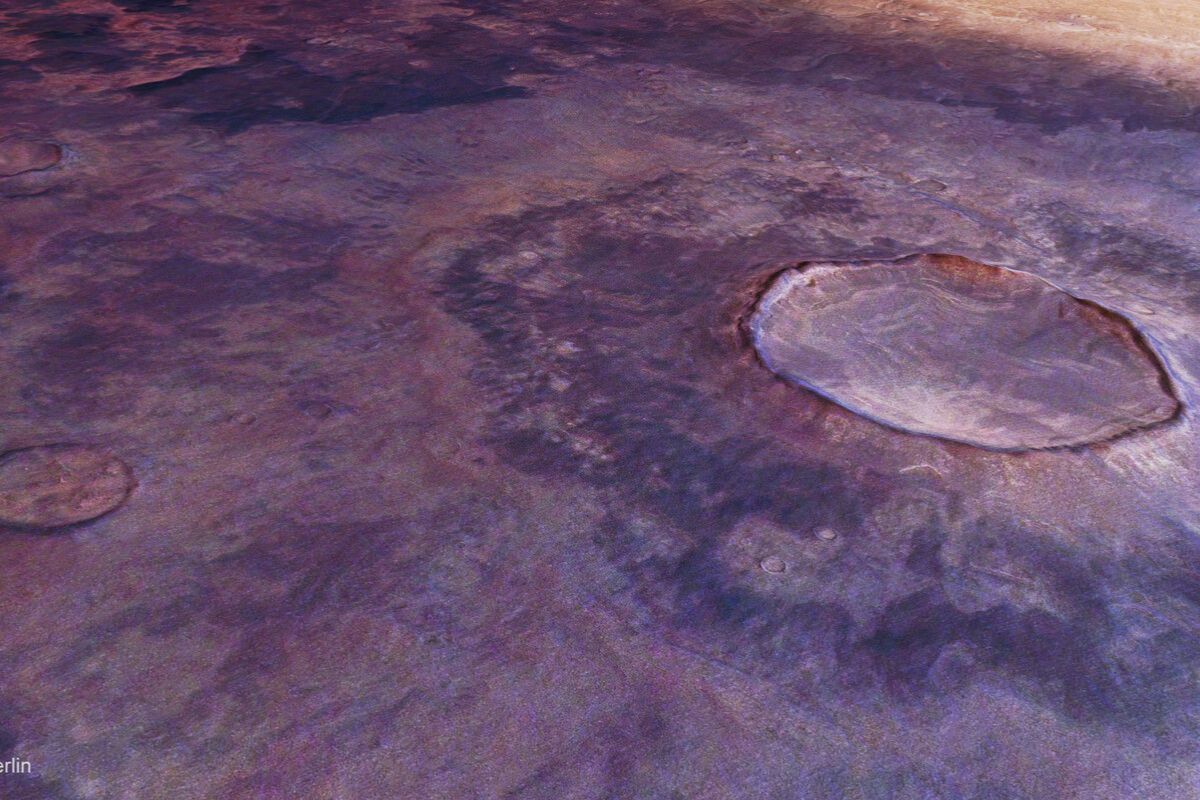

Mars appears with a vast area of dark ash in Utopia Planitia, in an image analyzed by ESA scientists, with signs of crater, subsurface ice, and a past of geological violence
Mars often gives the impression of being a planet frozen in time, with changes so slow that they would take millions of years to become visible. However, this time, Mars caught attention for a rare reason: scientists from the European Space Agency detected a transformation in the landscape that occurred quickly enough to be noticed within a single generation.
The photo released in the context of space observation shows a striking expansion of dark ash in a region known as Utopia Planitia. In addition to the visual contrast, the scene also exposes a set of clues about how Mars has been shaped by impacts, volcanoes, and ice, as if the planet had kept its scars in layers.
A rapid change in a planet that seemed static
The very base highlights that perceptible changes on Mars are usually slow, but specialists observed a different case. What impresses is not just the presence of ash, but how much it seems to have spread in just a few decades.
-
The large jar blender has a rival: Oster Ultra Power bets on 1,000 W, six stainless steel blades, and two portable cups with leak-proof lids.

-
Tesla injected an additional $250 million into the German factory, doubled the battery cell target, and opened its own production line for startups.

-
No more TV stuck on the wall: Samsung The Freestyle+, the new projector with over 400 lumens projects on walls, floors, and ceilings, bringing cinema to any corner of the house.
-
A Japanese governor single-handedly stalled the construction of the world’s fastest train for nine years, and only now has he agreed to allow a tunnel excavated at a depth of 1,400 meters.



This changes the reading of the planet: instead of a frozen scenario, the image suggests that there are processes capable of reshaping entire areas in much shorter timeframes than expected.
From Viking to Mars Express: what changed in 50 years

The ash had already appeared in photos from NASA’s Viking probes in 1976. The difference is that now, the amount recorded is much greater than at that time, making the comparison inevitable.
The recent image was captured by the High Resolution Stereo Camera (HRSC) from the Mars Express mission. It was this contrast between eras that raised the alarm: the ash is not new, but the current scale is.
Why the ash points to a volcanic origin
The origin of the ashes is treated as relatively clear in the base. The volcanic material tends to be rich in mafic minerals, formed at high temperatures. Two examples mentioned are olivine and pyroxene, dark-appearing minerals, very similar to the shade seen in the images.
This relates to a larger trait of the planet: Mars is associated with high volcanic activity and hosts the largest volcano in the Solar System, Olympus Mons. Adding up the evidence, the interpretation is that the ashes have a strong volcanic signature.
The Martian wind may have spread or revealed what was already there
The least certain point is how so much ash became visible in such a short time. The hypothesis presented is the wind.
The Martian winds may have moved this material, spreading it over a larger area, or they may have “uncovered” the ashes, lifting the typical ochre dust from the surface and revealing a dark layer that already existed beneath. In both scenarios, the wind appears as an agent that reorganizes the visual of the terrain.
The 15 km crater in the middle of the ashes and the ejection ring
A detail that gives scale to the scenario is the crater mentioned in the base, with 15 kilometers in diameter, appearing amidst the ashes.
Around it, a lighter ring appears, described as “ejection blanket”, which is the material thrown out during the impact that formed the crater itself.
This type of structure is almost a geological record in photography: the impact leaves a mark, expels material, and reorganizes the soil around it like a “carpet” of debris.
The wavy lines that reveal subterranean ice in motion
Inside the crater, the image also shows wavy lines. The reading presented is that these marks indicate where frozen material existing beneath Mars has spread.
This is an important detail because it connects ashes and impact to a third element: ice. The photograph, according to the base, serves as a visual synthesis of how Mars has been shaped by impacts, volcanoes, and ice trying to escape through cracks, with signs that not everything happens at the slow pace that many people imagine.
If you had to choose a more “likely” explanation just based on what the image suggests, would you bet that the ashes spread with the wind or that the wind merely removed the light dust and revealed a dark layer that was already there? Why?