Portuguese
  Spanish



High oil prices drive accelerated growth, while economic and social risks begin to emerge in the internal scenario
The war in the Middle East, with direct impacts on the Strait of Hormuz, has begun to reshape the global energy map.
In this context, a neighboring country of Brazil has emerged as one of the main beneficiaries outside the conflict region.
At the same time, the country is experiencing an unprecedented economic boom, driven by soaring oil prices.
-
Chinese Nuclear Submarine Launches Simulated Warhead Missile in Pacific, Heightening Regional Tensions Amid Naval Drills with Russia Near Qingdao; New Zealand and Papua New Guinea Warn of Persistent Chinese Military Presence

-
Ayatollah Ali Khamenei’s Funeral Draws 15 to 20 Million in Tehran, Calls for Revenge Against Trump After Joint Israel-U.S. Attack

-
U.S. Establishes Permanent Embassy in Jerusalem, Reigniting International Debate Over Israel’s Capital
-
The world has nearly 12,000 nuclear warheads, with the majority held by the United States and Russia; see the figures for China, France, and the United Kingdom.


Since 2019, when offshore exploration began, the economy has multiplied fivefold, becoming the fastest-growing in the world.
Now, with the barrel nearing US$ 100 in 2026, above the average of US$ 69 recorded in 2025, the gains have been amplified by global instability.
Accelerated growth drives record revenues
With the escalation of oil prices, revenues have significantly increased.
Since the start of the conflict involving Iran in 2026, weekly revenue has jumped from around US$ 370 million to over US$ 620 million.
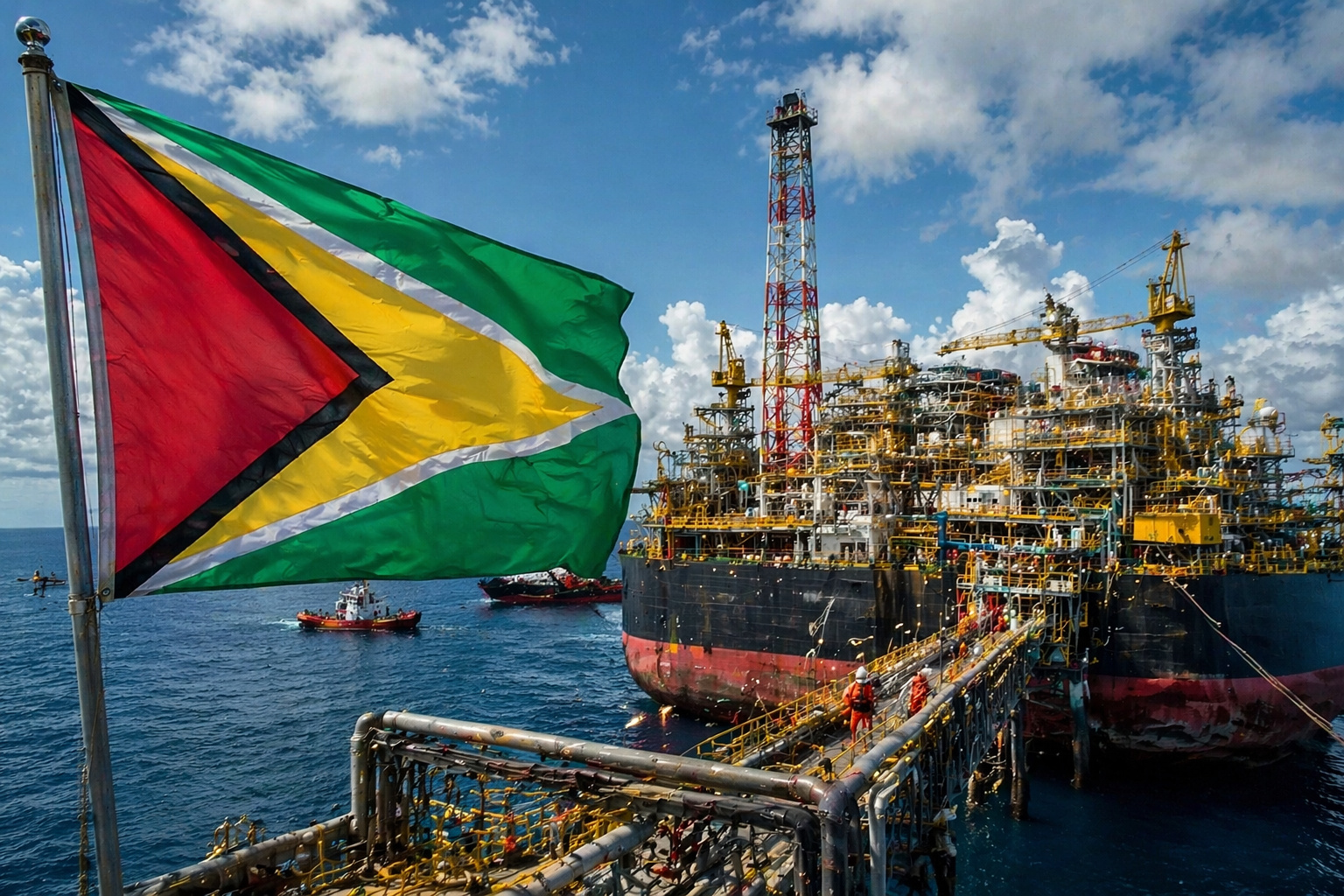
Additionally, the main production hub is concentrated in the Stabroek block, operated by a consortium led by ExxonMobil.
Production is expected to reach 940,000 barrels per day by 2026, with accelerated expansion.
If prices remain high, the oil fields could generate up to US$ 33 billion in the year, about 75% above previous projections.
Meanwhile, Europe, pressured by the energy crisis, is paying higher premiums for oil, boosting the country’s gains.
Project expansion accelerates production
Meanwhile, major oil companies are advancing with new investments.
Currently, four projects are already operational, each supported by FPSO platforms valued at around US$ 2 billion.
Additionally, a fifth project is expected to come online ahead of schedule, while others are still under construction.
Among them, there are initiatives also focused on natural gas.
As initial costs are amortized by the end of 2026, the government’s share is expected to rise from 14.5% to over 50%.

Dependence on oil worries experts
Despite the boom, dependence on oil is growing rapidly.
Currently, the sector accounts for about 50% of the public budget and 75% of GDP.
This level even surpasses that of traditionally dependent countries, such as Libya.
In light of this, experts warn of the so-called “resource curse”.
While oil generates wealth, other sectors suffer from rising energy costs.
Although the government has eliminated taxes on fuels, private operators are already passing on increases.
Inflation and social impacts intensify
Moreover, the effects are already being felt by the population.
Since 2021, food and housing prices have risen by about 75%, putting pressure on the cost of living.
At the same time, the oil sector attracts skilled labor, reducing professionals in other areas.
Meanwhile, signs of institutional pressure are emerging, with risks of waste and tensions with the press.
Infrastructure projects are also facing delays and rising costs.
One example is the natural gas project, which already costs six times more than expected and is still delayed.
Government tries to balance growth and stability
Even in the face of challenges, the government seeks to maintain economic balance.
To this end, investments in infrastructure have been initiated, including a highway to Brazil and a bridge over the Demerara River.
According to international organizations, indicators such as core inflation and fiscal deficit remain relatively under control.
Still, economists recommend caution in resource management.
Among the suggested measures, strengthening the sovereign fund stands out to avoid excessive spending.
The challenge of quick wealth puts the country to the test
Finally, the country has become a clear example of how geopolitical shocks create unexpected winners.
At the same time, it highlights the classic challenges of economies dependent on natural resources.
In light of this, the main challenge will be to avoid uncontrolled expansion of public spending.
Thus, the country will need to ensure that oil wealth does not compromise the development of other sectors.
In light of this scenario, will this neighboring country of Brazil be able to transform its wealth into sustainable growth or will it fall into the trap of oil dependency?