






 Portuguese
  Spanish


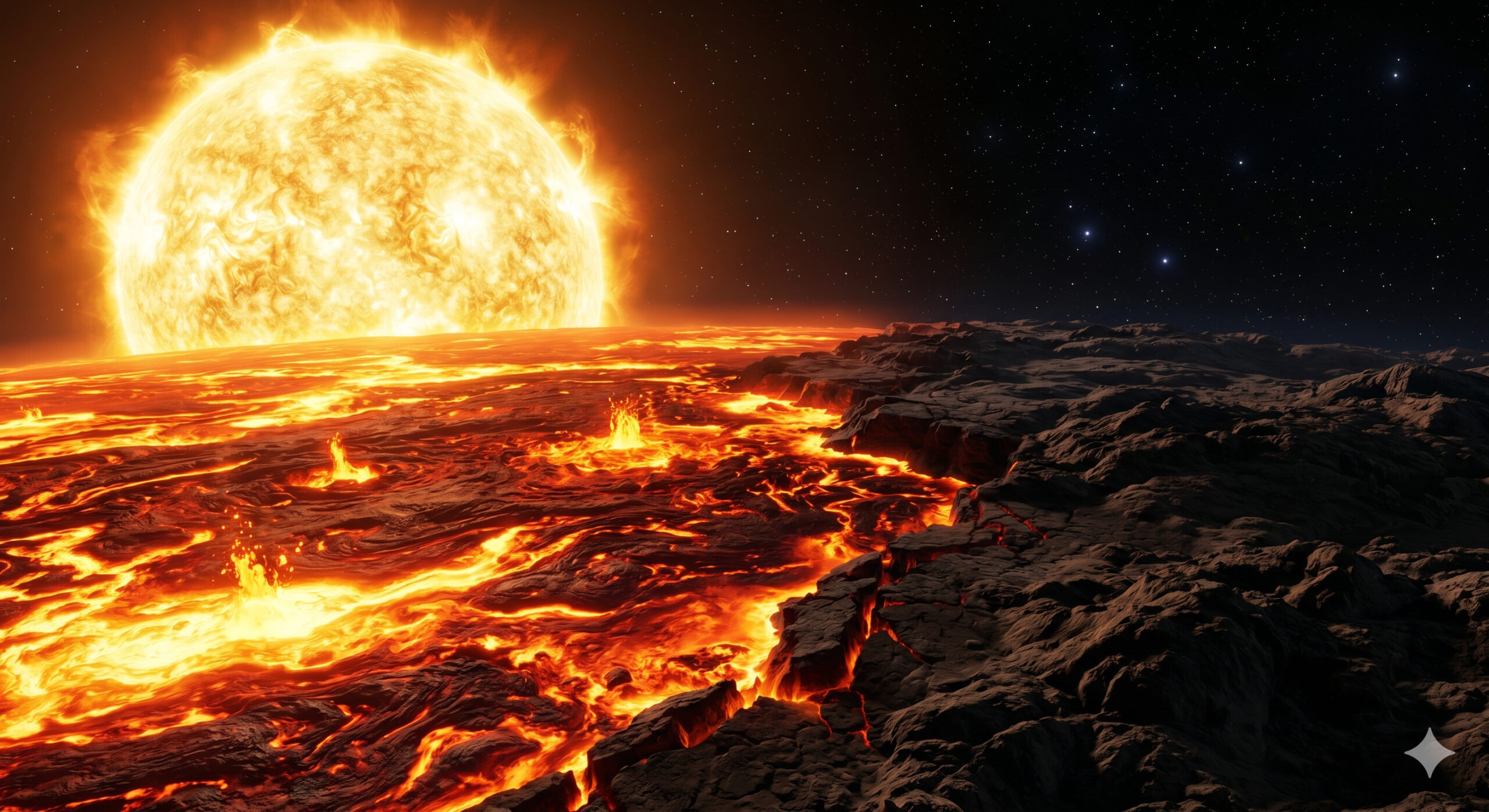


Exoplanet HD 63433 d has a year of 4.2 days, temperatures of up to 1,257°C, and may have an entire hemisphere covered in lava.
In 2024, NASA reported on January 10 the identification of one of the most extreme rocky exoplanets ever described by data from the Transiting Exoplanet Survey Satellite (TESS): HD 63433 d, located approximately 73 light-years from Earth, in the direction of the constellation Gemini. The discovery was detailed in a study published on February 1, 2024 in The Astronomical Journal, conducted by an international team led by Benjamin K. Capistrant and Melinda Soares-Furtado, who analyzed TESS light curves to confirm a young planet, similar in size to Earth, orbiting a Sun-like star.
What sets this planet apart is not just its size, estimated at about 1.1 times the radius of Earth, but a rare combination of physical factors. HD 63433 d completes an orbit around its star in just 4.2 Earth days, meaning that a whole “year” on this world passes in less than a week. This extreme proximity causes the permanently illuminated side to reach about 1,257°C, a high enough temperature to support the hypothesis of a partially melted surface.
This scenario has led scientists to suggest that the planet may have a hemisphere covered in lava, as it is likely tidally locked, with one face always facing the star and the other plunged into darkness. Being the smallest confirmed exoplanet with less than 500 million years and the closest Earth-sized young planet identified, HD 63433 d has become an important target for understanding how rocky worlds evolve under extreme radiation.
-
Engineers Develop Fridge-Sized Machine to Produce 95-Octane Synthetic Fuel from Air and Water, Aiming to Sustain Combustion Engines Without Oil

-
Two-Armed Robot Uses AI to Reassemble Destroyed Pompeii Frescoes, Solving an “Impossible” Puzzle
-
New Law in Brazil Requires Breaks for Type 1 Diabetes Management at Work, School, and Public Exams

-
Scientists Confirm “Greening” of Antarctica: Ice on the World’s Coldest Continent Turns Green as Mosses Multiply Over Tenfold in Four Decades


HD 63433 d: what does a year of just 4.2 days mean
The orbital characteristic of HD 63433 d is one of the most impressive points of the discovery. While Earth takes 365 days to complete one orbit around the Sun, this exoplanet takes only 4.2 days to complete the same movement around its star.


This fact is not only curious but fundamental to understanding the extreme conditions of the planet. The closer a planet is to its star, the greater the gravitational force and the faster its orbit. In the case of HD 63433 d, this proximity is so great that it is practically “stuck” to the star in astronomical terms.
As a direct consequence, the planet receives a gigantic amount of stellar energy, far greater than that received by Earth. This explains why the surface reaches such high temperatures, sufficient to melt rocks and turn the crust into liquid magma.
A planet locked by the star and divided into two worlds
Another critical aspect of HD 63433 d is the phenomenon known as tidal locking. Just as the Moon always shows the same face to Earth, this exoplanet likely keeps one side permanently facing its star.
This creates an extreme division between two completely different hemispheres. The daytime side, constantly exposed to stellar radiation, can reach temperatures above 1,257°C, sufficient to keep the surface in a partially or fully molten state.

The nighttime side, on the other hand, remains in constant darkness, potentially much colder. This contrast can create gigantic thermal differences, generating complex atmospheric conditions, should any residual atmosphere exist.
This type of configuration turns the planet into a natural laboratory for studying thermal extremes and atmospheric dynamics under conditions outside known standards.
The possible global lava ocean on exoplanet HD 63433 d
The most striking hypothesis involving HD 63433 d is the existence of a lava ocean on its illuminated side. This concept is not just theoretical, but based on physical models used to explain the behavior of ultra-hot rocky planets.
When the temperature exceeds certain limits, solid minerals begin to melt, forming a liquid surface composed of molten rock. Under conditions estimated for this exoplanet, this process could occur on a global scale, at least in one of the hemispheres.
This means that, instead of oceans of water, like on Earth, this planet may have vast expanses of exposed magma, with its own dynamics, including circulation of molten material and possible gas release.
This scenario has already been proposed for other exoplanets, but HD 63433 d stands out for being Earth-sized, making the comparison even more relevant for planetary studies.
A young planet still evolving
Another factor that makes HD 63433 d particularly interesting is its age. Unlike Earth, which is about 4.5 billion years old, this exoplanet is relatively young in astronomical terms.
Studies indicate that the HD 63433 system is about 400 million years old, which means that the planet may still be undergoing intense processes of formation and geological evolution.
This opens a rare window to observe how rocky planets evolve in their early stages, especially under extreme conditions of temperature and radiation.
The youth of the system makes HD 63433 d one of the best candidates for understanding how rocky worlds transform over time.
The role of TESS in the discovery
The detection of HD 63433 d was made possible thanks to NASA’s TESS space telescope, launched with the goal of identifying exoplanets around nearby stars.
The method used was the transit method, in which the telescope observes small dips in the brightness of a star when a planet passes in front of it. These variations allow for the calculation of the planet’s size, its orbit, and other fundamental characteristics.
In the case of HD 63433 d, TESS data revealed not only its existence but also its rocky nature and extremely short orbit.
This type of discovery demonstrates how modern missions are rapidly expanding the catalog of exoplanets, especially those with extreme characteristics.
What HD 63433 d reveals about other worlds
The study of exoplanets like HD 63433 d is not only descriptively valuable. It helps answer fundamental questions about planetary formation, atmospheric evolution, and physical limits of rocky worlds.
For example, understanding how the crust behaves at such high temperatures can provide insights into the geology of planets close to their stars. Similarly, studying the possible loss of atmosphere in extreme environments helps to understand why some planets retain atmospheres while others do not.

Moreover, these studies contribute to the search for habitable planets, as they help define the limits of the so-called “habitable zone,” where liquid water could exist. By studying extreme worlds, scientists can better understand where life may or may not arise in the universe.
Differences in relation to Earth and the Solar System
Although it is similar in size to Earth, HD 63433 d is completely different in almost every other aspect. Its proximity to the star, its extreme temperature, and its possible lava surface place it in a category of its own.
In the Solar System, the planet that comes closest to this type of condition is Mercury, but even it does not reach such high temperatures nor shows evidence of global surface magma.
This comparison highlights how diverse the universe can be when it comes to planets, going far beyond the known examples in our own system.
Limitations and what is still unknown about the exoplanet that reaches 1,257°C
Despite the available information, there are still many uncertainties about HD 63433 d. It is not possible to directly confirm the presence of a lava ocean, as current observations do not allow for that level of detail.
A large part of what is known comes from theoretical models based on temperature data, composition, and the physical behavior of materials under extreme conditions.
Therefore, it is important to highlight that some conclusions are scientific inferences, not direct observations. Future missions and more advanced telescopes may refine this information.
This means that the planet may be even more extreme than imagined or exhibit characteristics not yet predicted by current models.
The future of observations with the James Webb
The James Webb Space Telescope, launched by NASA in partnership with ESA and CSA, represents the next big step in the analysis of exoplanets like HD 63433 d.
With the ability to observe atmospheres and chemical compositions with greater precision, Webb will be able to investigate whether the planet has gases such as carbon dioxide or mineral vapor, and better understand its thermal dynamics.
These observations may confirm or refine the lava ocean hypothesis and provide more detailed data about the planet’s structure.
What do you think of a planet where a year lasts only 4 days and half of the surface could be a lava ocean?
The discovery of HD 63433 d raises a series of reflections on the diversity of worlds in the universe and the physical limits that a planet can reach. With temperatures high enough to melt rocks and an extremely fast orbit, it represents one of the most extreme examples ever identified.
In light of this scenario, do you believe there are still types of planets even more extreme waiting to be discovered?








Yes, the Universe undoubtably has many more surprises in store. We have just scratched the surface of our understanding.