






 Portuguese
  Spanish


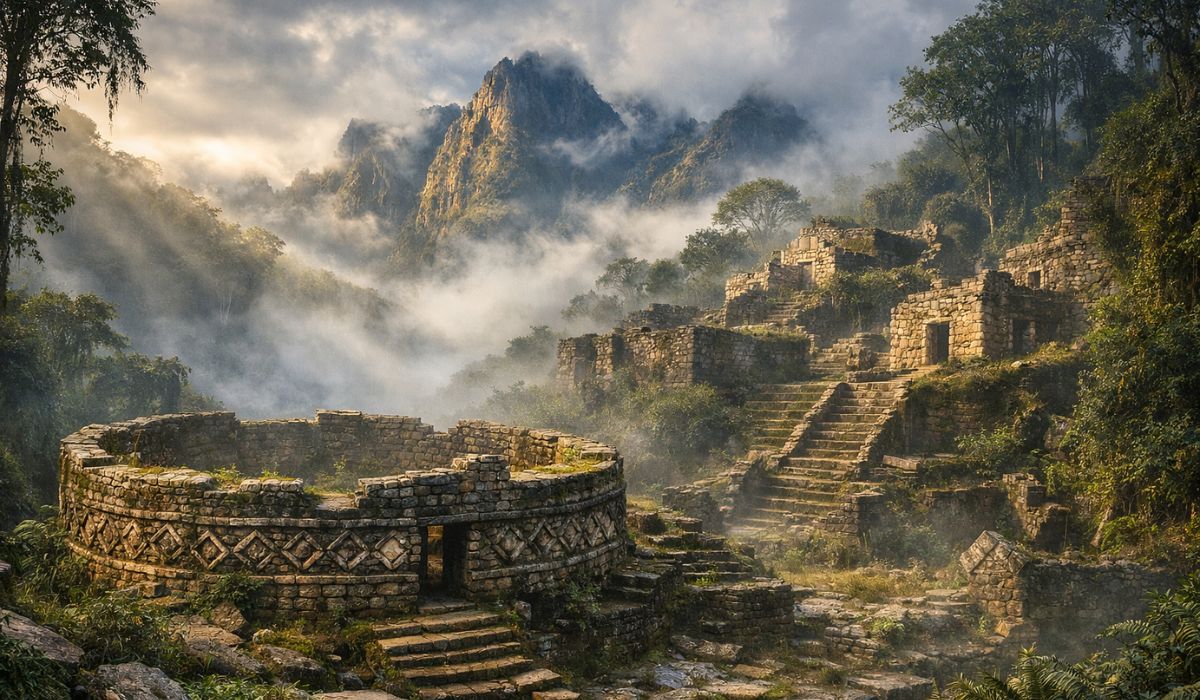


New mapping in Gran Pajatén expands the reach of research on the Chachapoya and reinforces the importance of recording technologies in a remote, sensitive, and strategic area for Andean archaeology.
More than 100 previously unknown archaeological structures have been identified in Gran Pajatén, in the Río Abiseo National Park, Peru.
The finding expands what was known about the Chachapoya presence in the Andean cloud forest area.
The announcement was made by the World Monuments Fund, which described the set as part of a broader network of pre-Hispanic settlements, rather than an isolated complex.
-
Project Daedalus: The 190-Meter Spacecraft Aiming to Reach Another Star with Nuclear Fusion and a 50-Year Fuel Supply

-
Giant 2.2 km Device Sweeps Plastic from Pacific Ocean, Cleaning an Area the Size of a Football Field Every 5 Seconds to Contain World’s Largest Ocean Garbage Patch
-
Brazil’s Public Health System Launches Study on Semaglutide’s Impact on Obesity
-
NASA’s Giant “Space Flower” to Unveil Earth-like Planets by Blocking Distant Stars’ Light




Gran Pajatén and the presence of the Chachapoya
The new mapping has brought Gran Pajatén to the center of archaeological discussions about the Chachapoya, a people who occupied the northeastern Andes of present-day Peru between the 7th and 16th centuries.
The society is historically associated with the high-altitude forest and left characteristic architectural marks, such as circular buildings, geometric reliefs, ceremonial platforms, agricultural terraces, and funerary structures in areas of difficult access.

Archaeological technology in the cloud forest
This time, the advancement did not occur through extensive excavations in open areas.
The main work front combined technology and field research in a remote and environmentally sensitive region.
Between 2022 and 2024, the team used aerial and manual LiDAR scans, photogrammetry, topographic recording, and technomorphological analysis to produce a detailed map of the area.
These techniques allowed for the recording of structures hidden beneath vegetation cover, as well as documenting construction forms and the spatial organization of the site.
According to the World Monuments Fund, the method reduced the need for more invasive interventions in an environment considered delicate from both archaeological and natural perspectives.
What changes with the discovery of new structures
Gran Pajatén had already been known to archaeology since its modern rediscovery in the 1960s.
In the 1980s, research teams had documented 26 structures at the site.
Now, with the identification of more than 100 new elements, the site is interpreted within a broader territorial context, connected by pre-Hispanic paths to other centers of the same cultural tradition.
This new framework alters the prevailing reading of the area.
Gran Pajatén has always attracted attention for its stone architecture, mosaics, and high-relief friezes, including human figures and geometric motifs.
With the most recent documentation, however, the site is no longer seen merely as an isolated monumental core and is now related to a more extensive occupation network.

Statements from the World Monuments Fund
In a statement released by the institution, the president and CEO of the World Monuments Fund, Bénédicte de Montlaur, stated that the significance of the moment lies not only in the scale of what has been recorded but also in the way the work was carried out.
According to her, the team managed to gather detailed visual and scientific documentation without compromising the park’s environment.
Dating and ancient use of the area
On the ground, the investigations also brought chronological information.
According to the official announcement, the presence of the Chachapoya in Gran Pajatén has been confirmed since at least the 14th century.
Furthermore, analyses of the soil layers indicate the possibility of older use of the area, although the released material does not provide a specific date for this earlier occupation.
Río Abiseo National Park and UNESCO heritage
The landscape helps explain why the site has become a recurring reference in studies of Andean archaeology and montane forest.
Established in 1983, Río Abiseo National Park combines natural and archaeological heritage and is included in the UNESCO World Heritage list for its cultural and natural attributes.
In the official description, the international organization highlights that the area preserves traces of human occupation over millennia and houses numerous archaeological sites at different altitudes.
At the same time, the park concentrates montane forest ecosystems, canyons, and páramo areas.
This geographical context has contributed to the preservation of some of the remains over time.
UNESCO itself notes that the rugged terrain, difficulty of access, and low presence of infrastructure have limited more intense human interventions in various sections of the protected area.
Restricted access and preservation of the archaeological site
Isolation, however, has also imposed obstacles to systematic research.
Due to the fragility of the heritage and access restrictions, public visitation remains quite limited.
Therefore, the use of remote recording technologies has gained importance in recent work, both to expand scientific knowledge and to reduce impacts on the structures.
Network of pre-Hispanic settlements in Peru
In this scenario, the identification of more than 100 structures carries weight beyond the numerical increase of the known collection.
The result reinforces the hypothesis that the Chachapoya occupation in the region was part of an articulated territorial logic, with physical and functional connections between different settlements.
According to the researchers, the existence of roads and spatial links between the sites supports this interpretation.
This reading is also reflected in the assessment of Juan Pablo de la Puente Brunke, executive director of the World Monuments Fund in Peru.
In a statement released by the organization, he stated that the evidence confirms that Gran Pajatén is not an isolated complex, but part of an articulated network of pre-Hispanic settlements from different periods.
Conservation of structures in Gran Pajatén
In addition to documentation work, the team carried out conservation interventions at specific points.
Among the mentioned actions are the reinforcement of stairs, stabilization of stone reliefs, and partial reassembly of a perimeter wall.
According to those responsible for the project, these measures aimed to reduce deterioration risks in structures already affected by the passage of time and the advance of vegetation.


This type of front often receives less public attention than the discovery itself, but is part of the effort to reconcile research and preservation.
In areas covered by dense vegetation and subject to humidity, the exposure of structures can accelerate wear processes if there is no continuous technical monitoring.
Digital documentation and public access to heritage
Another point highlighted by the World Monuments Fund is the role of digital documentation in expanding access to the site without encouraging tourist pressure on a vulnerable area.
As Gran Pajatén is located in a remote region with restricted visitation, visual models, three-dimensional records, and scientific dissemination materials have become an alternative to present the site to the public.
Exhibition on Chachapoya Culture in Lima
The impact of the discovery also reached exhibition spaces.
The Museo de Arte de Lima hosted, from May 21 to June 18, 2025, a free exhibition dedicated to Chachapoya culture and recent work in Río Abiseo.
The initiative brought together part of the material produced during the research and aimed to bring the public closer to a heritage that, for conservation reasons, remains out of reach for most visitors.
As a result, Gran Pajatén is no longer seen merely as a monumental site surrounded by forest but is analyzed, according to the data presented by researchers, as part of a broader network of pre-Hispanic occupation.
The outcome expands the field of investigation on the Chachapoya and adds new elements to an area that still holds open questions for Andean archaeology.


