






 Portuguese
  Spanish
  11 min of reading
  0 comments


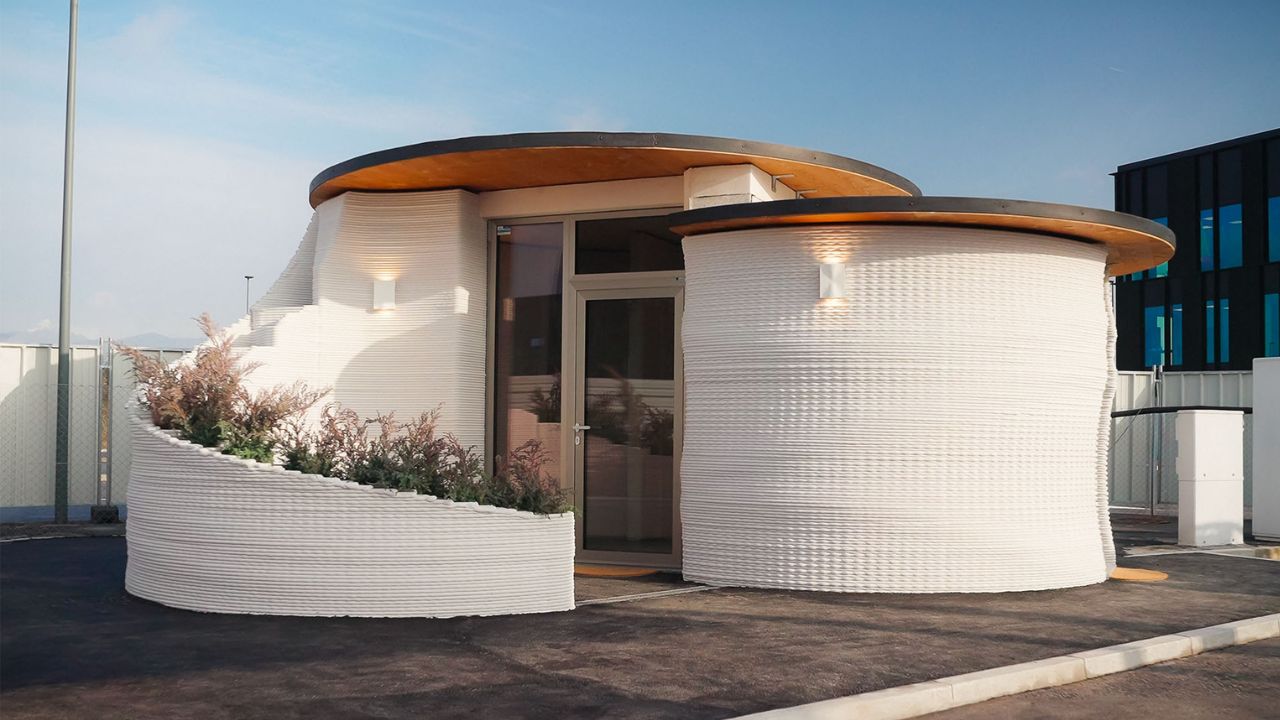
3D Printed Structure at Bergamo Airport Uses Lime-Based Material That Captures CO₂ During Curing, Reduces Waste, and Points to a New Sustainable Path for Fast and Industrial Constructions.
The production of Portland cement — the base material for almost all construction on the planet — accounts for about 8% of all global CO₂ emissions, according to data from VoxelMatters citing the construction sector. It is more than the entire aviation industry. It is more than global maritime transport. And it is a number that the construction industry has lived with for decades without finding a practical solution that works on a large scale.
In December 2025, a team of Italian engineers delivered a building at Milan Bergamo Airport that represents exactly the opposite. The walls were built with a lime mixture — a material that, when curing, undergoes a process called carbonation and absorbs carbon dioxide from the atmosphere. It does not emit. It absorbs.
The building’s walls were printed by a robot in just 7 days, without a single wooden form, without material waste, without a large team on site. The entire construction took 19 days. The project is called Ol Casél — “the little house” in Bergamasque dialect — and it is the first 3D printed building ever constructed inside an airport in the world.
-
Bolivian Female Construction Workers Form Association to Combat Discrimination and 38% Pay Gap in the Industry

-
Near Amsterdam, residents buy land and discover they must also build streets, manage drainage, handle waste, and grow food on half their plot.
-
Brazil’s WEG to Open New Factory in China by 2027, Expanding Production of Large Rotating Electric Machines and Low to Medium Voltage Motors in Rugao

-
Chinese Shipyard Secures $1 Billion in Orders for Low-Carbon Container Ships Amid Global Fleet Renewal Efforts


The Problem Cement Created — and Lime Can Undo
To understand why Ol Casél is relevant, it is necessary to understand what happens when Portland cement is produced. The industrial process involves heating limestone to temperatures above 1,400 degrees Celsius to produce clinker. During this heating, the limestone releases CO₂ in large volumes — both from the fuel used to generate heat and from the chemical reaction of decomposing calcium carbonate itself.
The result is that, for each ton of cement produced, approximately 0.8 tons of CO₂ are emitted. Multiplied by the volume of cement manufactured worldwide — about 4 billion tons per year — it accounts for 8% of global emissions.

Lime works differently. During production, it also emits CO₂. But during curing — the hardening process after application — lime undergoes carbonation: it reacts with CO₂ present in the air and incorporates it into its structure. Over time, part of the carbon emitted during production is reabsorbed by the already installed material. In well-designed projects, this reabsorption can be significant enough to make the emission balance close to neutral or even positive.
It is not a new technology. Lime was the dominant material in construction for millennia — from Roman stucco to medieval European churches. What is new is the combination of this material with robotic 3D printing and sufficient technical standardization to be approved in an environment as regulated as an airport.
The printer that built the Ol Casél
The equipment responsible for the walls of the Ol Casél is the Crane WASP, developed by the Italian company WASP — an acronym for World’s Advanced Saving Project. It is a modular system based on a central mast with an extendable arm, capable of reaching printing areas larger than 50 m². The arm rotates around the mast and extrudes the material in continuous layers, following a digital model with millimetric precision.
The printing speed reaches 200 millimeters per second. The equipment weighs more than 700 kilograms and is over five meters tall. It includes an integrated pumping system and double screw extruder — components that ensure consistency in the application of the lime mixture layer by layer, without thickness variation and without the need for manual intervention during the process.
The modular configuration allows the equipment to be transported and assembled directly on site — which was decisive for the airport project, where access to the site is highly controlled and the time teams and equipment can stay needs to be minimized.
7 days of printing, 19 days of construction
The construction process of the Ol Casél began with the development of the digital model of the structure, with spaces for wiring and openings for windows and doors already defined in the file before printing started. This eliminated the need for any drilling or later adaptation in the walls — all electrical interferences and openings were planned in the project and were automatically created during printing.
With the model ready, the Crane WASP was installed on site within the airport’s logistics zone. The printing of the walls lasted 7 days. The robotic arm deposited the lime mixture in successive layers, forming the walls of the structure from bottom to top without interruption, without scaffolding, and without wooden forms.

After printing the walls, the construction teams from EDILCO installed the roof, windows, and doors using conventional methods. The combination of the two processes — robotic printing on the walls, traditional construction on the rest — resulted in a construction with a total time of 19 days, from start to finish.
The building met all regulatory requirements demanded for structures in a controlled airport environment, including structural resistance, thermal performance, and compliance with the safety standards of Milan Bergamo Airport, operated by SACBO S.p.A.
What Ol Casél is in practice
The building is neither a residence nor a terminal. It is a service module for customs officers — with bathrooms and a rest area within the airport’s logistics zone. In square meters, it is small. In technical relevance, it is enormous.
The fact that it is a service building has a deliberate logic. Pioneering 3D construction projects in critical environments need to demonstrate technical feasibility before advancing to larger scales. Building within an airport — one of the most regulated environments in the world in terms of security, access control, and regulatory requirements — is a demonstration that the technology has passed the most stringent tests available.
Unlike a residential house on open land, an airport building needs to meet requirements that go beyond the physical structure: compatibility with security systems, resistance to specific climatic conditions of the region, compliance with fire regulations, and approval by multiple regulatory bodies. Ol Casél passed all of this in December 2025, with walls made of lime and printed by robot.
The advantage of form-free printing
In conventional masonry construction, each wall requires a series of steps that consume time, material, and labor: foundation or base, laying brick by brick with mortar, waiting for curing, surface regularization with plaster, and disposal of debris generated in the process. Any opening for a door, window, or electrical passage needs to be calculated at the time and eventually adjusted with later cuts.
3D printing eliminates almost all of these steps. There are no bricks, no mortar, no plaster, no significant debris. The digital model defines where each layer goes, where the openings are, and where the wiring passes. The robot executes exactly what was designed, without variations caused by fatigue, imprecision, or misinterpretation of the project. The result is a more uniform wall, with less material waste and built in a fraction of the time.
In the case of Crane WASP, the achievable construction volume exceeds 50 m², allowing real-sized structures to be printed in a single operation. The same equipment can be reassembled and reused on other sites — reducing the cost per project as the number of constructions increases.
Lime versus concrete: the technical comparison
Conventional concrete based on Portland cement has well-known characteristics: high compressive strength, rapid curing, wide availability of materials, and specialized labor. Its disadvantages are also documented: high CO₂ emissions in production, low tensile strength without metal reinforcement, and difficulty in recycling at the end of the structure’s life.
Lime does not have the same immediate compressive strength as conventional cement. The curing is slower — the carbonation process can take months or years, depending on the thickness of the walls and the conditions of humidity and temperature. But for smaller constructions and without heavy structural load, like the service module at Bergamo Airport, the properties of lime are adequate — and the environmental advantages are significant.

WASP developed a specific mix for use in the Crane WASP that maintains the properties of lime while meeting the consistency requirements necessary for robotic extrusion. The mix needs to be fluid enough to pass through the extruder nozzle and solid enough to maintain its shape once deposited, without the lower layers giving way under the weight of the upper ones. Finding this balance required specific technical development from the company.
WASP’s role in this context
WASP did not arrive at Ol Casél suddenly. The Italian company has a history of projects that combine 3D printing with alternative materials to conventional concrete — including structures made with raw earth, clay, and natural fibers. The TECLA project, developed in partnership with the architecture studio Mario Cucinella Architects, demonstrated in 2021 the feasibility of constructing entire homes with robot-printed earth, without cement.
The difference with Ol Casél compared to previous projects is the context: it is the first 3D printed within an airport, with full regulatory approval, using a material with carbon capture potential, and completed within a timeframe compatible with the demands of a real operational environment.
The project was promoted by the construction company EDILCO Srl in collaboration with SACBO — operator of Milan Bergamo Airport — and with WASP as the provider of the printing technology. Completed in December 2025, it represents the convergence point between three developments that were happening in parallel: the technical maturity of 3D printing in construction, the maturation of lime formulation for robotic use, and the willingness of an airport operator to take the risk of being the first.
What this means for construction beyond airports
Ol Casél will not solve the 8% global cement emission on its own. But it is a demonstration that a technically viable alternative exists, has passed rigorous regulatory approval, and was delivered within a timeframe compatible with real works.
The combination of 3D printing with low-carbon materials is not new in the lab. What the Bergamo Airport project brings differently is field validation — in a real, regulated, operational installation. This is what is needed for alternative construction technologies to move off the drawing board: not just to work technically, but to work within the approval, safety, and standardization systems that govern the sector.
For the construction sector as a whole, the natural path is the gradual expansion to larger-scale projects. Service modules in industrial infrastructures, small installations in remote construction sites, sanitary blocks in social housing projects — all are candidates where the combination of printing speed, low waste, and low-carbon material can be competitive compared to conventional masonry.
What changes when there is no wooden form
In conventional masonry construction, wooden or metal forms are invisible in the final product but represent a significant portion of the cost and time of construction. They need to be assembled before the concrete is poured, wait for the structure to cure, and then be dismantled and discarded or reused. In projects with curved or irregular geometry — like the organic walls of Ol Casél — the forms need to be specifically manufactured for that project, increasing cost and time.
3D printing eliminates the need for forms by definition. The robot deposits the material where the digital model determines, and the layers progressively support themselves as the lime begins to gain consistency. Curved forms, irregular angles, and complex geometries are produced with the same cost and time as a straight wall — which opens up design possibilities that in conventional masonry would be prohibitively expensive.

In Ol Casél, the walls have smooth curves that would be laborious to execute in brick. With printing, these curves were simply drawn in the digital model and executed by the robot without any additional complexity. The visual result is a structure that appears to have been molded, not built piece by piece.
Carbonation explained without jargon
The process by which lime absorbs CO₂ has a technical name — carbonation — but the mechanism is simple. Slaked lime, the main component of the mixture used in Ol Casél, is calcium hydroxide. When exposed to air, it reacts with the carbon dioxide present in the atmosphere and progressively converts into calcium carbonate — the same mineral that forms limestone and marble.
This reaction is slow. In thin walls, it can occur in months. In thicker walls, the process advances from the surface to the interior over years or decades. But it is continuous as long as the lime is exposed to air — which means that a lime building continues to absorb carbon throughout its useful life.
It is a complete inversion of the logic of cement. A concrete structure emits carbon once, during cement production, and then remains neutral. A lime structure emits carbon during production and slowly reabsorbs part of these emissions over time. In well-designed constructions, with adequately thick walls and good exposure to air, the net balance can be neutral or positive.
Airports as a laboratory for future construction
The choice of an airport as the setting for the first regulated application of 3D printing with lime was not accidental. Airports operate under constant time pressure — operational interruptions are costly — and under regulatory requirements that rarely accept exceptions. If a technology works in an airport, it works in practically any context.
SACBO, the operator of Milan Bergamo Airport, took the institutional risk of being the first to approve such a project at its facility. This risk is real: if the building had structural, safety, or compatibility issues with the operational environment, the impact would be immediate and visible. The successful approval and delivery in December 2025 transform Ol Casél into a concrete technical argument for other infrastructure operators to consider similar applications.
For WASP and EDILCO, the project serves as a certified reference. Instead of presenting technology at a fair or demonstration, they can showcase a functioning building, approved by regulators, within one of the most demanding environments in the infrastructure sector. It’s the kind of credential that opens doors to larger projects.
Millennial history, 21st-century application
Lime is not a novelty in contemporary sustainable construction. It is one of the oldest building materials of civilization. The Pantheon in Rome, the Colosseum, the medieval cathedrals of Europe, and the colonial mansions of Brazil used lime as the main binder in their mortars. Many of these structures are still standing after centuries — or millennia — which is practical evidence of the material’s durability.
The abandonment of lime in favor of Portland cement occurred throughout the 20th century, mainly motivated by the curing speed of cement — days instead of weeks or months — and the industrial consistency of its large-scale production. For the pace of modern construction, where tight deadlines and site productivity are determining factors, cement won the competition for practical reasons.
3D printing changes part of this equation. When the robot prints, the curing speed of lime becomes less critical — the layer-by-layer deposition process is slow enough for each layer to gain consistency before the next is applied. The slowness that was a disadvantage in manual application becomes compatible with the pace of robotic printing.
What was impossible to use in quick masonry work becomes viable when the work is done by machine. It is this combination — millennial material with cutting-edge technology — that Ol Casél puts into practice for the first time in a certified airport environment.
The name that became a symbol
Ol Casél — “the little house” in Bergamasque, the dialect spoken in the Bergamo region — is a deliberately simple name for a project with big implications. The choice reflects a clear orientation of those responsible: not to present the building as a technological extravagance, but as a practical solution to a concrete problem — building faster, with less labor, in less time, and with material that does not worsen the carbon balance of the construction.
Seven days of printing. Nineteen days of construction. Walls that absorb CO₂ while hardening. Complete regulatory approval in an airport environment. If the construction industry needs an argument that it is possible to build differently without compromising speed or standards, Ol Casél is, so far, the most complete example available.





-

-

-

-

-

19 people reacted to this.