Portuguese
  Spanish


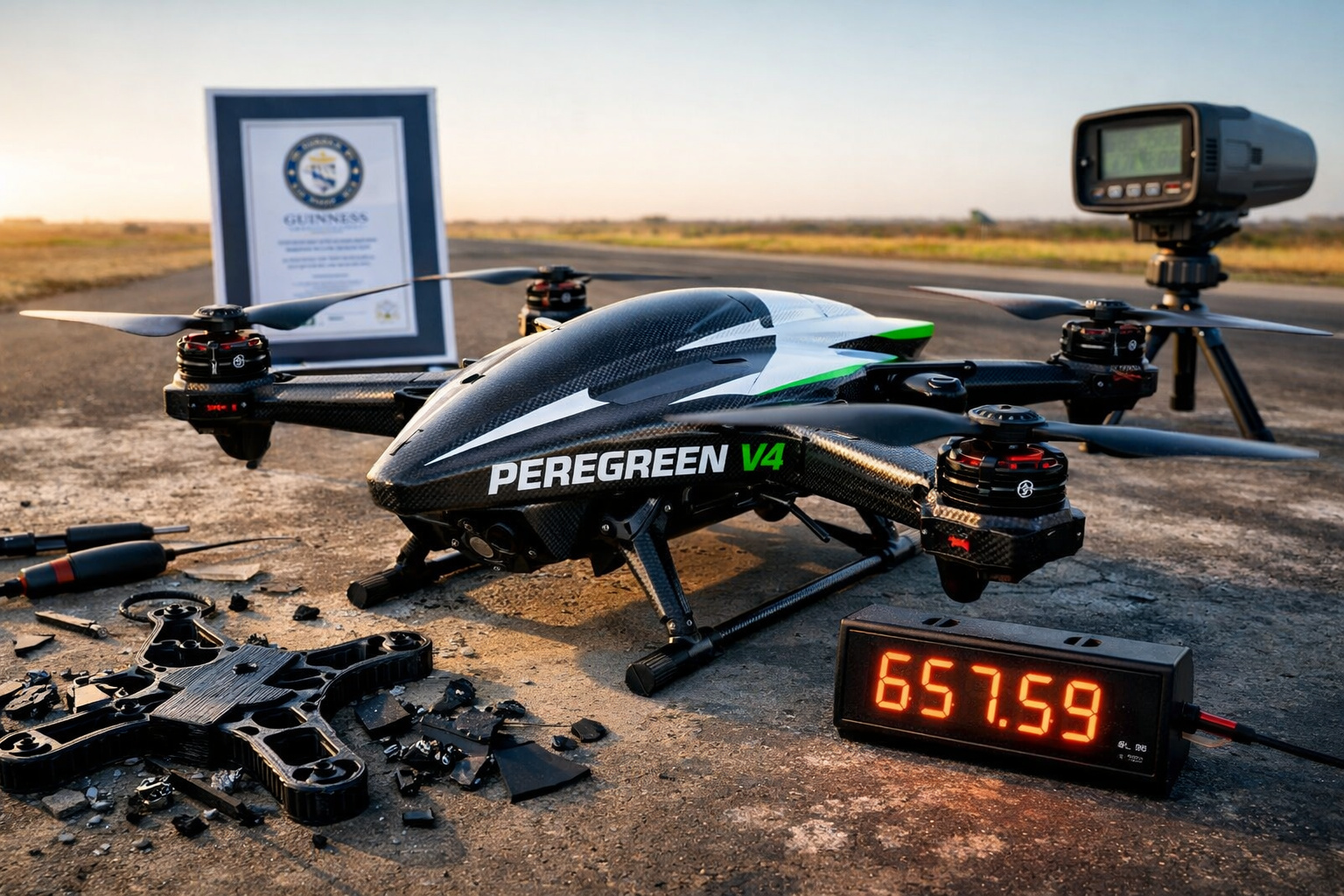


Independent project demonstrates extreme innovation by combining 3D printing, intensive testing, and precise engineering, pushing speed limits in electric drones and highlighting South African talent in the global technology scenario.
On December 11, 2025, independent engineers Luke Bell and Mike Bell from South Africa officially recorded an achievement that caught the attention of the global engineering and technology community: the Peregreen V4 drone reached 657.59 km/h, setting a new world record for remotely controlled electric quadcopters, certified by the Guinness World Records.
The project, developed over more than two years, did not originate within a large aerospace laboratory, nor did it receive traditional corporate funding. It emerged from an iterative process conducted outside the conventional industry, with successive versions tested, adjusted, and in many cases, completely destroyed during experiments.
The final result was not just a speed record. The Peregreen V4 came to represent a new technical benchmark for small unmanned aircraft, demonstrating how far independent solutions can advance when they combine precision engineering, modern materials, and extreme aerodynamic optimization.
-
Longest Solar Eclipse of the Century Will Turn Day to Night for Over 6 Minutes, Allowing Star Gazing; Won’t Recur for 156 Years

-
Brazilian Researcher Develops Protein Supplement from Tilapia Waste, Combining Innovation and Sustainability with Economic Potential

-
Women in São Paulo Unknowingly Tracked by Coin-Sized Tags Hidden in Cars and Belongings, Raising Stalking Concerns
-
Near a $750 million AI data center in Brazil, a resident’s well runs dry, leaving her unable to afford the $25,000 needed for repairs.


3D printed structure was crucial for achieving extreme speeds
One of the central elements of the project was the use of 3D printing in the drone’s aerodynamic structure, allowing the creation of geometries that would be difficult or unfeasible with traditional manufacturing methods.


The team used Bambu Lab printers to produce structural components with different materials, including carbon fiber reinforced polymers, PETG, and technical elastomers, each applied in specific regions according to the need for strength, flexibility, and vibration absorption.
This approach allowed the integration of fuselage parts into single blocks, reducing failure points and improving aerodynamic efficiency. At the same time, it facilitated quick adjustments between versions, speeding up the development cycle. In this case, 3D printing was not just a manufacturing choice, but a determining factor in achieving the level of refinement necessary to exceed the 650 km/h mark.
More than two years of testing and prototypes destroyed until reaching the final version
The Peregreen V4 did not emerge as an immediate success. It is the result of a long experimental process, which involved multiple previous versions and a series of failures along the way. During development, various prototypes were lost in high-speed tests, whether due to structural failures, aerodynamic instabilities, or limitations in the control systems.
Each failure generated data that was incorporated into subsequent versions, allowing for progressive adjustments in mass distribution, motor positioning, and structural shape. This iterative process was essential to achieve a level of stability that allowed sustained flights at extreme speeds, something that represents one of the greatest challenges for quadcopter-type drones.
High-speed motors and LiPo batteries required extreme balance between power and control
To achieve the record speed, the Peregreen V4 was equipped with high-performance motors capable of operating at extremely high rotational speeds. These motors, combined with high-discharge LiPo batteries, generate power levels that push the drone to a regime close to the structural limit of its components.
However, power alone is not enough. One of the greatest challenges of the project was maintaining control of the aircraft at speeds where small instabilities can lead to total equipment loss.
To address this, fine adjustments were made to the control system, including response calibration, thrust distribution, and dynamic balance. The result was a setup capable of sustaining continuous acceleration without entering regimes of critical instability.
Refined aerodynamics was essential to reduce drag and increase efficiency
Another determining factor for the performance of the Peregreen V4 was the work of aerodynamic optimization. At speeds exceeding 600 km/h, drag becomes one of the main performance limiters. The structure of the drone was designed to minimize drag, reducing turbulence areas and adjusting surfaces to improve airflow.
This level of refinement is more common in large-scale aerospace projects, which makes it even more relevant that it was achieved in an independent project. The combination of shape, material, and component distribution was essential to allow the drone to surpass barriers that normally limit aircraft of this type.
Record places electric drones in a new performance level
The achievement of 657.59 km/h positions the Peregreen V4 among the fastest electric systems ever recorded in its category. This milestone demonstrates the advancement of electric propulsion technologies, especially in the context of unmanned aircraft, where weight, efficiency, and control are critical factors.
Furthermore, the record reinforces the ability of independent projects to compete at high technical levels, even without the structure of large corporations.
Project evidences change in the profile of technological innovation
The development of the Peregreen V4 reflects a transformation in the landscape of technological innovation. Tools such as 3D printing, simulation software, and access to high-performance components allow small teams to achieve results that previously depended on large institutions.
This movement broadens access to advanced engineering and creates an environment where innovative solutions can emerge outside traditional research centers. In the case of the Peregreen V4, this combination of factors was crucial in achieving a result that exceeds expectations for an independent project.
High-speed engineering is no longer exclusive to large companies
The case of the Peregreen V4 shows that high-performance engineering is no longer restricted to large manufacturers or highly funded research centers.
The ability to test, fail, adjust, and repeat quickly allows independent projects to advance at an accelerated pace, exploring solutions that often would not be viable in more rigid environments. This development model can influence other sectors, encouraging more flexible and experimental approaches.