Portuguese
  Spanish


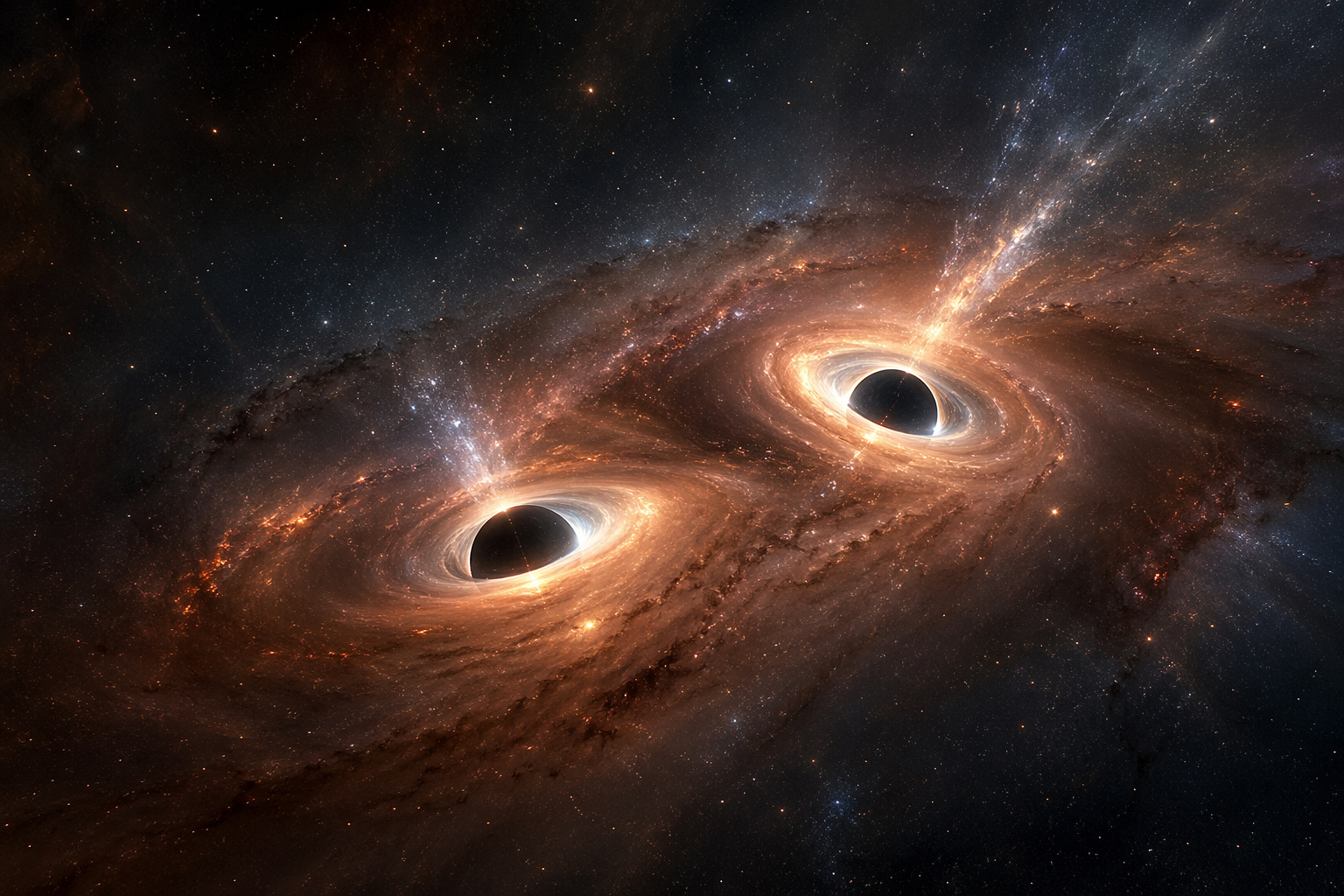

System 500 million light-years away gathers cosmic giants in rare stage, according to study published in the Monthly Notices of the Royal Astronomical Society
A significant astronomical discovery was recently presented by an international team of researchers, led by the Max Planck Institute for Radio Astronomy in Germany.
Furthermore, the study, published in the scientific journal Monthly Notices of the Royal Astronomical Society, indicates that two supermassive black holes may collide in approximately 100 years, a time frame considered short on a cosmic scale.
Still, the system is located in the galaxy Markarian 501, about 500 million light-years from Earth, which reinforces the importance of indirect observation by advanced instruments.
-
She spent 73 years breathing inside an iron lung, survived the aftereffects of polio, and became the last woman in the United States dependent on the equipment before dying at 78 years old.

-
Brazilian students created a $1 filter using pine bark, cotton, and 3D-printed parts to clean cassava wastewater, reduce the toxicity of a hazardous waste, and transform contaminated water into biofertilizer.

-
Astronaut from Artemis II steps down after mission to the Moon and decision surprises after a record of 406,771 km, a historic 10-day journey, and an unprecedented achievement for Canada.

-
A fossil kept for years in a small museum in Montreal concealed 450-million-year-old soft tissue, a discovery that has only happened once before in history.


Orbital dynamics reveal accelerated approach
Initially, scientists identified that the two objects have masses between 100 million and 1 billion times the mass of the Sun.
Additionally, they orbit each other with a period of approximately 121 days, completing rapid cycles by astronomical standards.
On the other hand, the distance between them varies between 250 and 540 times the distance between the Earth and the Sun.
Therefore, despite seeming large, this separation is considered small for objects of such mass.
Consequently, as they orbit, the black holes lose energy through the emission of gravitational waves.
Thus, their orbits progressively decrease, bringing them closer to final merger.

Radio observations indicate double structure
Previously, the galaxy Markarian 501 was already known to host a blazar, an extremely luminous type of active galactic nucleus.

However, over the years, observations have indicated unexpected changes in the direction of the particle jet.
Thus, this variation was not explained by a single black hole.
So, to investigate the phenomenon, researchers analyzed data collected over more than two decades by the Very Long Baseline Array (VLBA) in the United States.
As a result, a second particle jet was identified, emerging from the core of the galaxy.
Moreover, the two jets appear simultaneously in various observations, with distinct directions.
Therefore, this evidence suggests that each jet is generated by a different black hole, confirming the hypothesis of a binary system.
Merging process follows galactic pattern
Initially, when galaxies interact, their central black holes can become trapped by gravity.
Thus, they begin to orbit a common center, initiating a process of gradual approach.
Over time, this orbit continuously reduces.
Consequently, the final merger occurs, a rare event to observe.
In this sense, the system in Markarian 501 represents a advanced stage of this evolution, considered unusual by astronomers.
Gravitational waves can be detected
When the collision occurs, gravitational waves will be generated, ripples in spacetime predicted by Albert Einstein in 1916.
Moreover, events of this type have been detected previously, but involving smaller objects.
On the other hand, in this case, the signal may be significantly more intense.
Thus, scientists indicate that the event could be identified through the monitoring of pulsars, which function as cosmic clocks.
International projects, such as Pulsar Timing Arrays, analyze small variations in the signals of these objects.
In this way, if a gravitational wave passes through the space between Earth and the pulsars, there will be a detectable change in the timing of the signals.
System offers rare scientific opportunity
Even before the merger, the system is already considered a high scientific value object.
This is because it allows the study of the final phase of the approach between supermassive black holes, a process still poorly understood.
Moreover, new observations could confirm current data and refine theoretical models.
Therefore, researchers emphasize that it will be possible to monitor, almost in real-time, the last moments of this cosmic interaction.
In light of this, the possible collision in Markarian 501 could significantly enhance the understanding of the evolution of galaxies and black holes themselves — and, considering this scenario, what else can these extreme events reveal about the Universe?