Portuguese
  Spanish


Iberê Thenório, from Manual do Mundo, spent 4 years building a homemade fiberglass submarine in the garage. In Paraty, he dove with the Ariranha to the bottom of the sea, faced a hatch leak and a false air alarm at 7 meters, and returned safe and sound. The historic dive of the submarine took place on September 28, 2021.
There are garage projects that turn into dust-covered shelves, and there are those that descend to the bottom of the sea carrying a person inside. The one by Brazilian Iberê Thenório is of the second type. After four years of sanding, gluing, and molding fiberglass, he finally put in the water the homemade yellow submarine named Ariranha and truly dived with it, in the sea of Paraty, Rio de Janeiro. And the dive had movie-like drama.
The feat was reported by O Antagonista and starred one of the most well-known faces of science on the Brazilian internet. Iberê Thenório runs Manual do Mundo, a giant channel of experiments and gadgets, and turned the construction of the homemade submarine into one of the most ambitious projects of his career. Between the dream and the bottom of the sea, however, there was leakage, a scare, and an alarm that almost ended everything prematurely.
The dive in Paraty: leak and false alarm at 7 meters
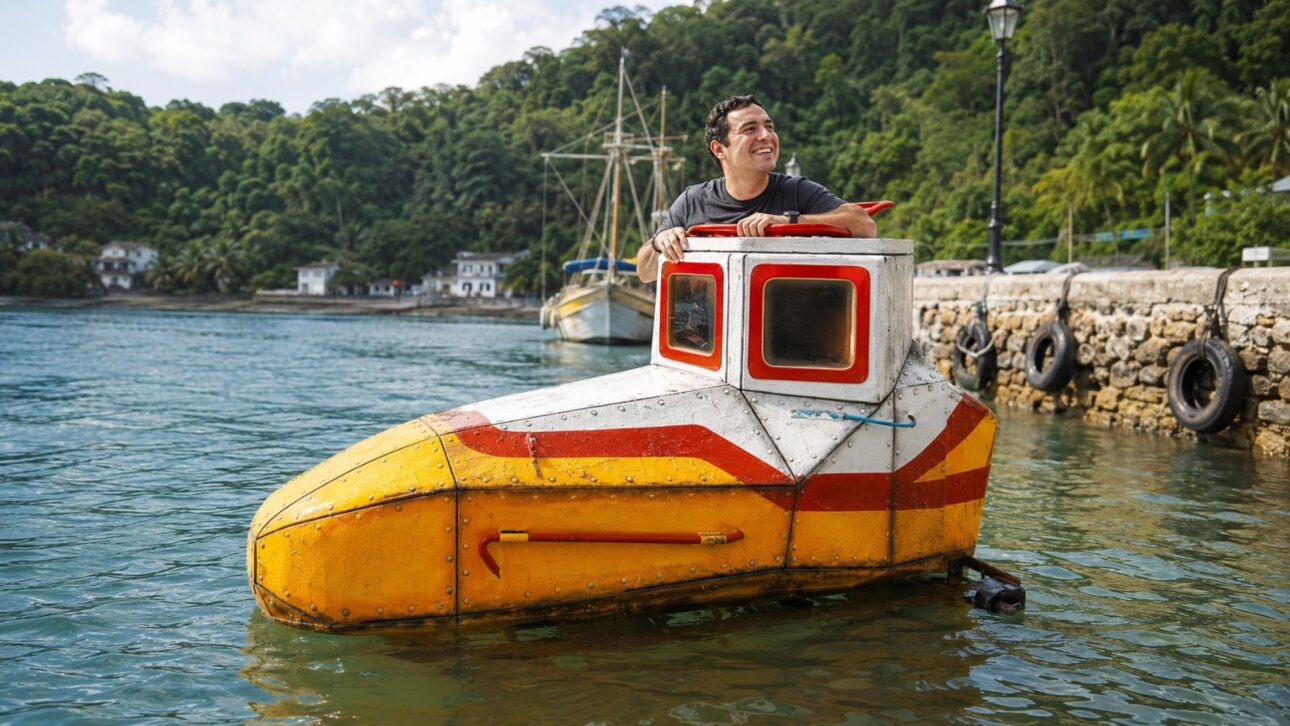
The dive took place in Paraty, near Ilha Comprida, chosen for its calm waters, sandy bottom, and good depth for the first official test. Even before submerging, there was already the fear of the hull cracking during transport and towing to the right spot.
-
Netherlands Reports First Child Euthanasia Case Since Rule Expansion for Minors

-
China Develops Custom 140-Ton Electric Mining Truck with 770 kWh Swappable Battery, Deploys 290 Units in Xinjiang’s Largest Zinc Mine

-
Meta to Launch Arena, a New Prediction App Targeting 3.56 Billion Users, Competing with Polymarket and Kalshi
-
Scientist Challenges Famous Human Evolution Theory, Argues Homo Sapiens Evolved Gradually Over Thousands of Years




Underwater, the troubles continued. Small leaks appeared in the hatch, the kind of detail that chills the blood of anyone sealed inside a homemade submarine. And then came the climax: at 7 meters deep, a false alarm of lack of air went off, suggesting that the oxygen was running out when, in fact, it wasn’t. Anyone’s heart would stop.
But the story ended in victory. Iberê Thenório remained calm, the problem turned out to be a scare, and the Ariranha reached the seabed and returned to the surface with the crew member safe and sound. It was the kind of real-time turnaround that transforms an engineering test into a jaw-dropping adventure, with a happy ending guaranteed by the planning behind it.
4 years of garage and a lot of fiberglass
Before the dive, there were years of silent work. The idea was born in 2018, when Manual do Mundo launched a challenge to its followers: if a video reached 500,000 likes, the team would build a submarine. The mark was hit, and the project came off the paper. What seemed like a joke turned into a four-year project.
The raw material of the endeavor was, above all, fiberglass. Layer after layer, Iberê and the team molded the hull capable of withstanding water pressure, in a process of trial and error that consumed time, patience, and a lot of resin. Building a homemade submarine with fiberglass is not assembling a kit, it’s solving a new problem at each stage, from the shape of the hull to sealing the joints.
This is the kind of persistence that defines the story. It wasn’t a stroke of genius over a weekend, it was determination over the years, with failures, tests, and restarts. The fiberglass piled up in the garage became a symbol of someone who doesn’t give up on a crazy idea, even when it takes time to get off the ground and requires redoing what was already done.
How the Ariranha is not crushed: the engineering of the pressurized cabin


The most fascinating part of the homemade submarine is invisible to those who only see the yellow hull. The technical heart of the Ariranha is the pressurized cabin system. As the submarine descends, air is injected into the cabin to equalize the internal pressure with the water pressure outside, in a delicate balance that changes everything.
The reason is pure physics, and it’s worth understanding. The deeper you go, the greater the pressure the water exerts on the hull, and a fiberglass hull, without help, would be crushed like a can. By pumping air inside and raising the internal pressure, the submarine prevents the water from crushing the structure, balancing the external force with the internal force. It’s the same principle that protects divers and equipment at depth.
Explaining this kind of thing, by the way, is the hallmark of the house. More than diving to the bottom of the sea, the goal of the homemade submarine has always been to show the engineering behind it, so that anyone can understand. The fun is not just the feat, it’s teaching how the feat is possible, turning a risky dive into a lesson in applied science.
Who is Iberê and the Manual do Mundo
It’s worth clarifying who is inside the submarine, because that changes the tone of the story. Iberê Thenório is not an unknown who appeared out of nowhere, he is one of the most well-known science communicators in Brazil, leading Manual do Mundo alongside Mari Fulfaro. The channel is a phenomenon, with millions of subscribers and records that have placed it among the largest in the world in the experiments niche.
This gives the feat a specific character. It is not the overcoming of a nobody who learned everything on his own by force, but rather the great move of an ace who already lives by turning science into content. The homemade submarine is the masterpiece of a communicator at his peak, with a team, resources, and audience following every step of the construction.
Recognizing this does not diminish the merit, it just adjusts the lens. Manual do Mundo built its own reputation precisely by doing what seems impossible and explaining why, from homemade rockets to giant experiments. The Ariranha is the boldest chapter of this trajectory, and taking a handmade submarine to the bottom of the sea crowns years of a brand that teaches Brazil while having fun.
Feat with safety net: the role of the divers
As cinematic as it was, the dive was not a leap into the unknown. The operation had the support of professional divers from the Adrenalina operator in Paraty, responsible for the logistical safety of the entire mission. There were trained people in the water at all times, ready to act if something really went wrong.
This detail is important to read the story honestly. The air shortage alarm, which seemed like the end, was false, and the entire structure was set up so that the real risk was as low as possible. It’s not a suicidal gamble, but rather a calculated feat, with a plan B, team, and professionals taking care of every step of the homemade submarine.
This combination makes the feat admirable without being irresponsible. Courage without planning is recklessness, but courage with engineering and a safety net is exactly what drives good exploration. Iberê Thenório took a risk, but he took a risk with method, and that’s what allowed him to dive to the bottom of the sea in Paraty and return to tell the story.
Why the feat enchants Brazil
In the end, what moves us is the mix of boldness and didactics. A Brazilian built, with his own hands and a lot of fiberglass, a machine capable of taking him to the bottom of the sea, and he also made a point of explaining how each part works. It’s the old magic of Manual do Mundo: turning curiosity into knowledge, and knowledge into adventure.
There is also the pride of seeing this coming from here. Homemade submarines have appeared around the world, built by anonymous people in garages, but seeing a Brazilian project reach this level, with so many people following, has a special flavor. The Ariranha shows that ingenious and well-explained contraptions are also a Brazilian thing, and not a privilege from abroad.
And there’s plenty of inspiration for those watching. History teaches that big ideas take time, that failure is part of the process, and that understanding how is as important as doing. A homemade fiberglass submarine thus became a reminder that it’s worth pursuing the crazy project in the drawer, as long as it’s done with study, safety, and plenty of patience.
Iberê Thenório’s adventure sums up the best of the creator’s spirit. Four years of fiberglass, a homemade submarine named Ariranha, a dive full of scares in Paraty, and a triumphant return to the surface, all narrated to teach science to millions. It’s a feat of a champion, done methodically and told with generosity. Few people combine courage and teaching so well.
And you, would you have the courage to enter a hand-built submarine in the garage and dive to the bottom of the sea, even with the entire safety team nearby? Tell us in the comments if you would take on this adventure or if you prefer to watch from the boat, safely.