Portuguese
  Spanish


The student from Ceará, Raul Victor Magalhães Souza, 16 years old, combined the observations of six rain prophets from the Jaguaribe Valley with data from Funceme and Inmet and created a weather forecasting artificial intelligence with 94.5% accuracy, which earned him first place in the Young Scientist Award.
A 16-year-old teenager took knowledge that has been passed down from father to son for generations in the interior of Ceará and taught this knowledge to a machine. Raul Victor Magalhães Souza transformed the wisdom of the rain prophets, those farmers who read the weather by observing nature, into an artificial intelligence system capable of predicting the rainy season with high precision. The project was recognized at the turn of 2025 to 2026 and took the young man to the top of one of the most respected science awards in the country. The story was told by Revista Fórum.
The result did not stop in Brazil. In June 2026, Raul also won the Brazilian stage of an international water award and was confirmed for the world final in August, in Sweden. But what moves in his journey is not just the list of trophies. It is the fact that a boy from the hinterland of Ceará looked at the knowledge of the elders, usually treated as folklore, and proved, with numbers, that there was real science there. His artificial intelligence for weather forecasting was born to serve those who depend most on the rain, the small farmer.
The boy, the grandfather, and the rain prophets
It all started at home, listening to stories. Raul’s grandfather, the farmer Luiz Maia, was the one who planted the seed of the project by telling how the ancients read the signs of nature to know if the winter would be good. In the northeastern hinterland, the so-called rain prophets are well-known figures. They are men and women who, without any device, observe the behavior of ants, the blooming of certain plants, the singing of birds, and the position of the stars to guess when and how much it will rain.
-
Netherlands Reports First Child Euthanasia Case Since Rule Expansion for Minors

-
Brazilian Innovator Survives Homemade Submarine Dive in Paraty Despite Hatch Leak and False Oxygen Alarm

-
China Develops Custom 140-Ton Electric Mining Truck with 770 kWh Swappable Battery, Deploys 290 Units in Xinjiang’s Largest Zinc Mine
-
Meta to Launch Arena, a New Prediction App Targeting 3.56 Billion Users, Competing with Polymarket and Kalshi




This knowledge has always been treated as oral tradition, passed down by word of mouth and often viewed with suspicion by outsiders. Raul saw something different there. Instead of dismissing the popular knowledge of the sertão of Ceará as superstition, he decided to test it with scientific methods to see how much of it held up when confronted with real data. The idea was to preserve the memory of the rain prophets and, at the same time, bring it into the 21st century.
The research gained traction within a serious institution. Raul developed the work in partnership with the Laboratory of Pharmacology of Venoms, Toxins, and Lectins at the Federal University of Ceará, under the guidance of Professor Helyson Lucas Bezerra Braz. What was once kitchen talk turned into a science project, with rigor, a database, and validation.
How artificial intelligence learned to predict rain
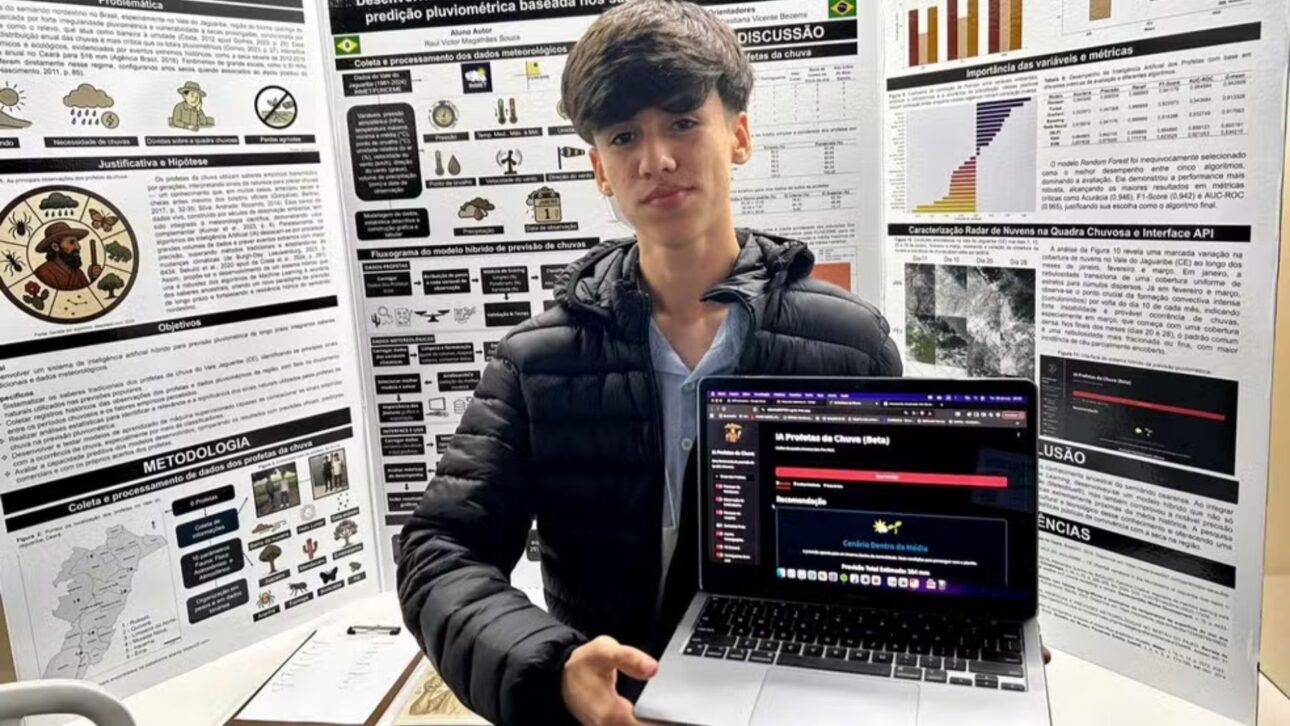
The heart of the project is a machine learning model, the famous machine learning, built in Python with a simple user interface. Instead of starting from scratch, the artificial intelligence was fed with two types of information that almost never interact. On one side, the empirical observations of the rain prophets. On the other, the technical records of official meteorological agencies.
To build this base, Raul gathered the knowledge of six prophets spread across five municipalities in the Jaguaribe Valley, in the sertão of Ceará: Iracema, Limoeiro do Norte, Morada Nova, Quixeré, and Russas. These observations were cross-referenced with historical series from the Ceará Foundation for Meteorology and Water Resources, Funceme, and the National Institute of Meteorology, Inmet, covering the long period from 1981 to 2024. More than four decades of data for the machine to find patterns.
The result of this fusion is what makes the project special. The weather forecast generated by the system does not disregard either tradition or technique; it combines the two. The model learns where the instincts of the rain prophets are accurate, adjusts with the official numbers, and returns a more reliable forecast than any of the isolated sources could achieve. It’s cutting-edge technology at the service of ancestral knowledge.
The 94.5% accuracy and what the number means
The data that draws attention is the accuracy. According to the award-winning project, the artificial intelligence achieved 94.5% accuracy in classification, with an average monthly error of just 5.7% during validation tests conducted between January and March 2025. For a system created by a high school student, it is a level that impresses even experienced researchers.
It is worth understanding what this number means in practice. It’s not about guessing the exact day of each rain shower, something that even supercomputers don’t do perfectly. Raul’s weather forecast model targets what truly matters for those who live off the land: whether the rainy season will be strong, weak, or regular, and when it is likely to start. Getting this trend right almost 95% of the time completely changes the planning of a crop.
This is where the work stops being just elegant and becomes useful. A reliable weather forecast, made with language and data from the region itself, is worth gold in a place where the difference between planting in the right week and the wrong week can mean harvesting or losing everything.
For whom this changes life: the small farmer
Raul’s target was never the laboratory, it was the field. The great motivation of the project is to democratize access to the weather forecast for the small rural producer, precisely those who do not have money to hire agricultural consultancy nor time to decipher complicated technical bulletins. In the sertão of Ceará, where family farming depends almost entirely on the rainfall regime, this information is a matter of survival.
The logic is simple and powerful. If the farmer knows in advance that winter will be delayed, they hold off planting and save seeds. If they know the rain will be strong, they prepare the soil and take advantage of the window. The tool puts this decision-making power in the hands of those in the field, turning risky guesses into informed choices. The rain prophets, who have always guided their communities for free, now gain technological reinforcement.
There is also a gain that goes beyond the next harvest. By recording and organizing the knowledge of the rain prophets in a digital system, Raul helps prevent this knowledge from being lost when the elders are no longer around. It is the preservation of culture and tackling climate change in the same gesture.
First place in the Young Scientist Award
The recognition matched the project. Raul won first place in the high school category of the Young Scientist Award, in its 31st edition, dedicated precisely to the theme of responses to climate crises. The award is promoted by the National Council for Scientific and Technological Development, CNPq, in partnership with the Roberto Marinho Foundation, as shown on the official website of the Young Scientist Award.
The winners were announced at the end of 2025, and the award ceremony took place at SESI Lab in Brasília, at the beginning of 2026. The recognized individuals received laptops, CNPq scholarships, and cash prizes that vary according to the category. For a 16-year-old student, sharing this stage with master’s and doctoral researchers would already be a victory. Taking the top of his category places Raul in a select group of young Brazilian scientists.
The Young Scientist Award has existed for decades and is known for revealing talents that later make a mark on national science. Not by chance, the next edition will have the theme “Artificial Intelligence for the Common Good,” precisely the area in which Raul already moves with ease. The boy arrived early to the agenda of the future.
The next step is Stockholm
The journey gained an international chapter in 2026. With the same project of the rain prophets, Raul won the Brazilian stage of the Stockholm Junior Water Prize, known in the country as the Stockholm Junior Water Prize, organized by the Brazilian Association of Sanitary and Environmental Engineering, ABES. The national victory was announced at a ceremony in Rio de Janeiro, in June 2026.
Now he prepares for the bigger challenge. In August 2026, Raul represents Brazil in the world final of the prize, during the World Water Week in Stockholm, Sweden, competing with young scientists from around the world. Before the final, the project will also go through an international popular vote. Bringing the name of the sertão of Ceará and the knowledge of its rain prophets to a European stage is, in itself, a historic achievement.
When asked about what’s next, Raul keeps his feet on the ground and his head in research. “Our next step is to expand the database to achieve even more accurate forecasts,” stated the student. His goal is clear: the more artificial intelligence learns, the better the weather forecast reaches those who need it.
A lesson from the countryside
The story of Raul Victor dismantles two prejudices at once. It shows that the popular knowledge of the sertão of Ceará has real scientific value, and it shows that cutting-edge science is not the privilege of large centers or wealthy people. It only took a curious teenager, a storytelling grandfather, and the desire to unite two worlds that seemed distant.
The most beautiful part is the project’s purpose. All the technology of artificial intelligence was put at the service of a concrete and ancient need, helping the farmer of the sertão to cope with drought and plant at the right time. The weather forecast that earned the Young Scientist Award and the spot in Stockholm was born, essentially, for a simple and urgent cause: that no one loses their crops due to lack of information.
And you, do you know any popular knowledge from your region that deserves to become science like the rain prophets did in Raul’s hands? Share here in the comments, we want to hear these stories.