Portuguese
  Spanish


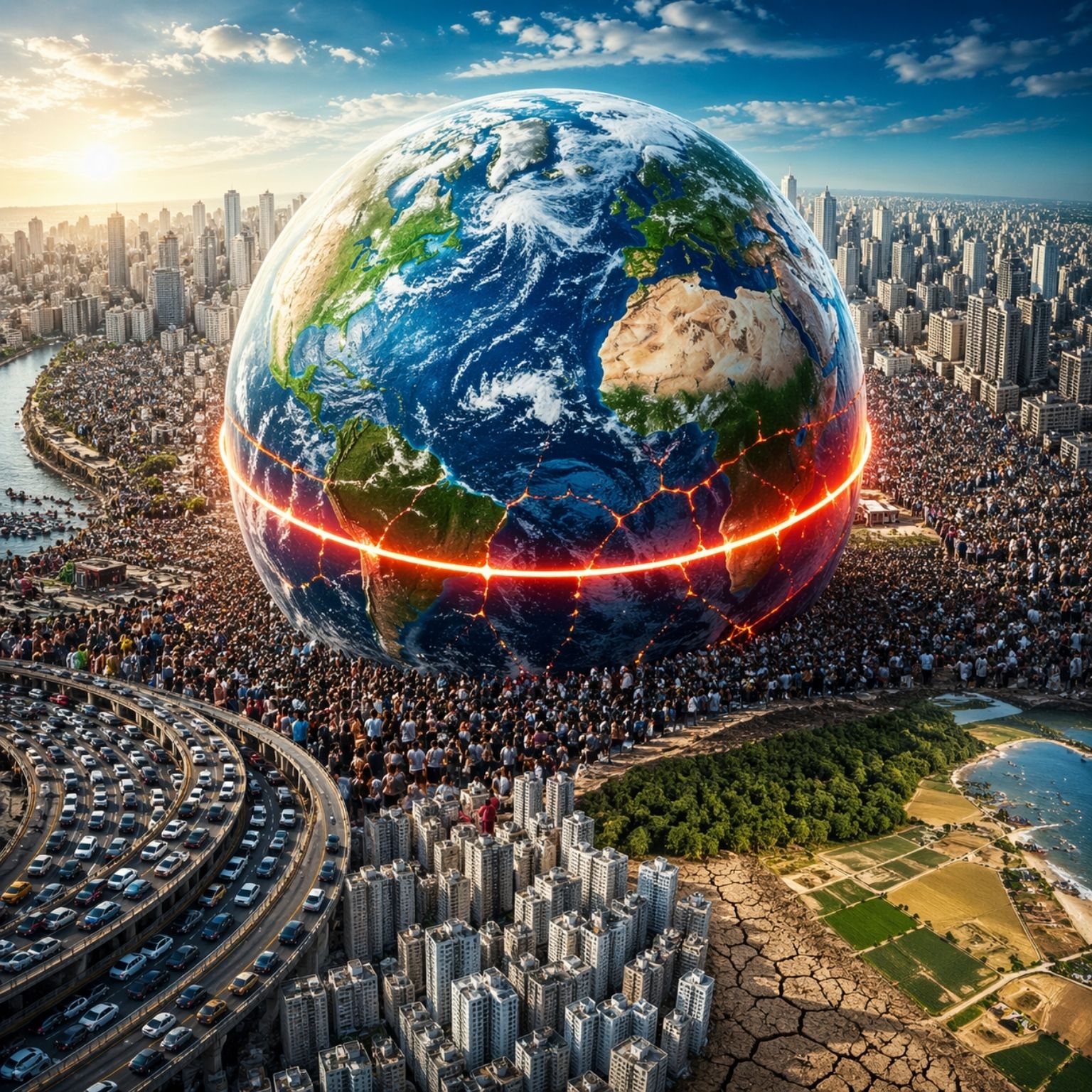

On Earth, the global population already exceeds ecological limits, and a study links fossil fuel-sustained growth to the worsening of climate change in the coming decades.
A new study has raised an alarm about the planet’s limits: according to researchers, Earth can no longer sustain the human population at its current consumption level. The analysis was conducted with over 200 years of population data and indicates that the dynamic of human growth changed decisively from the mid-20th century.
According to the work published in the journal Environmental Research Leaders, the global population, currently estimated at around 8.3 billion, would already be above what is considered sustainable. If current trends continue, the number of inhabitants is expected to reach a peak between 11.7 billion and 12.4 billion between the 2060s and 2070s, exceeding Earth‘s regenerative capacity.
What the study analyzed and why the turning point occurs after the 1960s
Researchers evaluated over two centuries of data and identified a change in how the population grew over time. Until the 1950s, population growth came with technological advancements and greater energy availability, which sustained a continuous expansion.
-
Ancient Stone City in the Desert, Once Home to 30,000, Puzzles Scientists with Nabateans’ Water Mastery 2,000 Years Ago

-
Ancient Creature Thought Extinct Since Dinosaur Era Reappears, Baffling Scientists

-
India Deploys Giant Fabric Tubes Filled with Sand to Combat Coastal Erosion and Rebuild Disappearing Beaches

-
China Unveils Most Human-Like Humanoid Robot for Public Sale, Featuring Silicone Skin and 88 Joints, Priced from $17,600




This pattern, according to the study, began to change in the 1960s. From then on, growth became more disconnected from a sustainable base, increasing pressure on Earth‘s natural systems.
The numbers that explain the warning: 8.3 billion today and a “sustainable level” near 2.5 billion
The study’s central comparison is direct and highlights the scale of the imbalance. The current global population, estimated at 8.3 billion, would be much higher than what the authors consider compatible with ecological limits under stable living standards.
According to the calculations presented, a level more aligned with the planet’s capacity would be close to 2.5 billion people. The difference between these numbers is presented as the result of decades of expansion supported by a high-energy, high-impact model that pushed Earth‘s limits.
Why fossil fuels are central to the explanation
The study indicates that population expansion in recent decades has been sustained by the intensive use of fossil fuels. This model allowed for increased production of food, energy, and goods on a global scale.
At the same time, this advancement accelerated carbon emissions, environmental degradation, and climate change, increasing the environmental cost of growth and intensifying stress on Earth.
What changes in practice: population weighs more than individual consumption in environmental variables
The analyzed data also shows a direct relationship between population increase and indicators such as global temperature, emissions, and ecological footprint. According to researchers, population size had a more significant impact on these variables than isolated individual consumption.
This does not mean that consumption doesn’t matter, but it reinforces the thesis that, in the final analysis, the volume of people and how society sustains that volume can increasingly pressure Earth.
Risk is not immediate collapse, but progressive worsening with chain effects


Despite the warning tone, the work does not point to an immediate collapse. What it describes is a progressive worsening of the situation if trends continue.
Among the cited risks are the intensification of extreme weather events, loss of biodiversity, and reduction of food and water security in various regions, effects that accumulate as pressure on Earth‘s natural systems increases.
Next steps: urgent changes in resources and strategies to alleviate pressure
The authors argue that structural changes are urgent, especially in how society uses resources such as energy, water, and land. The study also cites strategies aimed at reducing consumption and population stabilization as essential ways to relieve pressure on Earth‘s natural systems.
The final message is that the planet has physical and biological limits, and that the gap between what currently exists and what would be sustainable tends to exact an increasingly high price over the coming decades.
In your opinion, what should come first to relieve pressure on Earth: reducing consumption and waste now, or prioritizing population stabilization policies for the coming decades?