






 Portuguese
  Spanish


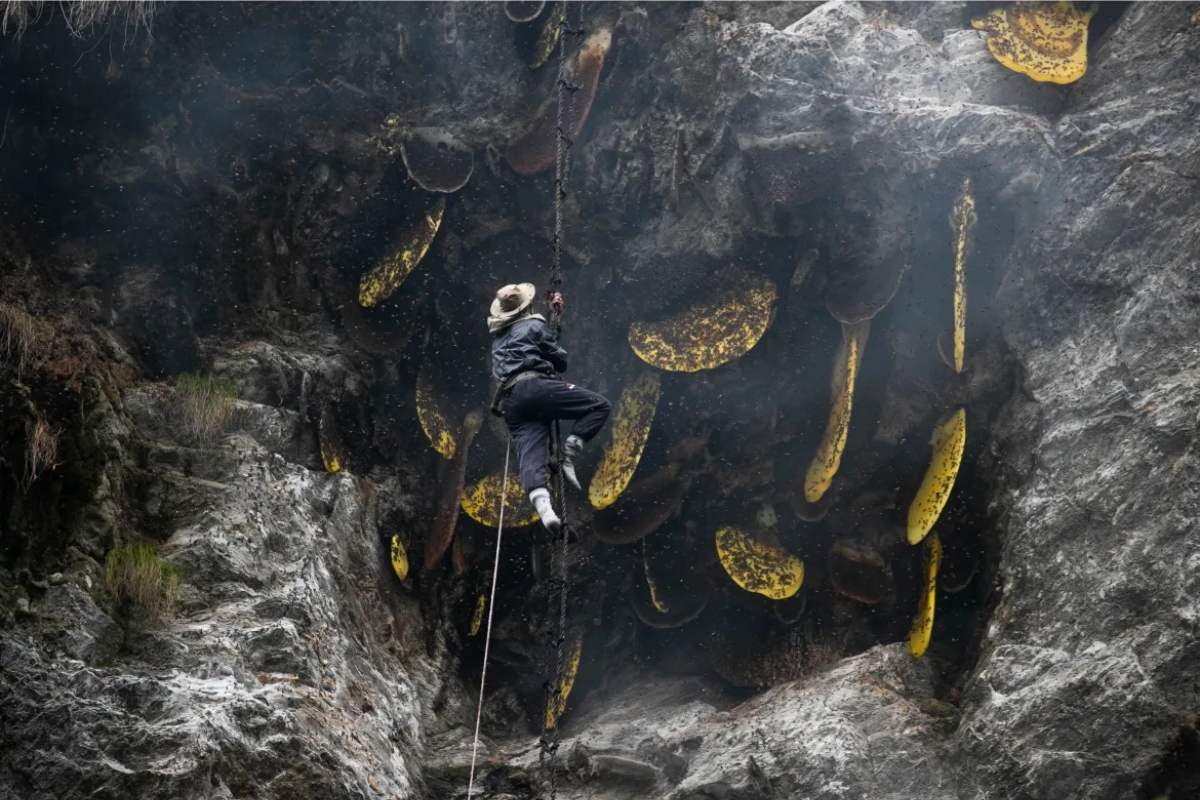


In The Himalayas, Gurung Hunters Scale 90-Meter Cliffs To Harvest The Rarest Honey In The World. The Tradition Involves Extreme Risk, Giant Bees, And A Unique Ancestral Ritual
There are stories that go beyond the imaginable and show how tradition, courage, and necessity shape the lives of entire peoples. In the Himalayas, in Nepal, one of these stories lives on: that of the Gurung hunters, who scale cliffs of up to 90 meters to harvest wild honey produced by giant bees. The scene looks like something out of an epic documentary, but it is real, and it continues to happen because this ancestral practice still sustains entire families and keeps alive a millennia-old culture.
The collection of “mad honey,” as it became known in the West, is filmed by National Geographic cameras, researchers from Asian universities, and, in recent years, documentarians seeking to understand why, even in the face of extreme risk, the Gurung continue to climb makeshift ladders to reach hives that can only be accessed on the edge of abysses.
This article delves into the details of this ritual, the extreme dangers involved, and the worldwide fascination surrounding honey that, despite being rare, carries a cultural and economic value that few foods in the world possess.
-
A Dutchman created a ‘box’ that makes trees grow in the desert almost without water and without irrigation: the invention has already brought seedlings to dozens of countries and achieves up to 90% survival where common planting did not exceed 10%.

-
Abandoned warehouse hid a giant collection of rare computers, with over 2,000 artifacts from the 1930s to the 1980s.

-
Scientists warn that melting ice is triggering an alarming chemical transformation in preserved areas, and the first signs are already concerning researchers worldwide.
-
China placed 198 robotic legs under a 7,600-ton school and made the building walk 62 meters in 18 days, rotating the historic structure as if a concrete structure had gained feet to escape demolition.





The Tradition That Defies Gravity And Common Sense
In the heart of the Kaski region, the Gurung gather twice a year for one of the most dangerous tasks a human being can perform. The ritual begins before dawn, when locals walk to the steep slopes where the hives of Apis laboriosa, the largest bee species in the world, are found, capable of measuring over 3 centimeters.
The hives hang precariously from cliffs that seem inaccessible. To reach them, the hunters set up a hand-made rope ladder, secured by wooden stakes driven into the top of the cliff. While one man slowly descends, balancing in the void, others remain on solid ground burning herbs to calm the bees. Despite this, the attack is inevitable. The hunters are stung dozens of times before reaching the first hive.

The most impressive scene, captured in National Geographic expeditions, shows the leader of the hunt hanging over a 90-meter cliff, striking the hive with a long stick until huge blocks of honey fall into makeshift baskets. There is no safety, no professional equipment, no guarantees. What exists is a tradition passed down through generations, reinforcing the deep respect this people have for the mountain and the bee.
According to local researchers, this practice has existed for centuries and symbolizes not only a source of income but a cultural bond that unites the community and reinforces the identity of the Gurung.
The Hallucinogenic Honey That Conquered The World
The international fame of “mad honey” began when European travelers and scientists discovered that this honey has mild hallucinogenic properties. This occurs because the flowers consumed by the giant bees, especially rhododendron, contain grayanotoxins — substances that can cause curious effects on the human body, from intense heat to sensory changes.
However, the same toxin that attracts the curious can also put lives at risk. In excess, “mad honey” can cause a sharp drop in blood pressure, vomiting, dizziness, and even fainting. For this reason, the Gurung consume small amounts in rituals or as a natural remedy for pain, insomnia, and circulation problems.

In the Asian black market, this rare honey can fetch very high prices, attracting traders, photographers, and adventurers — but it also generates controversy. In 2016, researchers from Tribhuvan University in Nepal warned of the declining number of hives due to commercial exploitation and climate change in the region.
For the Gurung, however, the collection is not a modern business. It is a ritual that involves respect for nature and the delicate balance between risk and survival. They insist that they only take what is necessary and leave part of the hives intact to ensure the natural cycle.
The Uncertain Future Of An Ancient Tradition In The Mountains Of Nepal
Although global interest has increased, the existence of this ritual is threatened. Reports from the BBC and Asian media highlight that many young Gurung prefer to leave the villages and seek opportunities in cities, reducing the number of experienced men capable of safely performing the collection.
Moreover, the giant bees face habitat reduction due to global warming, deforestation, and the increasing use of pesticides in the lower regions of Nepal. Environmentalists fear that in a few decades, the species will become even harder to find, putting an end to the production of the rarest honey in the Himalayas.

Even so, the older generation continues to try to keep the tradition alive. They organize group walks, teach techniques to young people, and reinforce that this ritual is an essential part of Gurung identity. For them, abandoning honey collection would be like breaking ties with their ancestors.
Meanwhile, researchers, documentarians, and tourists continue to travel to Nepal to witness this unique practice. All arrive with the same feeling: what the Gurung do defies logic, physics, and the limits of the human body. But for them, all of this is just part of a way of life passed down from generation to generation.
In the end, the hunt for wild honey is not just an extreme adventure. It is a living portrait of a people who resist, of a tradition that insists on surviving, and of honey that, even though rare and dangerous, carries stories that the world cannot ignore.





