Portuguese
  Spanish


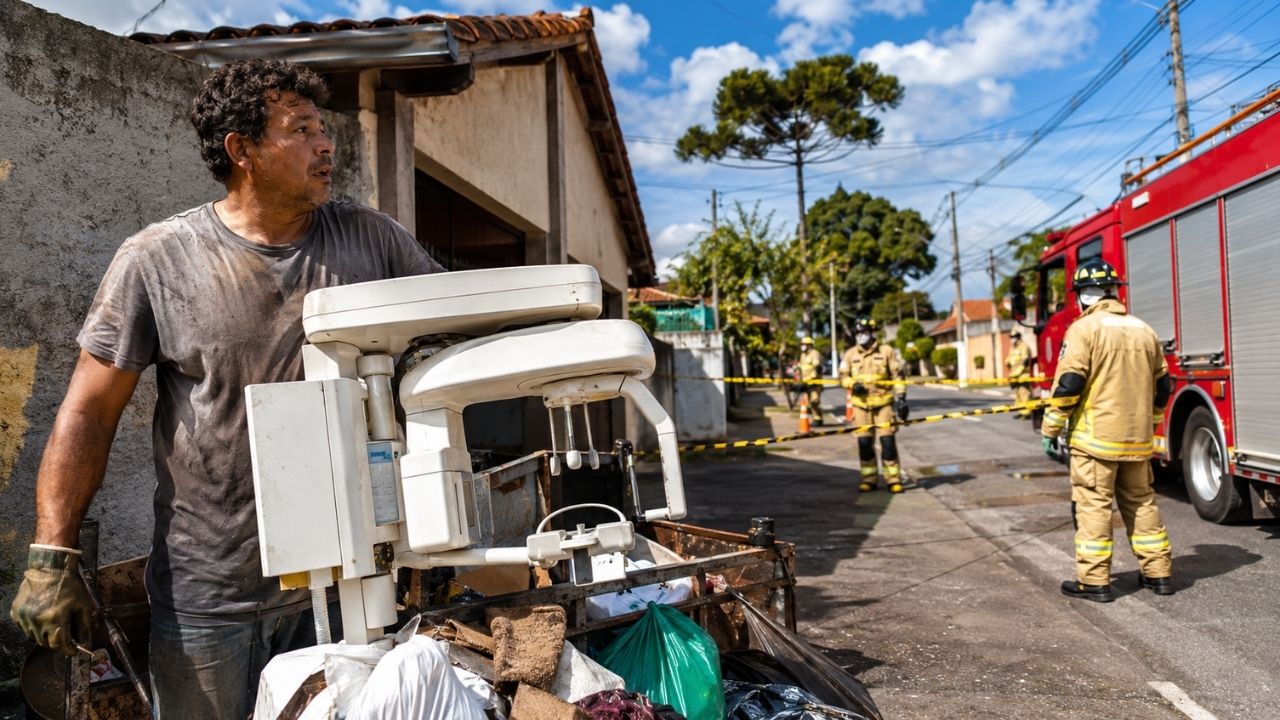

The X-ray machine was found by a waste picker, taken to a house in Curitiba, and led firefighters to isolate the area as a precaution, until the Sanitary Surveillance could evaluate the dental equipment and confirm there was no contamination or continuous radiation emission at the site after the irregular disposal of the material.
A dental X-ray machine irregularly discarded as common waste mobilized teams from the Fire Department and Sanitary Surveillance in Curitiba, Paraná. The equipment was found by a waste picker, taken to a residence, and was treated as a potential risk until technical evaluation.
According to the portal nd+, the case drew attention because it involved an object associated with radiation emission, but the analysis carried out on site ruled out contamination and continuous emission. Even so, the incident raised an alert about the disposal of medical and dental equipment outside appropriate channels.
Equipment was found as if it were common waste

The waste picker found the device in an inappropriate location, apparently discarded as common waste, and decided to take the equipment home. Afterwards, he contacted the responsible authorities to verify if there was a risk of radiation, contamination, or undue exposure.
-
How to Prevent Brown Recluse Spider Bites: Common Hiding Spots and Free Tips to Reduce Risks

-
Natto: The Unusual Japanese Superfood Gaining Popularity on Social Media and Driving Record Exports
-
Brazilian Mayor Goes Undercover as Homeless for 24 Hours to Assess Public Services

-
15-Year-Old Entrepreneur Malu Lira Publishes 20 Children’s Books on Financial Education, Earns $500,000, and Expands Her Project to the Amazon Rainforest




The action prevented the equipment from continuing to circulate uncontrolled. Even without confirmation of immediate danger, materials linked to the health sector require proper disposal, especially when they involve technical, electrical components, or those associated with examinations.
Fire Department teams were called and isolated the area as a precaution. The measure was adopted until Sanitary Surveillance professionals could evaluate the X-ray machine and determine if there was a risk to residents, neighbors, or people who had handled the object.
This type of response is common when there is doubt about the nature of the material found. In such occurrences, the priority is to prevent unnecessary contact, reduce circulation in the area, and await specialized evaluation before releasing the area.
X-ray machine was for dental use

After the inspection, it was confirmed that the equipment was a dental X-ray machine. This type of device is used in clinics for imaging exams of the dental arch, assisting diagnoses and treatments.
The initial concern arose because X-rays are associated with ionizing radiation. However, according to the assessment provided by the firefighters, the equipment did not continuously emit radiation while turned off, as it depended on an electrical connection to function.
This means that the risk was not the same as that of an abandoned radioactive source. The device was not releasing radiation on its own, without activation, and the Sanitary Surveillance ruled out contamination at the site.
Nevertheless, the situation is still serious from a disposal perspective. Dental equipment should not be abandoned in a common area, because its disposal must follow specific rules and involve responsible parties capable of handling this type of material.
Area was isolated until Sanitary Surveillance evaluation
The isolation of the area was a preventive decision. When there is suspicion of risk involving an X-ray machine, teams need to consider the worst-case scenario until technical analysis proves otherwise.
In the case of Curitiba, the Sanitary Surveillance inspected the equipment and concluded that there was no continuous exposure to radiation or risk of contamination. After that, the resident who collected the device was instructed on the correct way to dispose of it.
The main failure, therefore, was not the operation of the device at that moment, but the irregular disposal. Equipment used in clinics, offices, or health services cannot be treated as common scrap without proper screening.
The episode shows how improper disposal can mobilize firefighters, sanitary agencies, and residents, even when the final risk is ruled out. The mere doubt already requires a technical response, isolation, and specialized verification.
Irregular disposal reignites alert about health equipment
Health equipment needs to follow specific disposal procedures because it may contain electrical components, sensitive parts, contaminable parts, or elements that require traceability. Even when they do not pose an immediate risk, they need to be taken out of circulation through appropriate means.
In the case of the dental X-ray machine, emission depends on electrical operation, but this does not authorize abandonment anywhere. Correct disposal avoids scares, improper handling, and unnecessary emergency calls.
The problem is that technical objects discarded as common waste can be collected by people who do not know exactly what they are dealing with. Scavengers and residents may take these materials home believing they have reuse value, without knowing possible risks.
Therefore, responsibility should fall mainly on those who discard. Clinics, offices, and companies need to ensure that out-of-use equipment is sent through regular channels, with sanitary guidance and compatible disposal.
Case highlights the importance of not handling unknown objects


The incident also reinforces a simple recommendation: when finding abandoned medical, dental, industrial, or laboratory equipment, it is ideal not to take the material home. The safest approach is to notify competent authorities and avoid unnecessary contact.
Even when the object appears to be turned off or unusable, it is not possible to tell by appearance alone if there are dangerous components, contamination, a battery, a chemical product, a radiation source, or a part that requires controlled disposal.
In the case of Curitiba, the technical evaluation brought relief, but the scare could have been avoided. The X-ray machine did not present continuous emission, but the mobilization of firefighters showed that irregular disposal generates real concern.
The situation also serves as a warning for large cities, where discarded equipment in inappropriate places can circulate quickly. A piece abandoned on a street can end up in a house, in a junkyard, or in the hands of someone who has not received any guidance.
What the case leaves as a warning
The X-ray machine found in Curitiba did not pose a risk of contamination or continuous radiation emission, according to the Sanitary Surveillance’s assessment. Still, the episode exposed an important flaw: health equipment cannot be discarded as common waste.
The case shows that the problem is not just the fear of radiation, but the lack of control over technical materials out of use. When disposal is done irregularly, the entire city may be forced to react to a risk that perhaps did not even exist, but which needed to be investigated.
Do you think clinics and companies should face stricter inspection for the disposal of medical equipment, or is the problem the lack of information on how to dispose of this type of material? Leave your opinion in the comments.