Portuguese
  Spanish


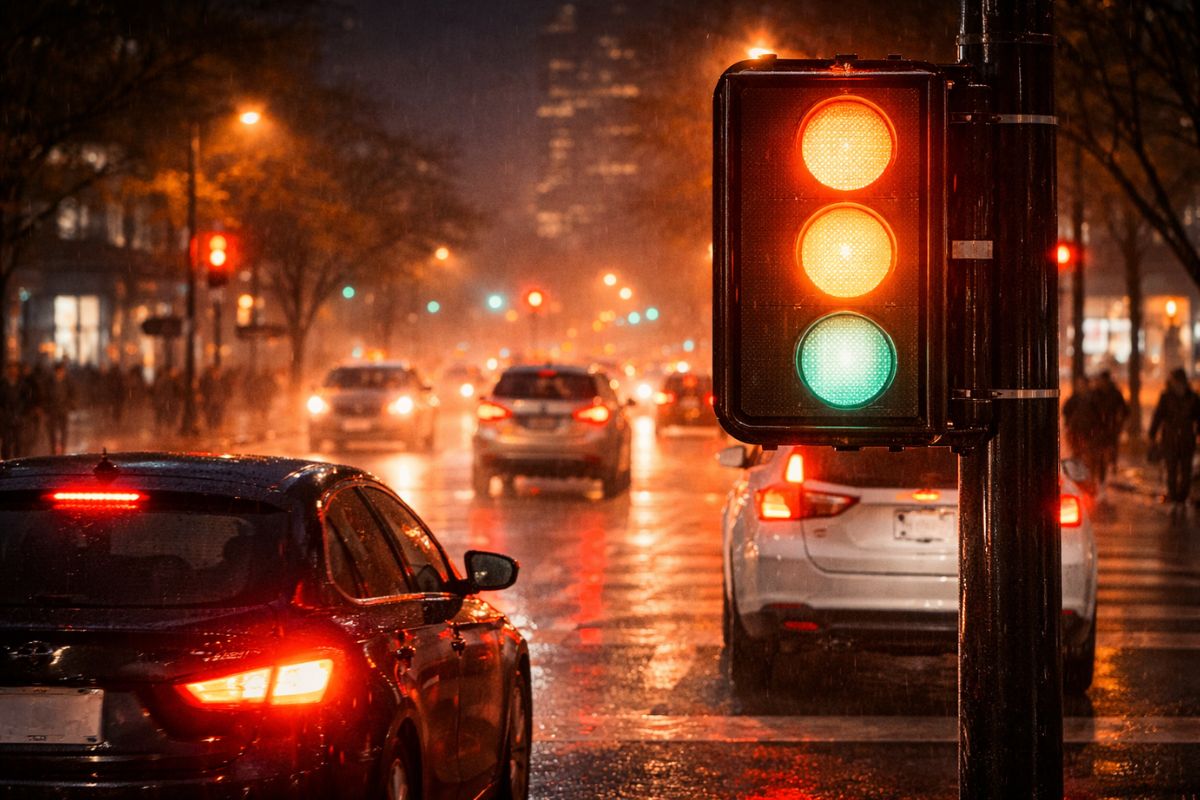


Under Federal Regulation, Pedestrian Signals at Intersections in Cities of the United States Display Portland Orange in the Don’t Walk Phase, an Identical Orange-Red to the Red Traffic Light; in Rain, Reflection, and Low Visibility, Quick Reading Fails and the Driver’s Decision May Be Delayed by Fractions of a Second and Becomes a Risk
A technical discussion about road signage gained momentum because part of the public discovered that the red traffic light is not always exactly the same “red” across all devices at the intersection. In several cities in the United States, pedestrian signals display a hue called Portland orange during the “Don’t Walk” phase.
The choice seems minor, but it affects automatic behavior: drivers and pedestrians react in fractions of a second, especially when there is urgency, multiple stimuli, and low visibility. At intersections, where exposure to conflict is greater, a color almost identical to the red traffic light can become a point of hesitation that shouldn’t exist.
What Is Portland Orange and Why Does It Appear on Pedestrian Signals

Portland orange is described as a specific orange-red hue, designed for the “Don’t Walk” phase on pedestrian signals.
-
Kazakhstan’s Torysh Valley Holds Thousands of Giant Stone Spheres, Intriguing Scientists with Ancient Oceanic “Cannonballs”

-
Egypt Discovers 18 Ancient Tombs with Gold Tongues, Unveiling Unusual Funeral Rituals and Amulets Believed to Give Voice to the Dead

-
Nigeria Dumps 120 Million Tons of Sand into Atlantic to Build Massive City with 8.4 km Sea Wall for Protection Against Ocean Waves and Erosion
-
German Engineer Developed Diesel Engine Running on Vegetable Oil Decades Before Electric Cars Became Popular; Can This Forgotten Idea Work in 2026?




It is not exactly red and not exactly yellow, but sits between the two, with the intention of creating a distinct identity for the warning intended for those crossing.
In practice, this difference is subtle enough to go unnoticed by most drivers, who continue looking for the red traffic light as the main reference.
The consequence is that, at busy intersections, the brain may “complete” the information and treat Portland orange as if it were the same visual command, even when the observed device is a pedestrian signal.
The Logic Behind the Federal Regulation and the Goal of Separating Commands at the Intersection
The central argument for adopting Portland orange is to avoid confusion between pedestrian warnings and regular traffic signals aimed at vehicles.
In traffic engineering, separating commands reduces cross-reading, especially when the person needs to interpret many elements simultaneously, such as lanes, arrows, signs, and the flow of people.
This standardization is described as part of national traffic engineering standards, associated with road safety guidelines cited in the context of the NHTSA.
The intended effect is that pedestrian signals have their own visual language, while the red traffic light for vehicular traffic maintains its unequivocal stop role, even for those approaching the intersection without knowing the area.
When the Difference Disappears in Low Visibility and Why It Matters
The critical point is that the separation of colors works best when the environment aids perception.
In rain, reflection on the pavement, low light, or headlights against the windshield, low visibility reduces contrast and compresses hue differences, making Portland orange appear even closer to the red traffic light.
Under these conditions, the issue is not just “seeing” the light, but quickly deciding which light is relevant for the vehicle.
At intersections, the driver may pick up a side signal from pedestrian signals in the peripheral field and react as if it were the main command, or may hesitate while comparing very close shades, and this hesitation, even if brief, increases risk for those crossing.
Hesitation of Fractions of a Second and the Visual Ergonomics of the Red Traffic Light
The hesitation is the link between design and accidents: it does not need to last long to interfere with stopping distance, reaction time, and acceleration choice.
When the red traffic light already triggers a conditioned reflex, any “almost identical” color tends to trigger the same response, and Portland orange has been described as close enough to provoke this automatic effect.
At the same time, the system tries to avoid another type of error, which is the driver ignoring pedestrian signals because they do not recognize them as part of the control of the intersection.
The contradiction appears here: the same proximity that seeks to maintain attention can generate confusion in low visibility, precisely when cognitive load increases and the visual field deteriorates.
What Changes for Drivers and Pedestrians at Urban Intersections
For drivers, the practical adjustment is to observe where the light is installed and who it is meant for.
Pedestrian signals are typically associated with crossing, and the red traffic light for vehicles tends to be aligned with the approach of the road; in some intersections, however, the geometry and position of the poles make this reading less obvious.
For pedestrians and cyclists, the discussion reinforces that intersections are the point of highest vulnerability, requiring attention and redundancy in checking.
If Portland orange is present, the desired effect is to make clear that the “Don’t Walk” phase is a dedicated instruction, but the actual experience can vary when there is low visibility and when the flow of vehicles depends on quick decisions.
The subtle change within the signaling shows that the red traffic light is more than just a color; it is a trigger for learned behavior, and minimal changes can produce unexpected effects at intersections.
Portland orange was designed to differentiate pedestrian signals, but in low visibility the distinction may fade and turn a detail of regulation into a point of risk.
In your routine, have you noticed pedestrian signals with Portland orange at intersections in your city, or do you only notice the traditional red traffic light? In which low visibility situations, such as rain or reflection, do you think this difference could create hesitation behind the wheel?