Portuguese
  Spanish


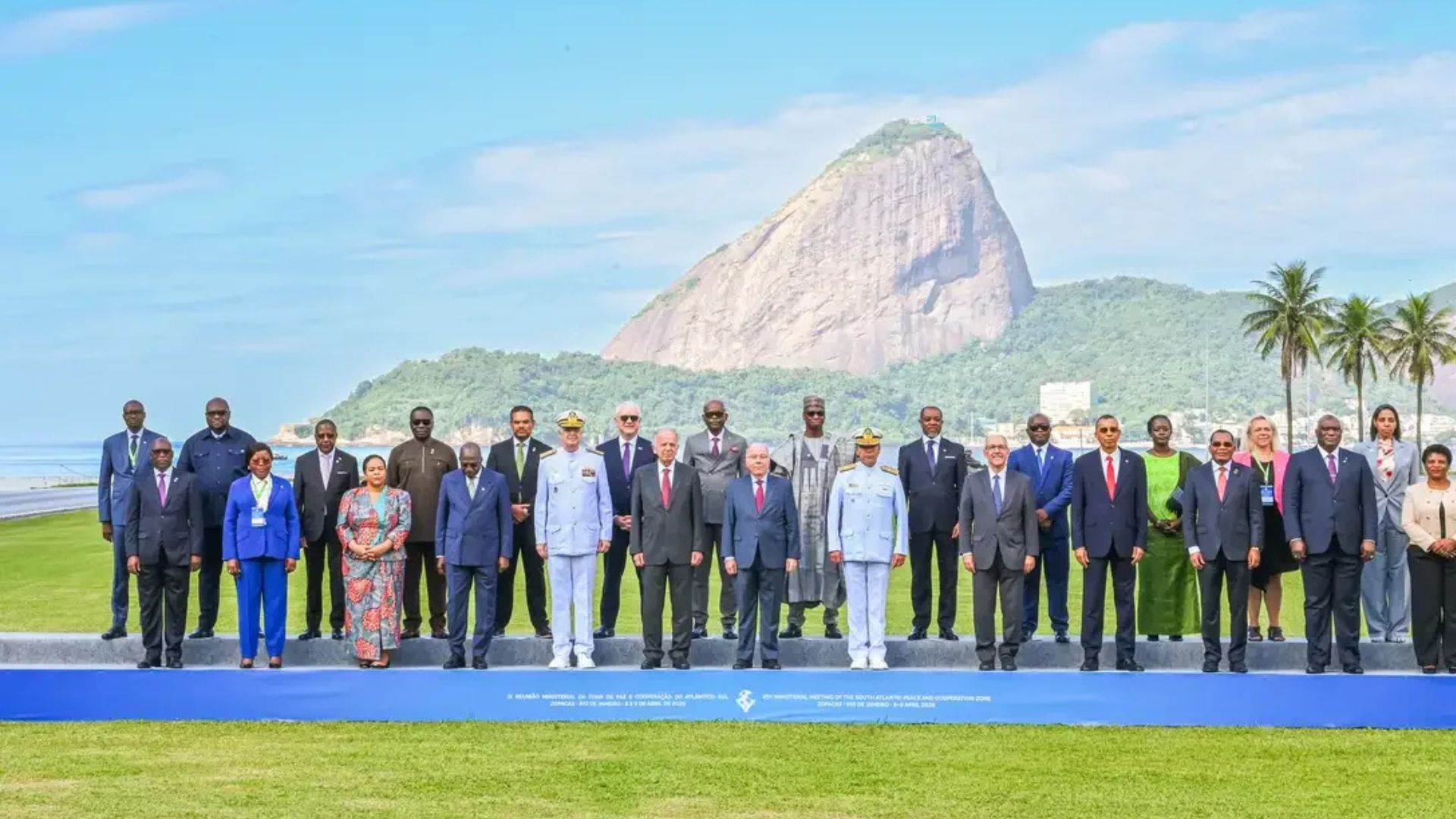

Brazil assumes presidency of Zopacas after 32 years and places South Atlantic at the center of naval and geopolitical strategy.
In April 2026, Brazil assumed the presidency of the Zone of Peace and Cooperation of the South Atlantic, Zopacas, a mechanism created by the UN in 1986 to keep the South Atlantic free of nuclear weapons and to enhance cooperation between South American countries and the African coast. The IX Ministerial Meeting of the bloc took place in Rio de Janeiro on April 8 and 9, bringing together representatives from 24 countries bordering the South Atlantic.
The Brazilian presidency marks the country’s return to the forum’s leadership after more than three decades. According to Itamaraty and the Ministry of Defense, the new phase of Zopacas occurs amid growing global geopolitical tensions, competition for maritime routes, the advancement of transnational maritime crimes, and the increasing strategic importance of the South Atlantic.
Zopacas brings together 24 South Atlantic countries in one of the largest maritime articulations in the southern hemisphere
Zopacas was created by UN General Assembly Resolution 41/11 in 1986 by Brazilian initiative. The group includes Brazil, Argentina, and Uruguay in South America, as well as 21 countries on the western African coast, from Senegal to South Africa.
-
U.S. Military Intervention Risk in Brazil Raises Alarm, Highlights National Sovereignty Amid Tensions Over Washington’s Terrorist Designation of PCC and Comando Vermelho

-
Brazilian Air Force’s Sole KC-30 Aircraft Completes Strategic Mission to Spain for 105mm Anti-Tank Ammunition for Leopard 1A5 Tanks

-
Brazilian Air Force Seeks to Acquire More Gripen Fighter Jets
-
U.S. Air Force Launches Air-to-Air Missile Project with Range of Up to 1,850 km for Indo-Pacific Operations



The main original objective was to prevent nuclear militarization of the South Atlantic and to avoid transferring disputes between major powers to the region.
Over the years, however, the forum has come to incorporate issues related to maritime security, naval cooperation, combating illegal fishing, international trafficking, environmental protection, and oceanic infrastructure.
Today, Zopacas functions as a strategic articulation among countries that control one of the most extensive and valuable maritime regions on the planet.
Brazil returns to the bloc’s leadership amid global competition for maritime routes and oceanic resources
According to Itamaraty, Brazil succeeds Cape Verde in the rotating presidency of Zopacas and will remain in the forum’s leadership for the coming years.
The Brazilian return occurs in an international scenario marked by the war in Ukraine, tensions in the Middle East, technological competition between the United States and China, and increased geopolitical competition over oceans and maritime logistics chains.
During the ministerial meeting in Rio de Janeiro, Chancellor Mauro Vieira stated that the South Atlantic should not import external rivalries that “have no relation to the interests of the peoples of the region.”
The statement was interpreted as a defense of greater regional autonomy in the face of growing global military tensions.
Brazilian Blue Amazon enters the center of the new national maritime strategy
The debate on Zopacas also brought back into focus the concept of Blue Amazon, a maritime area under Brazilian jurisdiction that exceeds 5.7 million km² and includes trade routes, biodiversity, fishing, and offshore energy reserves.

According to the Navy and documents related to national defense policy, this region concentrates a significant part of Brazilian oil production, as well as critical infrastructure installed on the seabed.
Among the most sensitive points are submarine communication cables and areas related to the pre-salt layer. The South Atlantic also hosts corridors used by Brazilian international trade.
In practice, protecting the South Atlantic means protecting energy, internet, exports, maritime logistics, and part of the Brazilian economy.
Submarine cables and oceanic infrastructure have come to be seen as strategic assets
The growth of international tensions has increased global concern about critical submarine infrastructure. Today, cables installed on the seabed carry a large part of international internet traffic and digital communication. Any damage to these systems can affect finance, telecommunications, and international connectivity.
The issue gained even more attention after recent episodes of sabotage and suspected damage to submarine infrastructure in other regions of the world.
Although Zopacas emerged during the Cold War with a nuclear focus, the current debate already involves much broader maritime security, including ocean monitoring, naval surveillance, and protection of submarine assets.
Brazil wants to prevent the growing militarization of the South Atlantic by external powers
Brazilian representatives stated during the meeting that the countries of the region themselves must ensure stability and cooperation in the South Atlantic.
The concern is related to the advancement of military and strategic interests of extraregional powers in oceans historically considered more stable. The Itamaraty emphasized that the region should remain free of nuclear weapons and other weapons of mass destruction, reaffirming the original principles of Zopacas.

The current agenda of Zopacas goes far beyond classic military defense. According to the Ministry of Foreign Affairs, the group is now working on issues such as combating maritime drug trafficking, piracy, illegal fishing, and transnational crimes.
The region has vast oceanic areas with low surveillance density, which increases vulnerability to illegal activities.
Furthermore, African and South American countries face similar challenges related to coastal protection, maritime surveillance, and limited naval capacity.
Brazil tries to expand naval and diplomatic cooperation between South America and Africa
Another objective of the Brazilian presidency is to strengthen South-South cooperation between Atlantic countries of Africa and South America. The Brazilian government advocates integration in areas such as defense, oceanic research, sustainable development, and maritime security.
During the meeting in Rio de Janeiro, environmental agreements related to the South Atlantic were also discussed, including measures against marine pollution. According to Itamaraty, the bloc is trying to regain international prominence precisely at a time of reconfiguration of the global order.
For many years, the South Atlantic remained relatively distant from the main global geopolitical disputes. In recent years, however, energy changes, pre-salt expansion, new maritime routes, growth of offshore mining, and the importance of submarine cables have changed this scenario.
Recent documents linked to Ipea indicate that Zopacas has returned to the center of the debate on maritime security, ocean governance, and international strategic competition. The ocean that for decades seemed peripheral is now being treated as a strategic asset by governments, armed forces, and international diplomacies.
Brazilian presidency may redefine the weight of Zopacas in the next decade
The new Brazilian presidency comes precisely when the mechanism completes 40 years of existence. The challenge now is to transform Zopacas into something more relevant than just a historical diplomatic forum.
Brazil tries to use the bloc to expand naval cooperation, reinforce maritime security, protect the South Atlantic from external disputes, and strengthen geopolitical presence in the region.
The question that is starting to gain traction in military and diplomatic circles is direct: in a world increasingly contested over oceans, energy, maritime routes, and submarine infrastructure, will the South Atlantic continue to be just a peripheral region or will it occupy a central strategic position in the coming decades?