






 Portuguese
  Spanish
  9 min of reading
  0 comments


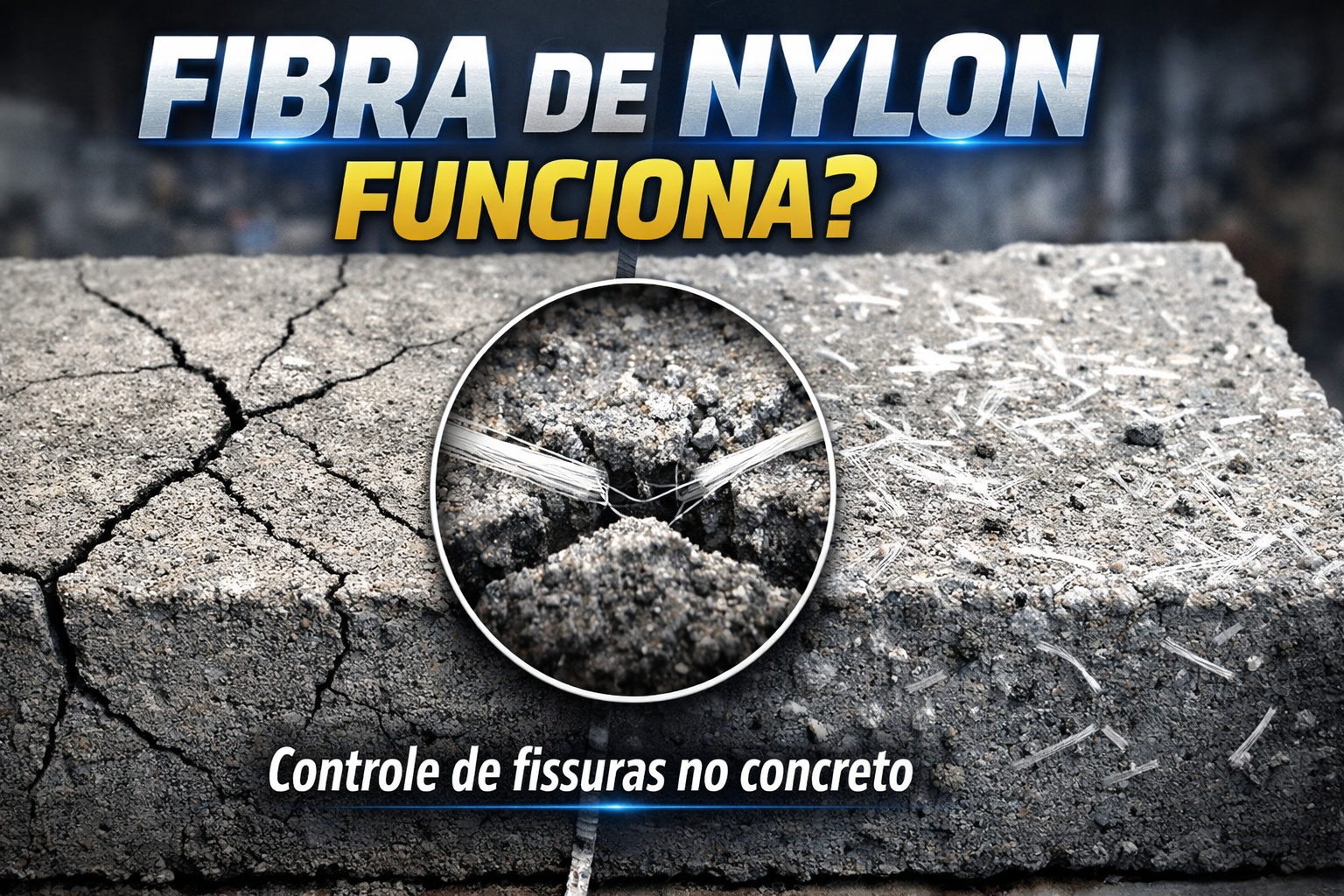
Nylon Fiber in Concrete Can Reduce Cracks Due to Plastic Retraction, but It Depends on Dosage, Dispersion, and Curing; Understand Limits and Evidence.
The discussion about adding nylon fiber to concrete has resurfaced strongly in Brazil in recent years, especially in residential works, floors, and sidewalks, as a “simple technique” to avoid cracks. As of February 17, 2026, the issue remains current because plastic retraction continues to be one of the most common causes of microcracks in freshly-laid surfaces, especially in hot environments, with wind and low humidity.
The technical basis for assessing whether this practice makes sense is well documented in reference guides and standards, such as the ACI 544.3R-08 (American Concrete Institute), which describes types of synthetic fibers, typical dosage ranges, and expected effects, and in testing methods like ASTM C1579, created to compare cracking due to plastic retraction in concrete panels with and without fibers under severe evaporation conditions.
The central question is not “does fiber work or not”, but which fiber, at what dosage, with what geometry, and in what cracking mechanism. Nylon (polyamide) can act as a dispersed micro-reinforcement, but actual performance depends on mixture control, finishing, and curing, and it does not always approach the capabilities delivered by industrial polypropylene microfibers or well-executed curing systems.
-
Bolivian Female Construction Workers Form Association to Combat Discrimination and 38% Pay Gap in the Industry

-
Near Amsterdam, residents buy land and discover they must also build streets, manage drainage, handle waste, and grow food on half their plot.
-
Brazil’s WEG to Open New Factory in China by 2027, Expanding Production of Large Rotating Electric Machines and Low to Medium Voltage Motors in Rugao

-
Chinese Shipyard Secures $1 Billion in Orders for Low-Carbon Container Ships Amid Global Fleet Renewal Efforts


Plastic Retraction: The Crack That Forms Before the Concrete Hardens
Plastic retraction is a phenomenon that occurs in the first few hours. The concrete is still “plastic,” with insufficient tensile strength, but water begins to evaporate from the surface.
When the evaporation rate exceeds the rate of water replacement due to exudation, capillary suction forms and the surface volume tries to contract. If there is restriction, typical cracks appear, generally shallow and more frequent in elements with large exposed areas, such as slabs and pavements.

The key point is time. These cracks appear before the final set, often within a few hours after pouring, and may not penetrate the entire thickness.
The ASTM C1579 method, for example, exists precisely to reproduce a scenario of evaporation and restriction capable of causing cracking while in the plastic stage and allowing for comparison between mixtures.
The classic control of this problem has always been a tripod: reduce evaporation (wind barriers, misting, appropriate timing), adjust the mixture and finishing (avoid excess water and re-tempering), and ensure immediate and continuous curing. Fibers act as an additional layer of mitigation, especially when job site conditions are difficult to control.
How Fibers Control Initial Cracks and What Changes with Nylon
Synthetic microfibers primarily act as a “brake” mechanism for microcracks that form on the surface. They create a dispersed three-dimensional network in the fresh concrete, inhibiting the initial opening and propagation of cracks and helping to maintain a more uniform distribution of stresses while the material is still vulnerable.
Technical literature from industry entities describes this effect as a blocking and internal support action, also related to how bleeding and capillary channels are organized in freshly-laid concrete.
The ACI 544.3R-08, a classic reference on fiber-reinforced concrete, differentiates between micro and macro fibers and cites nylon as fiber commonly used in the form of microfiber, with a specific density of around 1.14, and records typical usage ranges for microsynthetics of 0.05% to 0.2% by volume, varying according to the objective and product.
In practice, the industry has consolidated the use of polypropylene microfibers (monofilament or fibrillated) as a common solution for plastic retraction.

Technical sheets and manufacturer materials cite typical dosages close to 0.9 kg/m³ (1.5 lb/yd³) for PP microfibers aimed at this objective, and the industry itself (NRMCA) reinforces that synthetic microfibers are used to minimize plastic and settlement cracking, through an essentially mechanical mechanism.
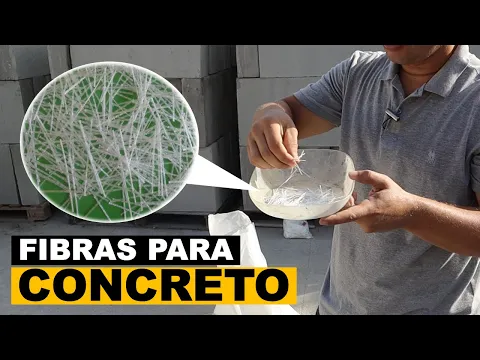
Nylon can perform part of this role, but with two important differences: the “improvised” fiber available on-site rarely has controlled specification (length, diameter, surface treatment, compatibility with the mixture), and nylon is not synonymous with “microfiber for concrete” from an industrial standpoint.
In other words, the logic of the mechanism may exist, but predictable performance depends on the material behaving like a suitable microfiber and being properly dispersed.
Process and Control: Where the Simple Technique Usually Fails
The effect of fibers on plastic retraction is sensitive to variables that seem minor but change the outcome. The first is dispersion.
If the nylon clumps into “balls” or flakes, the mixture creates areas without reinforcement and areas with excess fiber, worsening the finish and potentially creating defect points. The second is compatibility with slump, exudation, and additives.
Fibers can reduce workability and increase the tendency for inadequate finishing if water control is lost, leading to incorrect corrections on-site, such as adding water to “bring back the slump,” which increases the surface water-cement ratio and raises the risk of cracking and dust on the floor.
The third variable is the target of the problem. Cracks due to plastic retraction are not the same as cracks due to drying shrinkage, thermal cracking, or restrained shrinkage cracking at older ages. Microfibers help more at the initial stage.
If cracking is related to drying shrinkage, poorly prepared sub-base, poorly planned joints, insufficient thickness, poor curing, or thermal gradient, fiber alone does not solve the issue and may become an “easy explanation” for construction and design problems.
In tests and technical reviews on plastic retraction, there is consensus that the phenomenon is dominated by evaporation, exudation, and restriction, and that fibers function as mitigation, not as a substitute for curing and good practices. Recent reports and academic reviews reinforce that the volume of fiber, geometry, and aspect ratio (length/diameter) directly influence the initiation time of cracks, extent, and opening.
Numbers and Evidence: What Is Plausible to Expect and What Is Exaggeration
What practice promises is typically to “zero cracks”. This is the type of promise that often fails in the field.
What is plausible, according to industry literature and studies, is to reduce the number and width of initial cracks under critical conditions when the fiber is adequate and within the correct dosage range. Studies and reviews on synthetic fibers, frequently focusing on polypropylene, report significant reductions in plastic cracking under laboratory and comparative conditions, and standards like ASTM C1579 exist to quantify this difference reproducibly.
For nylon specifically, there is research investigating the behavior of concrete reinforced with nylon fibers (polyamide) in shrinkage and fracture, indicating that the type of fiber and its content influence shrinkage and microcracking responses, although these works often use fibers with specifications and controls incompatible with the “generic” nylon from construction sites.
There are also more recent publications reporting reductions in plastic retraction cracking in laboratory tests with nylon fiber, but the variability of methods and materials reinforces that the result depends on the complete system, not just on “adding fiber.”
In practical construction terms, the technically defensible expectation is: suitable microfibers may decrease the likelihood of plastic cracks and reduce their opening, but they do not guarantee total absence, and do not replace joint design, base preparation, and immediate curing.
Any claim of “eliminates cracks for sure” usually ignores the dominant role of climate and finishing procedure in the first hours.
Normative Limits and the Difference Between “Job Site” Nylon and Fiber for Concrete
From a compliance point of view, fibers for concrete have their own specifications. A recurring example in the market is compliance with ASTM C1116 for fibers used in concrete and shotcrete, in addition to dosage and application guidelines in technical sheets. This matters because control of geometry and performance needs to be repeatable.
The ACI 544.3R-08 reinforces that the type of fiber and volumetric content change the behavior of the concrete, and that microsynthetics occupy a typical lower volume range than macro fibers or steel, precisely because the goal is to control initial cracks and microcracks, not to replace the main reinforcement.
When practice uses nylon without specification, the risk is confusing “having fiber” with “having the right fiber.” Nylon can absorb more water than polypropylene and has different surface characteristics and modulus, which can alter workability and interaction with the paste. In an industrial scale, this is handled through product formulation and usage recommendations; in improvisation, it becomes uncertainty.
There is also a critical point: many cracks attributed to plastic retraction are, in reality, consequences of late curing, finishing with excess water, wind over the exposed surface, or lack of protection in the first hours.
In these scenarios, a fiber does not correct the physical flow that is pulling water from the surface and generating capillary suction.
What Defines Success in the Field: Simple, But Rigorous Engineering
When the goal is to reduce cracking due to plastic retraction, the most robust logic combines environmental control and the choice of appropriate dispersed reinforcement.
The engineering behind plastic retraction is not complex, but it is relentless: high evaporation and insufficient water replacement on the surface create the perfect window for cracks.
Technical guides from the industry describe the phenomenon as highly likely under high evaporation rates, before the concrete sets, and indicate that protective and curing measures are determining factors.
Fibers act as a redundancy component. In works with high climatic risk, synthetic microfibers specified for concrete can be an additional layer of control. When it comes to nylon, the criteria shift to compatibility and repeatability of the material.
Instead of “nylon fiber” as a generic concept, what works reliably is fiber with known purpose, geometry, content, and performance.
In the technical framework, the question “does it prevent cracks?” becomes “does it reduce the probability and severity of plastic cracks in the first hours?” and the most correct answer is: it can reduce if the fiber is suitable, well-dispersed, and accompanied by curing and protection from the beginning, but it is not a magic solution and does not replace good practices.
Challenges, Risks, and Future Implications for a Practice That Is Becoming Popular
The popularization of “simple mixes” often advances faster than standardization. The risk, in this case, is double. On one hand, when the technique occasionally works, it becomes a “universal truth” and is applied in situations where the cracking has another cause.
On the other hand, when it goes wrong, opposing myths arise, like the idea that fibers “do not work,” when in practice the problem was climate, curing, finishing, or inadequate material.
In the near future, the most consistent trend is the migration from improvisation to specification. The industry already offers microfibers with published typical dosages and explicit focus on plastic retraction, and the normative ecosystem exists to compare performance through testing, such as ASTM C1579.
For nylon, there is room in specific applications, but the path to reliability involves material characterization and comparison in standardized tests, not informal replication.
The Engineering of Using Nylon Fiber in Concrete
Adding nylon fiber to concrete can, in principle, help reduce cracks due to plastic retraction because dispersed fibers act as a mechanical containment network for micro-openings while the concrete has not yet gained strength.
The engineering that underpins this effect is known, tested, and documented in technical guides and in methods such as ASTM C1579, and standards such as ACI 544.3R-08 show that nylon appears as a possible synthetic fiber, typically in the microfiber category, with a typical volumetric dosage range for microsynthetics.
The limit lies in the “how.” Generic nylon, without specification and with uncertain dispersion, may not deliver the same effect as industrial microfibers made for concrete. In any scenario, the dominant control remains physical: evaporation, finishing, and curing in the first hours.
When these factors are under control, fibers become safety reinforcement. When they are not, fiber becomes a promise, and plastic retraction does what it has always done: opens cracks before the concrete can defend itself.





-

2 people reacted to this.