Portuguese
  Spanish


Giant Anteater was recorded again in Rio Grande do Sul after a reintroduction project started with only two animals in Argentina
A rare environmental recovery caught the attention of conservation specialists in Latin America.
The giant anteater, an emblematic species of South American fauna, reappeared in Rio Grande do Sul after about 130 years of absence.
The record occurred in 2026, in the Espinilho State Park, through camera traps installed in the region.
-
German Sailor Found Mummified on His Boat in the Philippines, Leaving Scientists Puzzled by an Unbelievable Detail

-
Brazilian Couple Trades Motorhome for “Houseboat” Adventure on Historic Welsh Canal with Unique Challenges
-
Neon Blue Glow in Brazilian Waters Captivates Locals and Goes Viral, Unveiling Rare “Sea Fire” Phenomenon
-
Forgotten Map Leads Diver to Shipwreck with Gold, Rare Jewels, and Secrets Hidden for Nearly 350 Years


According to Rewilding Argentina, the recovery began on October 17, 2007, in the Esteros del Iberá, in the Argentine province of Corrientes.
At the time, only two giant anteaters were released in an area where the species had disappeared decades earlier.
Argentinian project paved the way for the species’ return
The initiative was conducted by the Government of Corrientes in partnership with Rewilding Argentina.
According to the organization, this was the first reintroduction project of the giant anteater carried out on a global scale.
Since then, the population began to grow. Additionally, new generations started to be born in the wild.
Currently, more than 110 animals have already been reintroduced in the Esteros del Iberá, according to data released by Rewilding Argentina.
Many of these specimens came from rescues made in provinces of northern Argentina.
Among them are Chaco, Formosa, Salta, Jujuy, and Santiago del Estero, regions where hunting and habitat loss are still concerning.
Hunting and deforestation explain disappearance
The disappearance of the giant anteater did not happen suddenly.
The loss was slow, silent, and linked to the transformation of natural landscapes.
The species was affected by hunting, deforestation, and habitat fragmentation.
Additionally, farms and roads cut through important ecological corridors.
As a result, the animal lost extensive areas to feed on ants and termites.
As a result, in parts of Argentina and southern Brazil, the giant anteater simply ceased to be seen.
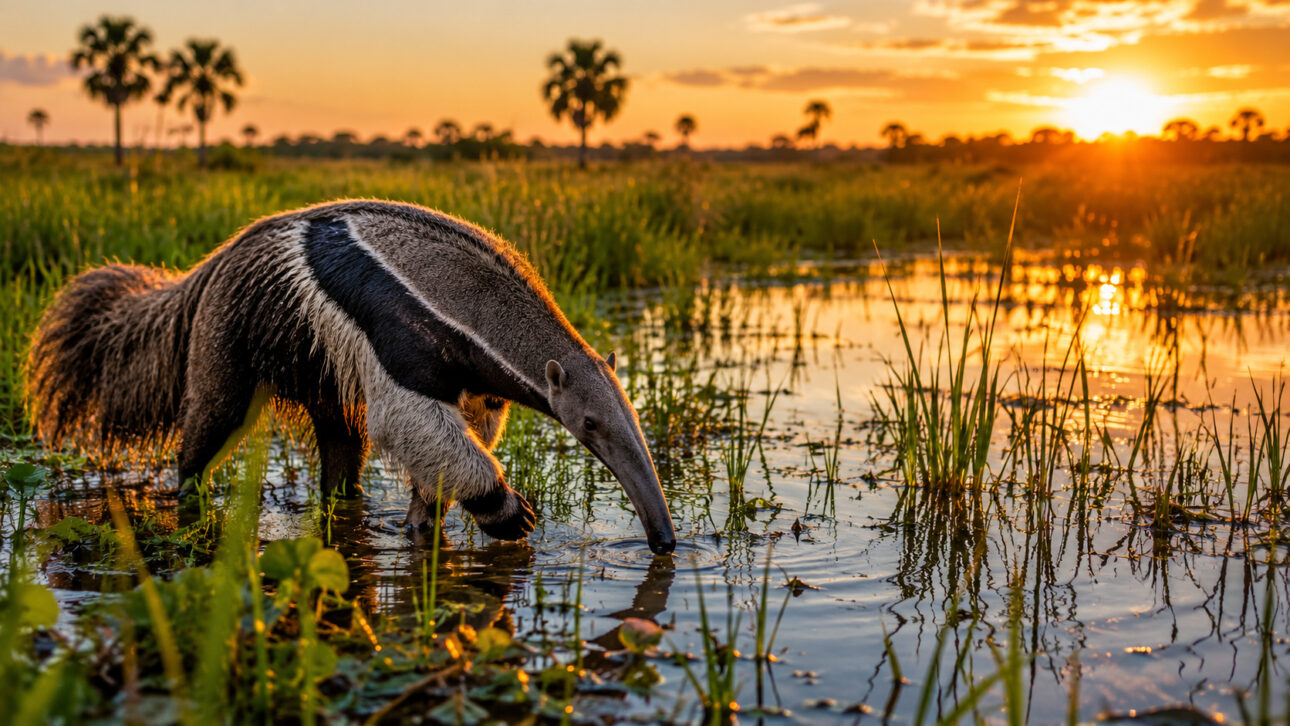
Techniques helped animals return to the natural environment
The process was not simple, despite the positive outcome.
Reintroducing a locally extinct species requires planning, monitoring, and gradual adaptation.
Therefore, the animals went through careful stages before their final release.
Among the main measures used in the project were:
- special quarantines, for health and behavior assessment;
- pre-release enclosures, for adaptation to the environment;
- long-distance transfers, with rescued animals;
- telemetry monitoring, to track movements;
- temporary food support, until autonomy in the field.
In this way, animals that were once in captivity managed to gradually adapt to free life.

Movements of more than 100 km show progress
The scenario changed over the years.
Several generations were born directly in the fields of Esteros del Iberá.
Some individuals began to occupy areas increasingly distant from the original release points.
According to information released about the project, some giant anteaters traveled more than 100 kilometers.
This behavior shows that the species has returned to acting in a wild manner.
In other words, the animals not only survived. They also began to explore new territories on their own.
Reappearance in Brazil becomes a conservation milestone
The record in Espinilho State Park, in Rio Grande do Sul, reinforced the importance of the Argentine project.
Veterinarian Flávia Miranda, from the Instituto Tamanduá, assessed that the animal probably came from Corrientes.
Therefore, the case indicates that the recovery has crossed international borders.
Even so, experts emphasize that the expansion depends on the existence of suitable habitat.
The species can only advance where it finds enough food, shelter, and natural conditions.
Despite these limits, the return of the giant anteater to southern Brazil has become a milestone for wildlife conservation in Latin America.
What do you think should be the priority now: expanding reintroduction projects in protected areas or further strengthening the preservation of natural habitats? Leave your opinion!