Portuguese
  Spanish


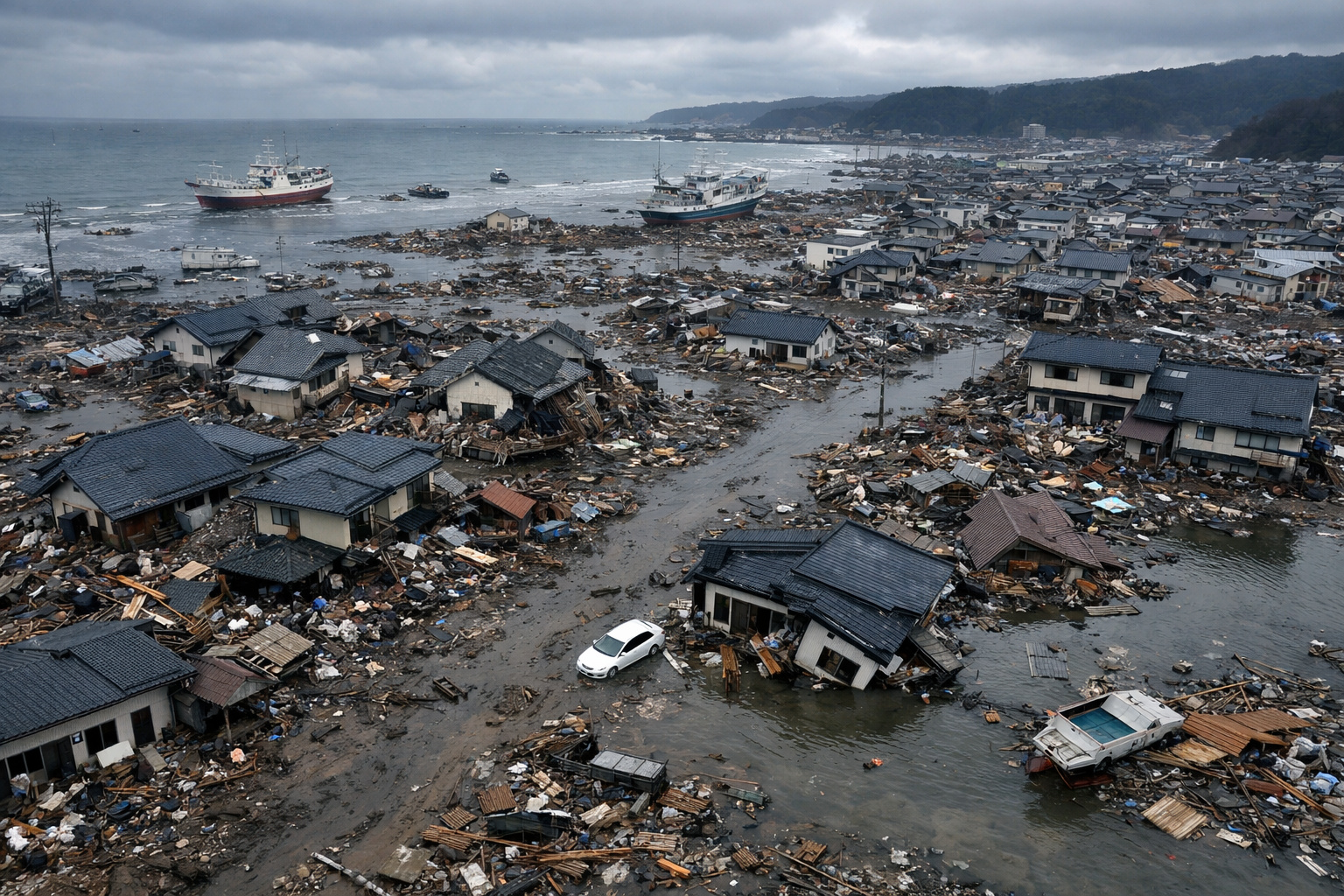

Authorities intensify seismic monitoring and alert the population to secondary risks while the prevention system is put to the test
Japan has returned to the global spotlight after a strong earthquake of magnitude 7.7 struck the country on Monday, reigniting tsunami alerts and raising concerns about new tremors in the coming days. The seismic shock occurred approximately 100 km off the coast of Sanriku, at a depth of 19 km, according to official data, prompting a rapid mobilization of Japanese authorities.
Shortly after the tremor, tsunami alerts were issued along the country’s northeast coast. However, as hours passed, these alerts were downgraded, although the situation still requires caution. Nevertheless, various essential services, such as bullet trains, remain suspended, highlighting the immediate impact of the event.
The information was released by “g1”, which emphasized that this type of alert is part of a standard protocol adopted by Japan after high-intensity earthquakes. Additionally, the government reinforced that the population should remain alert to new risks, including landslides, which often occur after seismic events of this magnitude.
-
Slovakia’s Ice Cave Holds Over 110,000 m³ of Frozen Wonders, Boasts Walls Up to 27 Meters Thick, and Was Among the First Electrified Caves Globally

-
Street Cleaner Accidentally Receives $200,000 Transfer, Returns Unexpected Fortune to Rightful Owner

-
Australian Space Agency Investigates Six Mysterious Metal Spheres Found on Queensland Beach, Isolating Area Over Possible Space Debris Risk

-
Transform Your Kitchen in a Day: New Flooring Solution Offers Quick Renovation Without the Mess or Noise



Understand the tsunami alert levels and why even small waves can be deadly
To understand the gravity of the situation, it is essential to grasp how the tsunami alert system works in Japan, considered one of the most advanced in the world. The country uses three distinct levels, each with specific recommendations for the population.
The first level is the Tsunami Advisory, considered the lowest, issued when waves of less than one meter are expected. Although this may seem minor, experts warn that even 30 cm waves can be fatal. Therefore, the recommendation is clear: leave the sea immediately and evacuate coastal areas.
Next is the Tsunami Alert, the second highest level, triggered when waves of up to three meters are expected. In this case, authorities advise residents to seek higher ground or buildings prepared for emergencies, also moving away from areas near rivers.
Finally, the maximum level is the Major Tsunami Alert, when waves exceeding three meters may repeatedly hit the coast. This scenario represents a high risk of destruction, requiring immediate and strict evacuation.
Currently, alerts have been issued for regions such as Iwate Prefecture, the Pacific coast of Hokkaido, and Aomori Prefecture. Warnings have also been directed to other areas of Hokkaido, Aomori, Miyagi, and Fukushima.

Japan’s seismic history increases tension and reinforces fear of new disasters
In light of this scenario, concern is growing about the possibility of new earthquakes of significant magnitude. According to statistical data, Japan experiences an earthquake of magnitude 7 or higher approximately every 16 months — that is, on average, just under once a year.
Furthermore, the country is responsible for more than 10% of all earthquakes of magnitude 6 or higher recorded worldwide, according to the Japan Meteorological Agency. This data reinforces the constant vulnerability of the region, located in the so-called “Ring of Fire” of the Pacific.
The most recent similar episode occurred in December 2025, when a magnitude 7.6 earthquake was recorded off the coast of Aomori Prefecture. Still, the most significant event in recent history remains the devastating Tohoku earthquake in 2011, with a magnitude of 9.0.
At that time, the subsequent tsunami killed more than 18,000 people and caused a severe nuclear accident in Fukushima Prefecture. One of the factors that exacerbated the tragedy was the underestimation of risk: many people did not believe the waves would be so large and did not seek sufficiently high areas.
Since then, Japan has invested heavily in education and public awareness. Today, there is a much broader understanding of the real dangers of tsunamis, including the fact that seemingly small waves can have enough force to sweep people away and cause fatalities.

Japanese government reinforces guidelines and keeps the population in a state of continuous alert
Meanwhile, authorities continue to monitor the situation in real-time. Prime Minister Sanae Takaichi urged residents in affected areas to seek higher ground immediately, emphasizing the importance of prevention.
Additionally, the Chief Cabinet Secretary, Minoru Kihara, advised the population to remain in inland areas until all alerts are officially lifted. According to him, about 100 homes lost electricity after the tremor, and some high-speed transport services remain suspended.
Thus, even with the reduction of some alerts, Japan remains in a state of maximum vigilance. Experts warn that aftershocks may occur in the coming days, which requires constant attention from the population and authorities.
Therefore, the current episode not only reinforces the unpredictability of natural phenomena but also highlights the importance of efficient alert systems and the rapid response of the population in the face of risk situations.