Portuguese
  Spanish


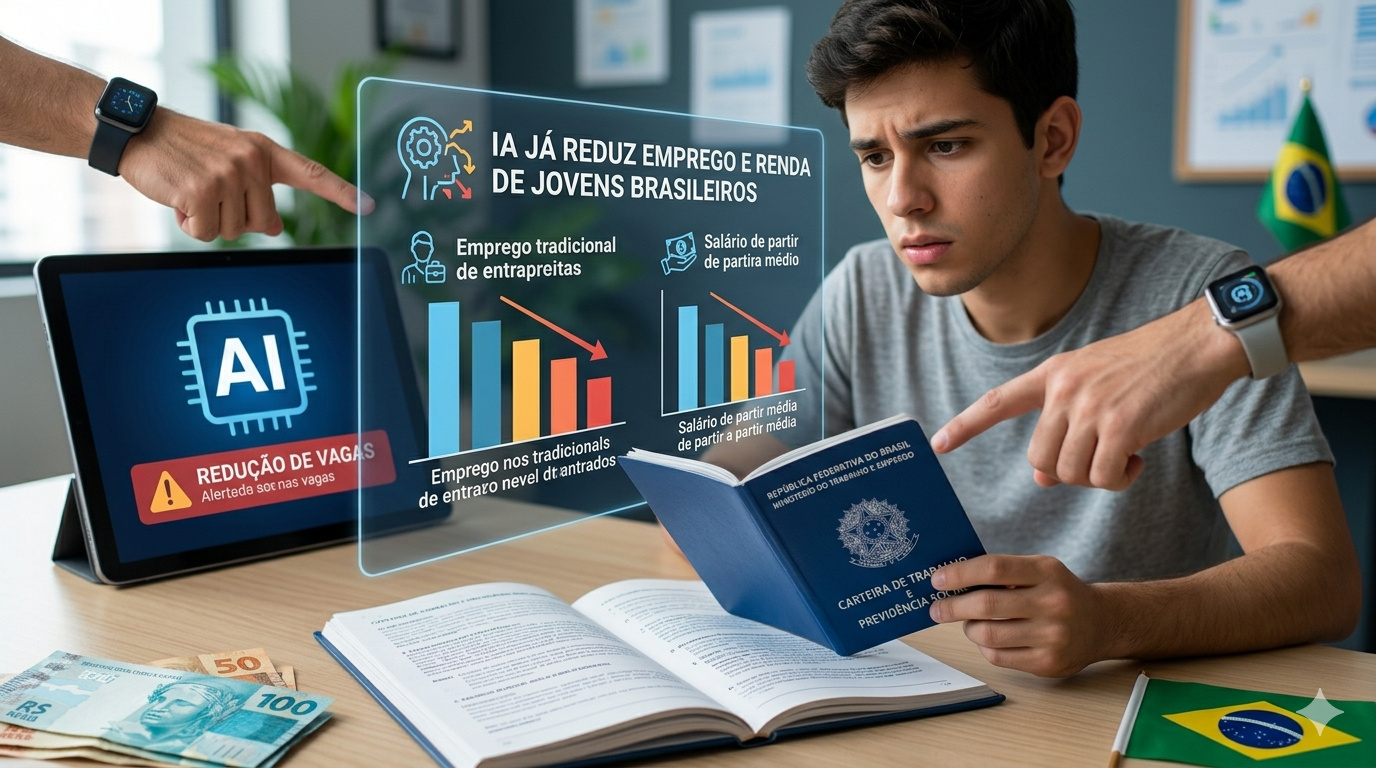

Study shows that AI impacts employment and income of young Brazilians, with salary decline and changes in the job market, reflecting a global transformation driven by technology
Artificial intelligence is already beginning to concretely alter the job market, and in this scenario, young Brazilians are among the most affected. According to a recent study, workers aged 18 to 29 have recorded an average income decline of 7%, while facing greater job instability. Furthermore, this trend is not occurring only in Brazil, as several countries are also observing similar impacts.
At the same time, it is important to understand that this transformation did not arise suddenly. In fact, it is part of a broader historical process, in which new technologies have always reorganized work. Still, the current speed of change is noteworthy, especially because artificial intelligence advances more rapidly than previous revolutions.
Technology has always transformed work
Historically, the job market has undergone various profound changes. For example, during the Industrial Revolution, machines replaced a significant portion of manual labor. As a result, many workers lost traditional roles, while new occupations emerged.
-
Indian Inventor, 58, Develops Steering Wheel-Free Agricultural Machine Operated by Levers, Offering Cost-Effective Alternative to Expensive Tractors

-
Brazilian Senate Approves Bill to Automate Child Support Payments Directly from Debtors’ Accounts
-
Brazilian Student in the U.S. Helps Provide Clean Water to 50 Families in São Paulo Slum, Launches Year-Long Volunteer Project with National Expansion Plans
-
Daughter of Farmers from Brazil Uses Social Media to Highlight Rural Life and Promote Agriculture


Additionally, throughout the 20th century, industrial automation also reduced the need for labor in sectors such as manufacturing. According to economist John Maynard Keynes, even in the 1930s, technology could create what he termed “technological unemployment.” In other words, there was already concern that machines would replace human workers.
However, despite these changes, the market has managed to reorganize over time. On the other hand, the current digital revolution presents an important difference, as artificial intelligence does not only replace physical tasks but also cognitive activities. Thus, professions that once seemed secure now also face risks.
Young people are more vulnerable in this scenario
In this context, young people end up being more impacted. Firstly, many of them are at the beginning of their careers, which means less professional stability. Additionally, they often occupy more operational or entry-level positions, which are precisely the most susceptible to automation.
According to the cited study, young people aged 18 to 29 experienced an average income reduction of 7%. Moreover, they face greater difficulty in securing their first job or maintaining stable positions. According to researchers from the Getulio Vargas Foundation (FGV), this age group tends to feel the effects of structural changes in the market first.
At the same time, the International Labour Organization (ILO) also warns that automation can widen inequalities among different groups. Therefore, young people without technological qualifications face even more challenges, especially in emerging economies like Brazil.

Global impact of artificial intelligence
On the other hand, this phenomenon is not limited to Brazil. In various countries, artificial intelligence is already causing similar changes. In the United States, for example, studies conducted by the Massachusetts Institute of Technology (MIT) show that automation has a direct impact on wages and job opportunities.
Furthermore, in Europe, research from the Organisation for Economic Co-operation and Development (OECD) indicates that low and medium-skilled jobs are more exposed to technological substitution. Thus, the global scenario reinforces that the transformation of work is occurring on a large scale.
At the same time, experts highlight that artificial intelligence also creates new opportunities. However, these new roles require different skills, such as analytical thinking, digital knowledge, and constant adaptation. Thus, those who do not keep up with this evolution may fall behind.
Income and employment in transformation
In light of this scenario, the decline in youth income does not happen by chance. Instead, it reflects a change in how work is valued. While some roles lose relevance, others require higher qualifications.
Moreover, competition increases as more people compete for positions that have not yet been automated. As a consequence, wages tend to fall in certain sectors. According to data from the Brazilian Institute of Geography and Statistics (IBGE), young people have historically faced higher unemployment rates, and artificial intelligence intensifies this situation.
On the other hand, workers who develop digital skills are better positioned in the market. Therefore, adaptation becomes a decisive factor for maintaining income and employability.
Education and adaptation as a response
In light of these changes, education gains even more importance. First of all, it is necessary to develop competencies aligned with the new demands of the market. Additionally, skills such as creativity, problem-solving, and critical thinking are becoming increasingly valued.
According to the World Economic Forum, professions related to technology, data analysis, and artificial intelligence are expected to grow in the coming years. Thus, investing in qualifications can reduce the negative impacts of automation.
At the same time, public policies also play a fundamental role. Governments and institutions need to create training programs and encourage digital inclusion. Otherwise, part of the population may be excluded from new opportunities.

A scenario of continuous change
Finally, it is important to understand that artificial intelligence does not only represent a threat but also an inevitable transformation. Just as in other technological revolutions, the job market will continue to evolve.
However, unlike in the past, the speed of change requires faster adaptation. Therefore, both individuals and companies need to prepare for this new scenario.
In summary, artificial intelligence is already impacting the employment and income of young Brazilians while redefining the future of work. Still, with proper preparation, it is possible to turn this challenge into an opportunity and build more sustainable paths for future generations.