Portuguese
  Spanish



The couple who spent four years exploring the continent now trades the road for a plot of land in southern Santa Catarina, with topographic survey, access opening, and eucalyptus cutting to start a new phase
The couple who spent years on the road aboard a 1986 Kombi decided to make a profound change of route. After crossing the American continent from the far south to the far north, the duo parked the vehicle not to continue their journey, but to start a life project on a plot of land in the interior of Santa Catarina.
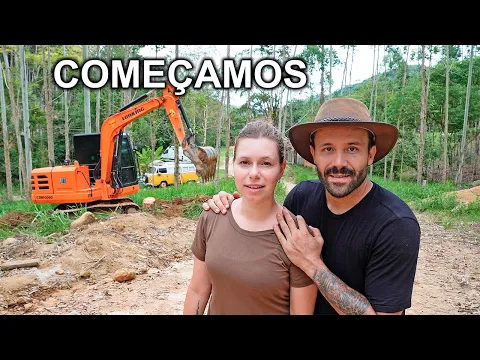
The change of phase began without ready structure, without comfort, and with a lot of work ahead. Amidst tall grass, mud, and an still improvised routine, the couple took the first step to transform the area into a refuge, with the help of family, technical support to understand the terrain’s relief, and the opening of the first private access to the property.
Couple trades years on the road for roots in Santa Catarina
After four years traveling through America with their Kombi Manezinha, the couple chose to interrupt their nomadic life to start a more settled cycle. The land in southern Santa Catarina came to represent something the road didn’t offer in the same way: permanence, gradual construction, and a sense of belonging.
-
Family of Six Leaves Georgia to Live in a $300,000 Cold War-Era Underground Bunker Since 2020: Unlikely 557 m² Home with 60 cm Concrete Walls

-
Self-taught Brazilian Mechanic Builds 10-Ton Aluminum Sailboat in Backyard, Now Navigates the Brazilian Coast at 50
-
Santa Catarina Launches $1.4 Billion, 145-Kilometer Highway Project with Six Lanes and Speeds Up to 120 km/h

-
Couple Transforms 1913 School into 370 m² Home with Four Bedrooms After $175,000 Purchase and Three Years of Renovation



The decision carries weight because it’s not just about changing address. The couple moved from a routine marked by constant displacements to face an still raw space, with little-known geography and non-existent infrastructure. What was once movement now becomes preparation, planning, and manual labor.
Topographic survey becomes a priority at the start of the project

Before fencing, building, or defining any use of the space, the couple decided to understand exactly what the purchased area was like. Therefore, one of the first steps was to hire a planialtimetric survey and the demarcation of the land’s boundaries.
The service was divided into stages. One part of the work focused on marking the perimeter, while another served to map the relief, ascents, descents, and characteristics of the total area with the support of a drone and total station.
This process is essential for anyone buying a still little-known plot of land, especially in places with a lot of vegetation and poor visibility of the entire property.
Family helps and improvised routine marks the first days
The beginning of the new phase happened with family support and a simple routine. While part of the group accompanied the work and did small cleanups in other areas of the land, the meal was prepared right there, outdoors, in an still improvised but already meaningful setting.
This detail helps to show the dimension of the change. For the couple, cooking on their own land for the first time symbolizes more than a daily task, because it represents the concrete beginning of a life built in that space. The experience is still rustic, but it already carries the feeling of home.
Opening access becomes one of the couple’s first missions
Among the initial priorities, one of the most important was to create private access to the land. Until then, car entry happened through a neighboring area, temporarily borrowed, which made it clear that the couple still depended on a provisional solution to move around autonomously.
The opening of this passage was treated as a central advancement in the project. With the aid of machinery, the access quickly began to take shape, allowing the Kombi to enter through the stretch that will become the property’s road.
Having a private path changes the relationship with the land, because it ceases to be just a purchased space and an effectively occupied area begins to emerge.
Eucalyptus cutting is part of the land preparation

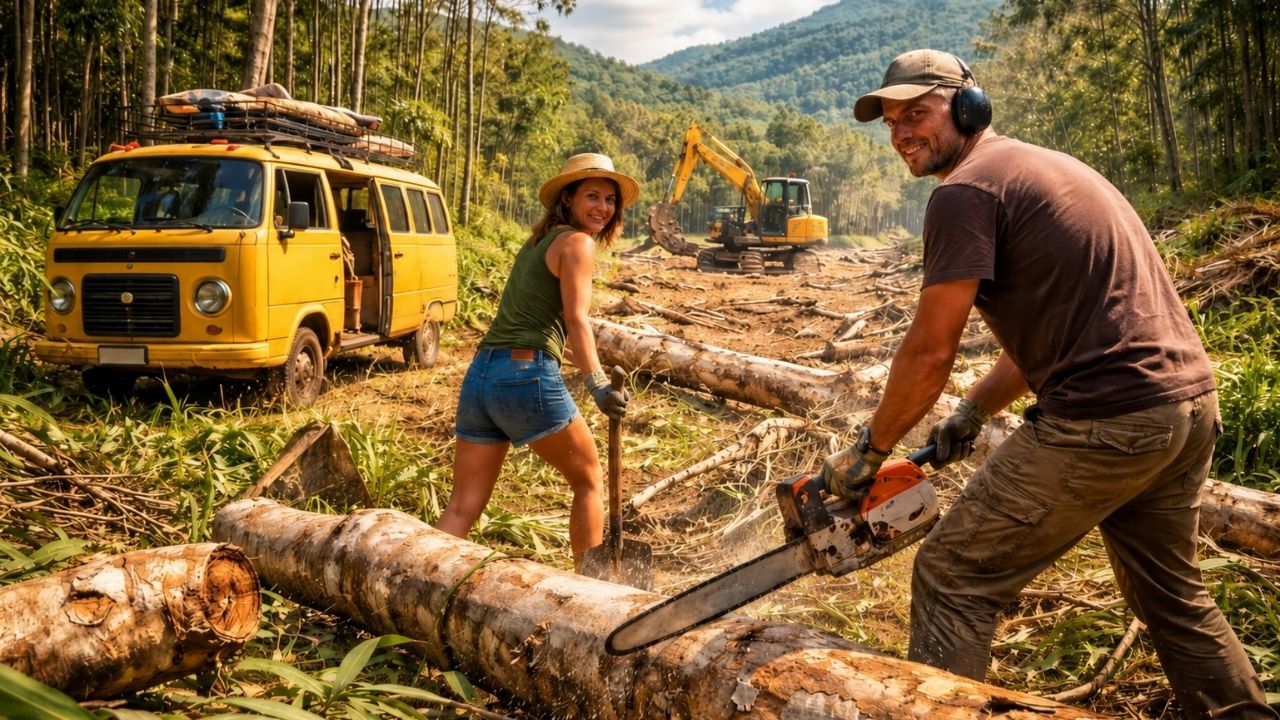
As the area was previously used for planting eucalyptus and pine for wood extraction, the **couple** had to deal with this legacy of prior land use from the start. To open the new entrance, some eucalyptus trees located at the front of the property had to be removed.
The process included the use of a chainsaw, which was started for the first time at this stage, with family supervision. The wood has already begun to be repurposed as firewood for the day’s barbecue, while eucalyptus leaves and branches also found other uses.
**Nothing was treated merely as waste**, as part of the material was set aside for tea, shower use, and even to help ward off mosquitoes.
Repurposing Eucalyptus Accompanies the Start of the New Phase
Beyond opening access, the way the eucalyptus was utilized reveals the practical spirit of this stage. What wasn’t immediately used as wood was transformed into firewood, leaves for drying, and branches for simple domestic use in the future.
This utilization reinforces the logic of the project’s beginning. **The couple is still in a phase where every available resource counts**, whether to solve specific needs or to reduce waste while the larger structure isn’t ready. It’s a stage marked by adaptation, improvisation, and patient construction.
Land Already Has a Spring, Next Steps Include Water and Electricity

Another important aspect of this new routine is the presence of a water spring within the property. Based on this, the **couple** has already set among their next goals to draw water for a more organized daily supply.
Electricity also entered the immediate planning. According to the report, the request has already been made, and the expectation is that power will arrive soon, as the grid passes near the location.
**Piped water, fencing, and electricity appear as basic steps to transform the land into a habitable space**, even before any more advanced construction.
Fencing, Division with Neighbors, and Space Organization Enter the Plan
With the land survey underway and access already started, the **couple** also began to think about fencing and proper division with neighbors. The idea is to delimit the area more securely and better organize the entrance and sides of the property.
This type of care shows that the new phase will not be marked only by emotion or symbolism. There is also a sequence of practical decisions, involving terrain, boundaries, infrastructure, and land use. **The dream of putting down roots necessarily involves technical and laborious steps**, which gradually shape the space.
Couple Ends First Day with a Sense of Real Progress
The end of the day brought together fatigue, a river bath, a bonfire to ward off mosquitoes, and a simple meal prepared on the land itself. Even without consolidated infrastructure, the feeling was one of concrete progress, especially since the entrance was open and the first tasks were completed.
At the same time, living with the parents, who are also setting up a van for a motorhome, gave the moment an even more symbolic tone.
**The couple ended the first day seeing their dream take shape in small steps**, amidst machines, mud, simple food, and the realization that the land finally began to transform from a plan into reality.
In your opinion, did the **couple** make the right choice by trading years on the road for a piece of land to start from scratch in Santa Catarina?