






 Portuguese
  Spanish


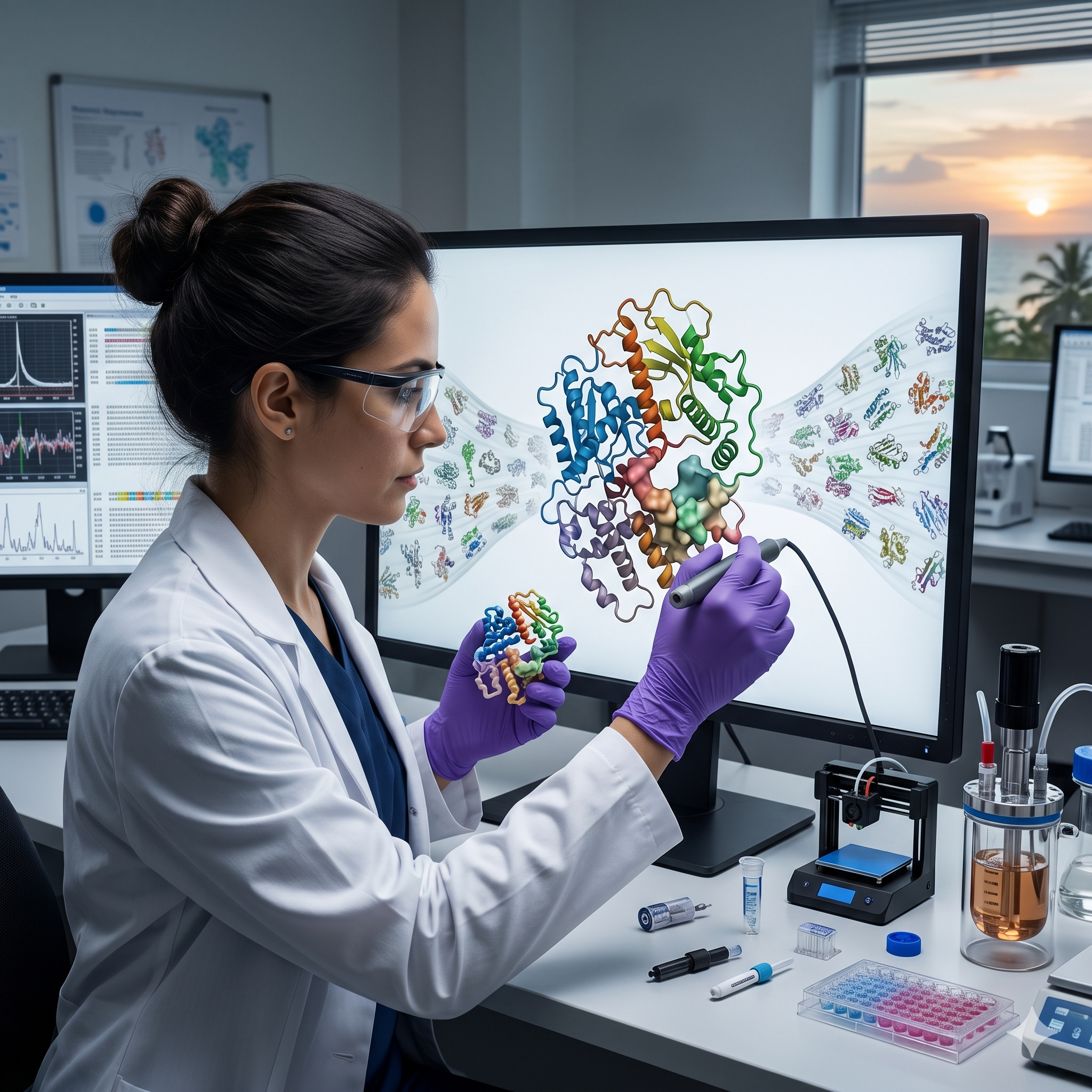
New AI goes beyond predicting proteins and starts creating unprecedented molecules, accelerating research in medicine, recycling, and carbon capture.
In 2022, DeepMind announced on July 28 one of the most significant advances in modern computational biology: AlphaFold expanded its database to over 200 million AI-predicted protein structures, covering almost all cataloged proteins known to science and making these models available in open access through the AlphaFold Protein Structure Database, developed in partnership with EMBL-EBI.
Until then, determining the three-dimensional structure of a protein relied on complex experimental methods, such as X-ray crystallography, nuclear magnetic resonance, and cryo-electron microscopy, processes that could require significant investment, specialized infrastructure, and long laboratory work cycles.
With AlphaFold, researchers gained access to structural predictions on an unprecedented scale, accelerating a step that for decades was considered one of the major bottlenecks in molecular biology.
-
Bosch Unveils Revolutionary 2.3 kg Hub Motor for E-Bikes with 45 Nm Torque and 400 Watts Power, Eliminating Resistance Above 25 km/h in Historic Shift for German Manufacturer

-
Brazilian Engineer Develops Marine Bacteria from Ubatuba into a Mini Power Plant Generating 227 mW per Square Meter, Cleans Air by Capturing CO₂ and Releasing Oxygen
-
Trump Signs Orders to Develop Quantum Computer and Bolster U.S. Systems Against Encryption-Breaking Attacks

-
Breakthrough in Clean Energy: Scientists Develop Battery-Free Artificial Photosynthesis Using Only Sunlight to Generate Chemical Energy


New generation of AI expands capabilities and begins to predict complex interactions
In 2024, the evolution of this system led to the development of AlphaFold 3, which significantly expanded the technology’s scope.


Unlike the previous version, the new model can predict not only the structure of isolated proteins but also their interactions with:
- DNA
- RNA
- small molecules (like drugs)
This capability represents a critical advance, because most biological functions depend on these interactions. In practice, AI stopped merely “seeing” proteins and started simulating how they behave within the body.
From prediction to creation: AI begins to design proteins that never existed
The most recent advance is not in prediction, but in design. As of 2025, companies like Isomorphic Labs, Recursion Pharmaceuticals and EvolutionaryScale have begun to use generative artificial intelligence to create unprecedented proteins, which never arose naturally throughout evolution.
This process works like digital molecular engineering: the AI receives a specific objective and proposes protein structures capable of fulfilling that function.
What once took millions of years of biological evolution is now being simulated and accelerated in the lab with computational support.
Artificial enzymes are already being designed to solve real problems
Among the most advanced applications are enzymes designed to address industrial and environmental challenges. Recent research shows that AI-created proteins are already capable of:
- degrading plastics like PET in reduced time
- capturing carbon dioxide with greater efficiency
- acting in chemical processes more precisely

Although many of these systems are still in the experimental phase, the progress is consistent. Protein engineering is becoming a practical tool to solve problems that nature would take centuries or millennia to adapt to.
Drug discovery enters a new accelerated phase
The pharmaceutical sector is one of the most impacted. Traditionally, drug development involves trial and error, with cycles that can last over a decade. With AI, this process is beginning to change.
Advanced models can:
- predict how a molecule interacts with a target protein
- suggest structures with a higher chance of success
- reduce the number of necessary tests
This allows for accelerating the creation of treatments, especially in areas like cancer, rare diseases, and complex conditions. AI does not replace clinical trials, but it drastically reduces the time needed to arrive at promising candidates.
The space of possible proteins is larger than anything nature has ever explored
One of the most impressive aspects of this advancement is its scale.
The number of possible proteins is practically infinite in practical terms. Natural evolution has explored only a fraction of this space over billions of years.
With artificial intelligence, scientists can access regions of this “molecular universe” that have never been tested by nature.
This means we are entering a phase where biology ceases to be merely discovery and becomes design.
Technology still faces important limits and challenges
Despite the advancement, the field still faces relevant challenges. Not all designed proteins work as expected in the real world. Furthermore, biological processes are highly complex and involve variables that are difficult to predict completely.
Other challenges include:
- experimental validation
- industrial scalability
- biological safety
AI accelerates the process, but does not eliminate the need for rigorous testing and scientific validation.
Impacts go beyond science and reach the global economy
The ability to design proteins can affect multiple sectors. Industries that may be impacted include:
- pharmaceutical
- chemical
- energy
- materials
- agriculture
The creation of custom enzymes can reduce costs, increase efficiency, and generate new production chains. This advancement transforms biotechnology into one of the most strategic areas of the global economy.
New AI redefines the role of evolution in modern science
Historically, natural evolution was the sole mechanism for creating new proteins.
With artificial intelligence, a new paradigm emerges: intentional design. Science now has the ability to direct processes that were previously random and slow.
This does not replace evolution, but it creates an additional layer of innovation based on simulation and engineering.
Is biology ceasing to be discovery to become engineering?
With models capable of mapping millions of proteins, predicting complex interactions, and now creating unprecedented structures with specific functions, artificial intelligence is redefining the limits of biology. What began as an analysis tool is transforming into a creation system.
The question that arises is direct: to what extent will science continue to discover existing biology, or will it begin to build completely new biology from scratch?





Be the first to react!