Portuguese
  Spanish


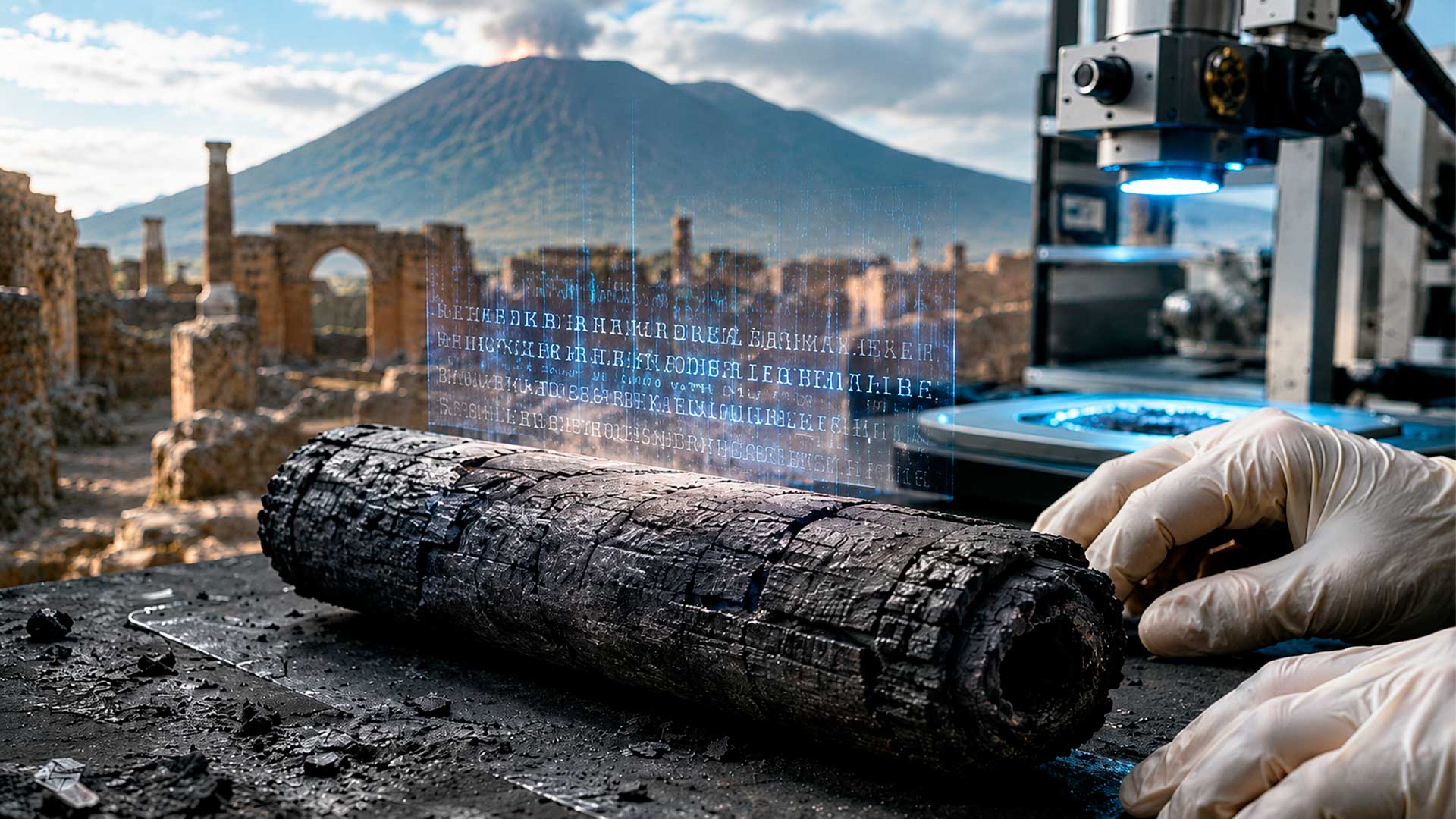

The complete reading of a Herculaneum scroll has opened a new phase in digital archaeology. Researchers used X-rays, artificial intelligence, and “virtual unrolling” to recover Greek texts preserved since the eruption of 79 A.D., including passages related to ancient philosophy, ethics, and human behavior.
A charred scroll from Herculaneum, sealed since the eruption of Mount Vesuvius in 79 A.D., was read from end to end without being physically opened. The breakthrough was announced on June 25, 2026, by the Vesuvius Challenge, an international project that brings together researchers, engineers, papyrologists, and artificial intelligence specialists.
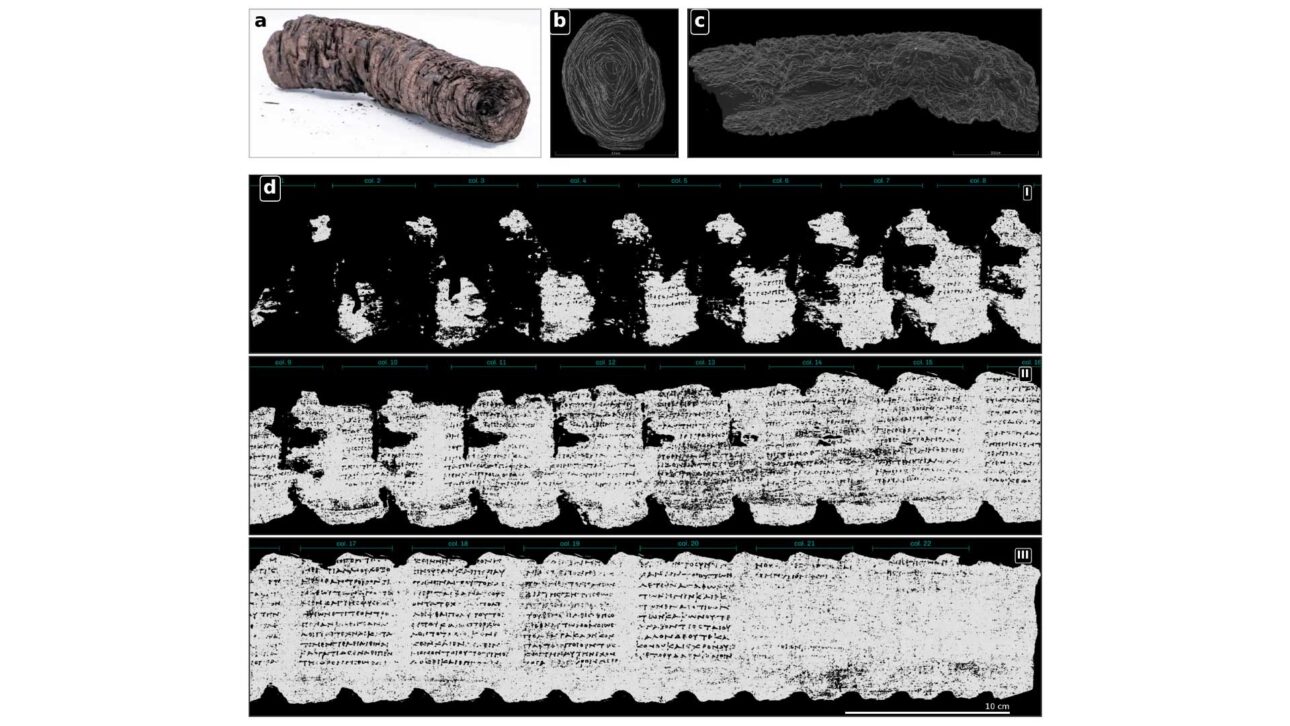
The material is known as PHerc. 1667. On the outside, it looks like a black and fragile block of charcoal. Inside, it held about 1.4 meters of written surface, with columns of Greek text that could not be accessed without risk of destruction.
The difference now lies in the method. Instead of touching the papyrus, scientists used high-resolution tomography, digital reconstruction of the rolled layers, and machine learning models capable of detecting almost invisible ink signals on the charred material.
-
Ferrari, BMW, Tesla, and Chinese Automakers Shift from Copper to Aluminum Wiring to Reduce Weight and Costs in Electric Vehicles

-
Brazilian Researcher Unveils Innovative Intraocular Lens for Cataract Treatment with High-Precision Optics, Enhancing Vision at Multiple Distances and Reducing Unwanted Visual Effects

-
World’s Largest Particle Accelerator Begins Four-Year Hiatus for Magnet Overhaul, Aiming to Hunt Dark Matter by 2030
-
“Sahara Dust Turns Rain Red, Startling Residents Across Europe”



According to the Vesuvius Challenge, this is the first time a Herculaneum papyrus has been digitally unrolled and read in sequence, from one end to the other, for continuous academic study.
The scroll was not opened because any physical attempt could destroy the text
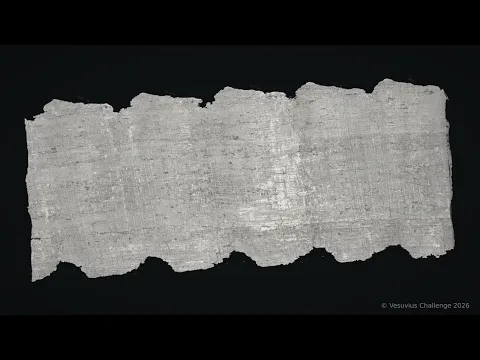

The Herculaneum scrolls survived for an unusual reason. The heat from the eruption charred the rolls, but also helped preserve part of the material within a compact mass. The problem is that this preservation came with a catch: trying to unroll the papyrus could break the layers and erase precisely what remained.
For more than two centuries, scholars have attempted to open fragments with mechanical methods. Some texts were recovered, but part of the material was lost in the process. In the case of PHerc. 1667, previous attempts in the 19th century, in 1969, and in the 1980s left only the inner core preserved.
The new reading changes this logic. The scroll remains closed, but its internal layers have been mapped in 3D. Then, algorithms transformed the rolled structure into a flat surface, as if the scroll had been opened on a table, but inside the computer.
This step does not deliver the text ready. Artificial intelligence helps to separate areas with ink and without ink, but the final reading still goes through specialists in papyrology, ancient Greek, and philosophy. It is at this point that technology leaves the laboratory and enters historical work.
What appeared in the text reveals a library larger than imagined
Among the materials presented is the recovery of more than 70 columns of text from another papyrus, the PHerc. 172, preserved in the Bodleian Library, University of Oxford. The reading was associated with On Vices, Book 1, a work attributed to the Epicurean philosopher Philodemus.
Also identified in PHerc. 139 was a title linked to On the Gods, Book 8, also by Philodemus. This detail is significant for scholars because it indicates that the work was more extensive than previously known, as until then only the first book was securely known.
According to the University of Kentucky, which plays a central role in the project, the discoveries allow tracking arguments in sequence, comparing columns, and preparing new critical editions of ancient texts. The institution also reported that the scans involved facilities such as the Diamond Light Source in the UK and the European Synchrotron Radiation Facility in France.
This point helps explain why the advancement is not just an archaeological curiosity. What is at stake is the recovery of a Greco-Roman library practically frozen by the eruption. The Villa of the Papyri, in Herculaneum, preserved hundreds of scrolls that may contain works known only by citations, as well as books that never reached the Middle Ages.
AI searched for carbon ink in carbonized papyrus, a task almost invisible to the human eye
The technical difficulty lies in the material. The ink of the scrolls was carbon-based, and the papyrus also turned into carbon after the eruption. In a common X-ray image, the difference between letter and charred sheet is almost erased.
To circumvent this, researchers analyzed microscopic deformations on the surface of the papyrus. The ink leaves subtle marks and changes in the fibers. Machine learning models were trained to recognize these patterns and indicate where there was writing.
The study published in preprint on arXiv describes the complete reading of PHerc. 1667 with phase contrast microtomography, computational unrolling, and papyrological review. The work also states that the method is no longer an isolated demonstration and becomes a scalable basis for recovering other still-closed scrolls.
In practice, AI does not “translate” the scroll on its own. It points out signals that the human eye cannot safely separate. After that, experts need to confirm letters, reconstruct damaged words, and compare the content with vocabulary, style, and authors of Hellenistic philosophy.
More than 600 scrolls may still be waiting to be read
The scale of the collection explains the expectation. Reuters reported that about 45 papyri and fragments have already been scanned, but more than 600 closed scrolls are still awaiting virtual reading. The Vesuvius Challenge also put data, codes, and models online and offers $1 million to the first team that manages to fully read another scroll.
The interest is not just academic. Each scroll can add entire pages to areas where Antiquity has reached us incompletely. Epicurean philosophy, Stoicism, debates on ethics, religion, art, and human behavior appear among the themes already identified.
There is another factor. Parts of the Villa of the Papyri remain unexcavated, keeping open the possibility of new discoveries. If technology advances before any physical intervention, future scrolls can be preserved from the start for digital reading.
The discovery also pressures a change in how museums and libraries handle fragile artifacts. Instead of choosing between preserving or opening, digital archaeology starts working with invisible layers, 3D archives, and reading assisted by computational models.
The finding shows how data science has entered the center of archaeology
The case of Herculaneum shows a practical turnaround. A problem that for decades seemed limited to conservation laboratories now depends on computing, data storage, particle accelerators, high-energy X-rays, and international teams working on the same files.
Reading the charred scroll does not end the story. It creates a queue of new texts for review, translation, and comparison. It also opens up competition among teams trying to improve algorithms and reduce the time needed to transform a scanned scroll into legible pages.
What once seemed like a piece of charcoal kept in an archaeological collection now begins to function as a book again. Almost 2,000 years after the eruption that destroyed Herculaneum and Pompeii, the combination of artificial intelligence and high-resolution scanning has returned the ancient text to a basic condition: being read.
Do you think artificial intelligence should be used to recover other ancient documents that cannot be opened without the risk of destruction? Leave your opinion in the comments and say which historical discoveries could still change what we know about the past.