Portuguese
  Spanish



Understand how the plastic triangle identifies types of plastic, facilitates plastic recycling, and improves the disposal of plastic packaging.
The numbers from 1 to 7 inside the triangle on plastic packaging reveal essential information about each material, making waste separation more efficient and strengthening the circular economy. Many people associate the triangle formed by three arrows on the bottom of plastic packaging with the idea that the material is automatically recyclable.
According to an article published in Diário do Litoral on June 30, 2026, however, the symbol does not necessarily mean that. In reality, it serves to identify the type of plastic used in the manufacture of each package, facilitating the separation of different materials.
The truth behind the plastic triangle and the role of cities
The presence of this icon does not guarantee that the item will undergo an industrial transformation. The triangle functions purely as a resin identification code to organize sorting. The efficiency of this process depends much more on the physical and logistical structure of the municipality’s selective collection where the disposal occurs than on the printed seal itself.
-
400 km² of Greenhouses in Almería, Spain, Astonish American Visitor by Producing Millions of Tons of Produce for Cold-Weather Markets

-
Antarctic Volcano Emits Microscopic Gold Particles That Travel Up to 1,000 Kilometers Across the Continent
-
Little-known Japanese factory is the world’s largest zipper manufacturer, producing 7 billion pieces annually and closing half the world’s pants.

-
Brazilian Factory Recycles One-Third of the Country’s Styrofoam Waste, Matching European Levels with 51,000 Tons Reused Since 2007


Each municipality defines which materials it can collect and effectively send to partner plants. Due to this variation in infrastructure, a package perfectly accepted in one city may end up being rejected and discarded in another. This classification means that two packages with the same symbol can have different destinations, changing according to local rules.


How recycling symbols on plastic prevent industrial contamination
The standardization generated by the recycling symbols is what enables daily work in sorting centers. Without this numerical marking, human operators and optical conveyors would have extreme difficulty differentiating polymers with identical visual appearance. This would cause serious errors, making the trade of recycled bales unfeasible due to the risk of mixing incompatible components.
For the correct recycling of plastic, the purity of the batch is essential. If different materials are melted together, the chemical properties are lost and the batch is damaged. A classic example occurs when mixing PVC with PET; the mistake generates acidic gases that corrode the machines and spoil the recovered plastic. Interpreting the engraved numbers avoids this problem.
Deciphering the seven types of plastic in the market
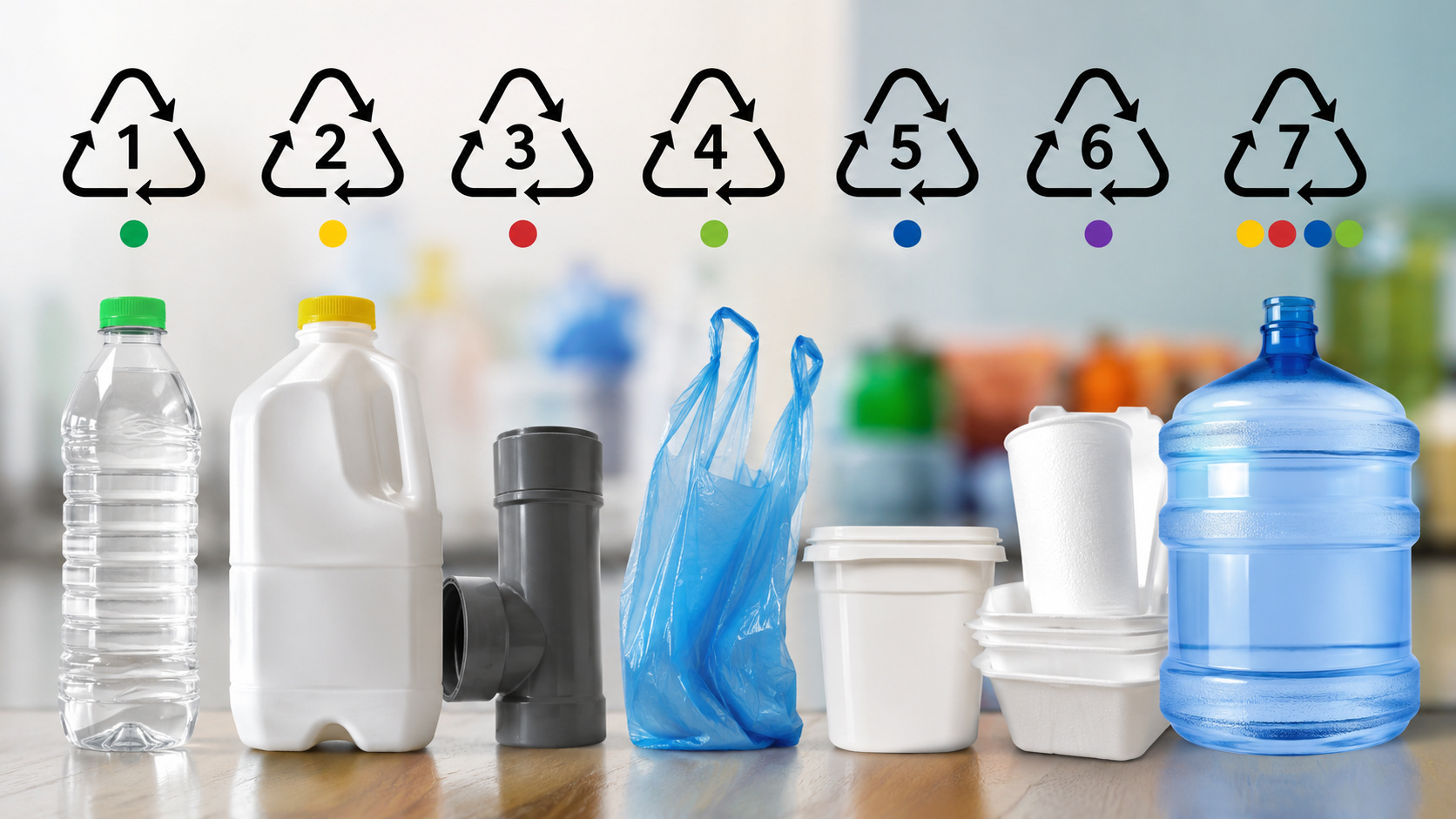
To organize disposal, the Society of the Plastics Industry established a technical list that divides polymers into seven commercial categories and helps map the types of plastic we consume every day:
- Code 1 (PET): Polyester very common in beverage bottles and food jars, ranking among the materials most accepted by collection systems;
- Code 2 (HDPE): Rigid resin used in milk, cosmetics, and cleaning product bottles, with a high reuse rate;
- Code 3 (PVC): Plastic found in construction pipes and fittings, whose complex recycling process prevents its acceptance in domestic collection;
- Code 4 (LDPE): Flexible film that makes up plastic bags and protective films, with conversion rates that vary depending on the region;
- Code 5 (PP): Heat-resistant polymer used in thermal containers and lids, whose destination depends on the sorting technology of each city.
The last two codes encompass the most complex structures in the market:
- Code 6 (PS): Polystyrene found in disposable cups and styrofoam, considered one of the least reusable materials due to high logistical costs;
- Code 7 (Other): Group that includes mixed plastics or special multilayer packaging, representing the greatest technical separation challenge.
The financial impact of plastic packaging in the circular economy
The act of separating waste at home directly impacts the financial health of the green chain. When the consumer correctly sorts by observing the plastic triangle, the time spent on cooperative conveyor belts decreases drastically. This reduces operating costs and increases the sale value of compacted bales.
This efficiency generates more income for autonomous collectors and ensures good quality raw materials for processing industries. When disposal is done in a mixed or negligent manner, tons of valuable resources are buried in landfills, causing economic losses and demanding more extraction of natural resources.
Simple habits to optimize recycling symbols at home
Integrating knowledge about recycling symbols into your routine requires only a few changes in attitude when handling waste at home. Taking small precautions before throwing an item in the trash accelerates the entire sustainable flow:
- Quick wash: Removing food residues and grease prevents the material from rotting in storage and spoiling other dry waste;
- Compaction: Crushing bottles saves physical space at home and in collection trucks, reducing transportation costs;
- Caps secured: Keeping caps (usually made of code 5) screwed onto bottles prevents these small pieces from getting lost in transit.
Paying attention to the characteristics of each resin helps consumers make more eco-friendly purchasing choices on the market shelf. Prioritizing the use of containers made with codes 1 and 2 directly supports brands that operate with already established reverse logistics systems in the country.
Transforming the future through conscious consumption and sorting
Understanding the real meaning of the numerical code on plastic packaging empowers us to act more assertively for the environment. Knowing that the icon only classifies the polymer transfers the responsibility to citizens to seek information about sanitation in their own region, adjusting disposal to what the city can process.
The mechanism of plastic recycling only works completely if there is mutual cooperation between consumers, collection systems, and industries. By mastering the functioning of types of plastic and their respective destinations, we transform a simple daily habit into a driving force to consolidate the circular economy, preserving nature and generating real value for the entire society.