Portuguese
  Spanish


The rise in copper, which reached nearly US$ 15,000 per ton at the beginning of 2026, placed automotive wiring at the center of a dispute over cost, weight, and efficiency. Ferrari, BMW, Tesla, and Chinese manufacturers are already testing or expanding aluminum cables in electrified cars, a move that could affect part of the global demand for copper until 2030
Copper has spent more than two centuries as the almost natural metal for electricity in automobiles. It conducts well, withstands heavy use, and has become a common part in harnesses, motors, batteries, inverters, and charging systems.
Now, the electrification of cars is forcing automakers to look at another material that has always been nearby but gained less space in this part of the vehicle.
The switch is not happening as a trend. It appears at a time of expensive copper, heavier electric cars, and tight margins, especially in China, where the price competition among EV manufacturers has become a daily pressure on engineering and purchasing.
-
Understanding Plastic Codes: Numbers 1 to 7 on Packaging Aid Efficient Recycling and Boost Circular Economy

-
Brazilian Researcher Unveils Innovative Intraocular Lens for Cataract Treatment with High-Precision Optics, Enhancing Vision at Multiple Distances and Reducing Unwanted Visual Effects
-
World’s Largest Particle Accelerator Begins Four-Year Hiatus for Magnet Overhaul, Aiming to Hunt Dark Matter by 2030
-
400 km² of Greenhouses in Almería, Spain, Astonish American Visitor by Producing Millions of Tons of Produce for Cold-Weather Markets




As reported by Notícias Automotivas, based on Reuters’ findings, Ferrari and BMW have expanded the use of aluminum cables in recent models, following a path already seen in Tesla and Chinese manufacturers. The estimate cited by JPMorgan is that this substitution could affect about 2% of the global demand for copper in 2026 and reach 6% by 2030.
Ferrari reduced wiring weight and BMW took aluminum to high and low voltage systems
Ferrari adopted aluminum cables in the hybrid sports car 296 and then extended the solution to other models, including the Luce, the brand’s first fully electric car. According to Reuters’ findings, the Italian automaker claims that the switch can reduce the total wiring weight by up to 20%.
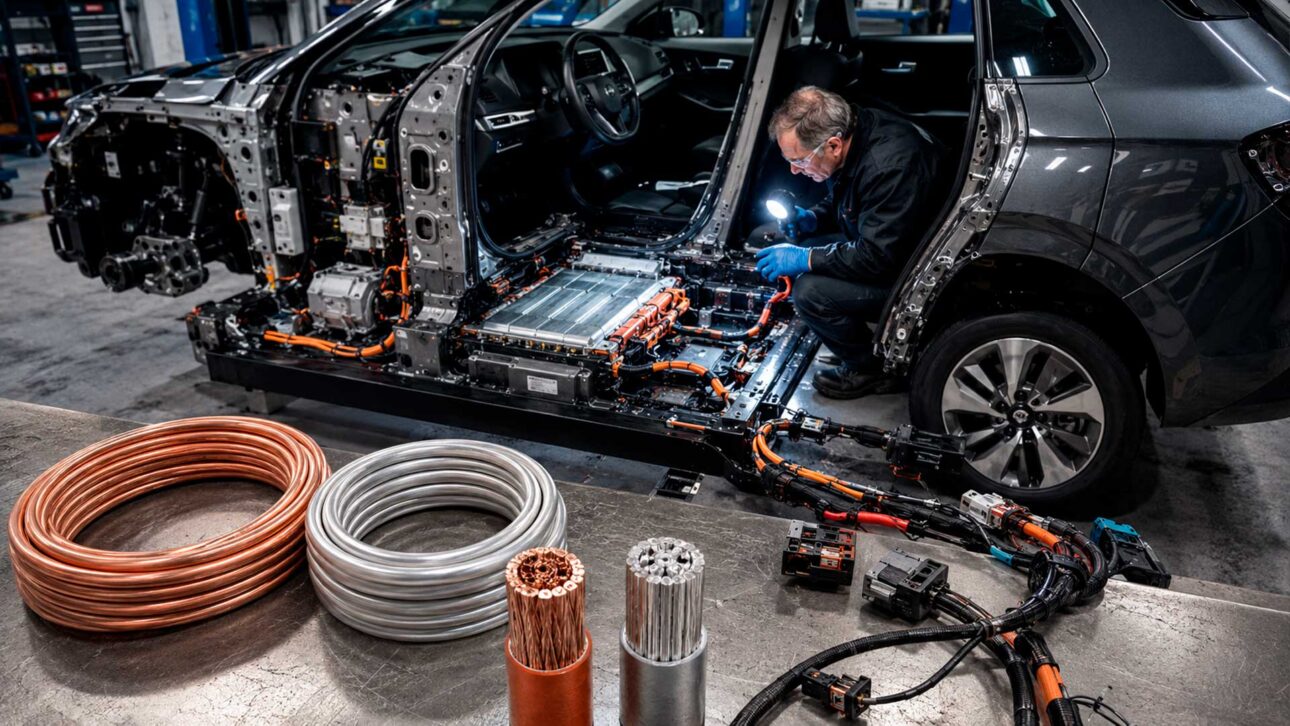
This economy seems small when viewed in isolation, but in an electric car every kilogram counts. Less weight can help with range, performance, and mass distribution, three sensitive points in vehicles with large batteries.
BMW has been using aluminum conductors since 2011, when it applied the material to the 1 Series. The German automaker expanded its use in hybrids and electric vehicles, including high and low voltage systems of the latest eDrive technology.
The change shows that aluminum is not just entering peripheral parts. It begins to occupy areas where copper once seemed difficult to replace, as long as the application allows compensating for the lower conductivity with the design, thickness, and layout of the cables.
Copper remains the best conductor, but the price has become a hard argument to ignore
Copper still has a clear technical advantage. The Copper Development Association states that the metal is used in electric motors, batteries, inverters, wiring, and charging stations because of its electrical conductivity, durability, malleability, and reliability. An electric car can use between 85 and 183 pounds of copper, equivalent to approximately 39 kg to 83 kg, depending on the model and architecture.
The problem is that the technical advantage now coexists with a much heavier price. In January 2026, a Reuters survey with analysts showed copper projections above $11,000 per ton and cited a previous surge to a record level above $14,000, driven by speculative buying and disruptions in mines, such as Grasberg in Indonesia.
In this scenario, aluminum gains ground for three direct reasons. It is cheaper, lighter, and can deliver sufficient performance in part of the systems, even requiring more material to conduct the same electrical current.
The economic equation has changed. According to Reuters, aluminum has about 61% of the conductivity of copper, but costs approximately a quarter of the price and weighs less. The substitution begins to make sense when copper exceeds 3.5 times the price of aluminum, and this ratio reached about 4.3 at the beginning of 2026.
China accelerates the switch because cheap electric cars need to cut grams and dollars
China appears as one of the centers of this shift. Manufacturers like AVATR, XPeng, and Xiaomi were cited among the brands already using aluminum wiring in electric vehicles, while local suppliers increase the share of products made with the metal.
The cost pressure explains part of the movement. In the world’s largest EV market, reducing a few dollars per unit can weigh when production scales to hundreds of thousands of cars. At the same time, cutting weight helps preserve range without increasing the battery, one of the most expensive parts of the vehicle.
The International Energy Agency reported that global sales of electric cars surpassed 20 million units in 2025, accounting for a quarter of new cars sold worldwide. For 2026, the entity projected 23 million units, close to 30% of global sales.
This volume explains why a change hidden within the electrical harness matters to the metals market. When millions of vehicles replace part of the copper with aluminum, the decision ceases to be an engineering detail and becomes a variable for mining companies, cable suppliers, automakers, and commodity buyers.
Aluminum advances, but it should not oust copper from electric cars
The substitution has limits. Aluminum conducts less electricity, requires well-designed connections, and may demand a larger physical volume in some applications. In high-demand systems, copper still tends to remain the safer choice.
There is also the environmental factor. Producing aluminum consumes a lot of energy, which can increase emissions when the electricity comes from fossil sources. Therefore, the weight and cost savings alone do not resolve the sustainability discussion.
Even so, the path seems open for selective substitutions. Cables, busbars, air conditioning components, and parts of electrical systems can migrate to aluminum where engineering can balance cost, mass, safety, and efficiency.
The likely result is not the end of copper in cars. It is a more calculated division. Copper stays where its conductivity pays off. Aluminum comes in where the lower weight and price help deliver a more competitive electric car.
This change shows how electrification affects not only the engine or the battery but also materials that go unnoticed by the driver. Do you think replacing copper with aluminum in electric cars is a smart solution or a cost-saving measure that could pose technical risks in the future? Leave your opinion in the comments.