Portuguese
  Spanish




Netherlands Uses Bamboo, Willow, and Geotextiles to Slow Rivers, Capture Sediments, and Create Islands in the Room for the River Project.
How is it possible to “build islands” just by slowing down water? And why does a high-tech country known for dikes, giant ports, and mobile barriers against the sea decide to use bamboo, willow, and geotextiles — seemingly simple materials — to solve a continental-scale problem? The answer involves sediment science, flood management, ecological restoration, and the design philosophy that transformed Room for the River, a Dutch government program run by Rijkswaterstaat (the national water infrastructure agency), into one of the most studied cases of adaptive river engineering on the planet.
Where It All Begins: Rivers That Became Too Narrow
The Netherlands is traversed by a river system that includes parts of the Rhine, Meuse (Maas), Scheldt, and their tributaries. For centuries, to protect cities and villages from flooding, the Dutch narrowed and confined the rivers with dikes, hard banks, and rectifications.

This approach worked fairly well until the end of the 20th century when increasingly extreme flooding events began to strain the system, particularly the floods of 1993 and 1995, which necessitated evacuations and made it clear that the model of simply “containing and constricting the river” had reached its limit.
-
The Trap of Modern Technology: How Screen Overload and Digital Connections Can Impact Your Mental Health and Well-being

-
Wyoming Couple Grows Tropical Fruits Year-Round in -40°C Using Geothermal Greenhouse, Demonstrating Earth’s Heat Can Produce Oranges and Lemons in Snow Without Traditional Heating

-
Ship Returns from Brazilian Coast with Thirty Newly Discovered Life Forms
-
Nigerian Professor Invents Electricity-Free Refrigerator Using Clay Pots and Wet Sand, Extending Shelf Life of Vegetables to 27 Days; 7,000 Units Distributed in Energy-Deprived Villages


The Dutch government, with strong technical support from Rijkswaterstaat, then decided to change the paradigm: instead of fighting the river, it was necessary to give more space to the river, allowing it to expand temporarily during flooding events. Thus, Room for the River was born, approved in the 2000s with projects spread throughout the following decade.
How Bamboo, Willow, and Geotextiles Enter the Story
This program includes dozens of interventions — widening riverbeds, relocating dikes, creating secondary channels, removing barriers, and controlled excavations — but one of the techniques that garnered attention in ecological and geomorphological research centers was the installation of bamboo mats, willow branches, and porous geotextiles within the riverbeds.
These mats function as microstructures for flow deceleration. When water encounters these elements, it loses velocity, turbulence, and shear energy.
With the reduced speed, the water starts to release sediments that were previously carried downstream, mainly silt and fine sand, which are very abundant in the Rhine-Meuse system.
Over time, this accumulation gives rise to sandbanks, which, with new deposits and pioneering vegetation, begin to stabilize and transform into shallow river islands, also called sand bars or mid-channel bars.
Why Use Willow and Bamboo?
The material was not chosen by chance:
• Willow (Salix spp.) is native to Central Europe and has extremely high rooting rates, allowing branches embedded in the mud to sprout and create natural bioengineering, capable of stabilizing banks and margins.
• Bamboo has high mechanical strength, excellent bending properties, and can withstand prolonged contact with flowing water without breaking.
• Geotextiles offer controlled porosity, allowing for reduced flow without completely blocking the bed.
The result is a type of “hydraulic ecological trench” that does not harden the river, does not channelize, does not seal, and does not destroy habitat — unlike what happens when using riprap, concrete walls, or gabions.
What Changes in Hydrodynamics
The science behind this is well known: rivers transport their sediments because water has the speed and energy to do so. If you reduce the speed, you reduce the transport capacity. Where capacity drops, the river deposits.
In studies conducted by Dutch and European institutes of geomorphology and river hydraulics, the following has been recorded:
• Localized reduction of water speed, especially between 20 and 60 centimeters/second.
• Capture of fine sediments, which can accumulate dozens of centimeters per year in favorable areas.
• Change in the cross-profile, with the emergence of submerged bars that surface during dry periods.
These initial bars are the seeds of future shallow islands, which play an important ecological role.
Islands That Change Habitat and Water Management Policy
While classic cemented barriers create deep, fast rivers that are biologically poor, shallow islands created by sedimentation offer:
• Slow waters for juvenile fish,
• feeding zones for birds,
• substrate for pioneering plants,
• persistence of micro-habitats,
• hydraulic heterogeneity that increases biodiversity.
The most interesting thing is that these islands are not the final goal, but rather a means to achieve a hydraulic end: when the flood comes, the water uses these areas as expansion space, relieving the pressure on cities and dikes.
In other words: biodiversity and urban safety go hand in hand.
Where This Is Being Applied
Although the details vary, interventions of this kind have been documented in locations such as:
• Waal River (Rhine) — one of the most critical corridors for cargo and navigation.
• IJssel — playing a strong role as a distribution route for water and sediments.
• Limburg/Meuse — with a history of severe flooding.
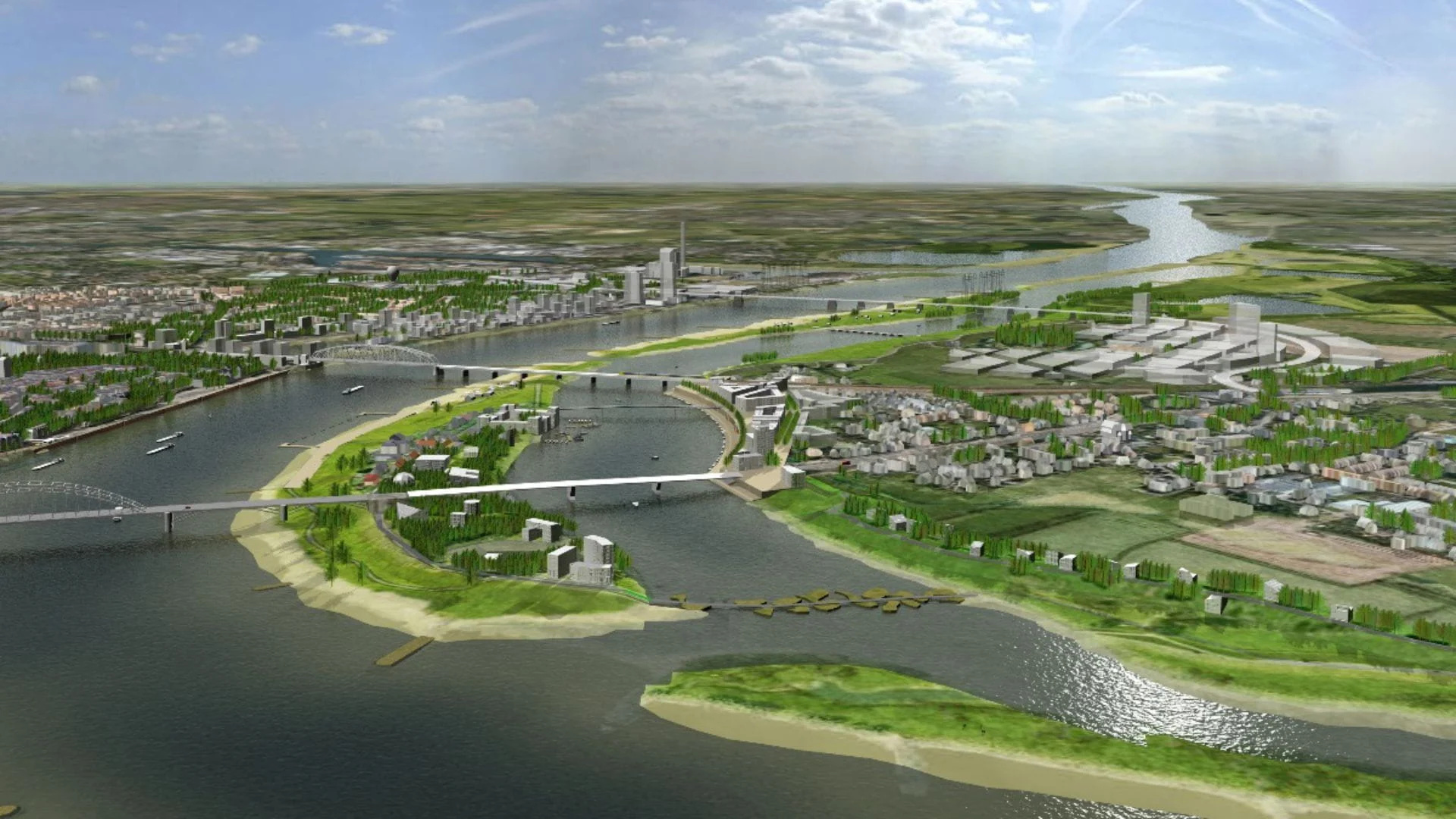
• Relocated floodplain areas near Nijmegen and Millingen.
The technique does not appear in isolation: it combines with:
• removal of rigid walls,
• lowering of banks,
• creation of secondary channels,
• lowering of existing islands,
• moving dikes further from the river.
Geomorphology researchers from Germany, Belgium, the United Kingdom, the United States, and Japan study the Dutch model to see if it can be adapted to their own densely populated river contexts.
The Economic-Political Side: Less Concrete, More System
The logic that dominates Room for the River is one of systemic optimization, not localized solutions. Instead of spending billions on walls, pumps, and sluices that solve one stretch and create problems elsewhere — the Dutch invest in watershed solutions, which include:
• relocation of farms,
• acquisition of land,
• changes in land use,
• controlled flooding plans,
• softening of banks.
Bamboo, willow, and geotextile are just one piece of the puzzle — but a piece that synthesizes the central philosophy: sometimes the best dam is the river itself working at a slower speed.
It may seem unlikely that one of the most technologically advanced nations in the world in hydraulics, capable of erecting colossal movable barriers against the North Sea, operating the largest ports in Europe, and reclaiming land from the ocean is using plants and geotextiles to build islands.
But this is precisely why the Dutch case has begun to influence global public policies: it demonstrates that extreme engineering is not limited to extreme concrete, and that sediments can be allies, not enemies, when the river is given space and time to work.
In the end, what the Netherlands is doing is not just preventing floods, but redrawing the relationship between society and rivers, trading absolute control for smart control, and rigidity for ecological resilience — an idea gaining traction in countries that have also discovered that “containing” to the limit, sooner or later, comes with a cost.