






 Portuguese
  Spanish


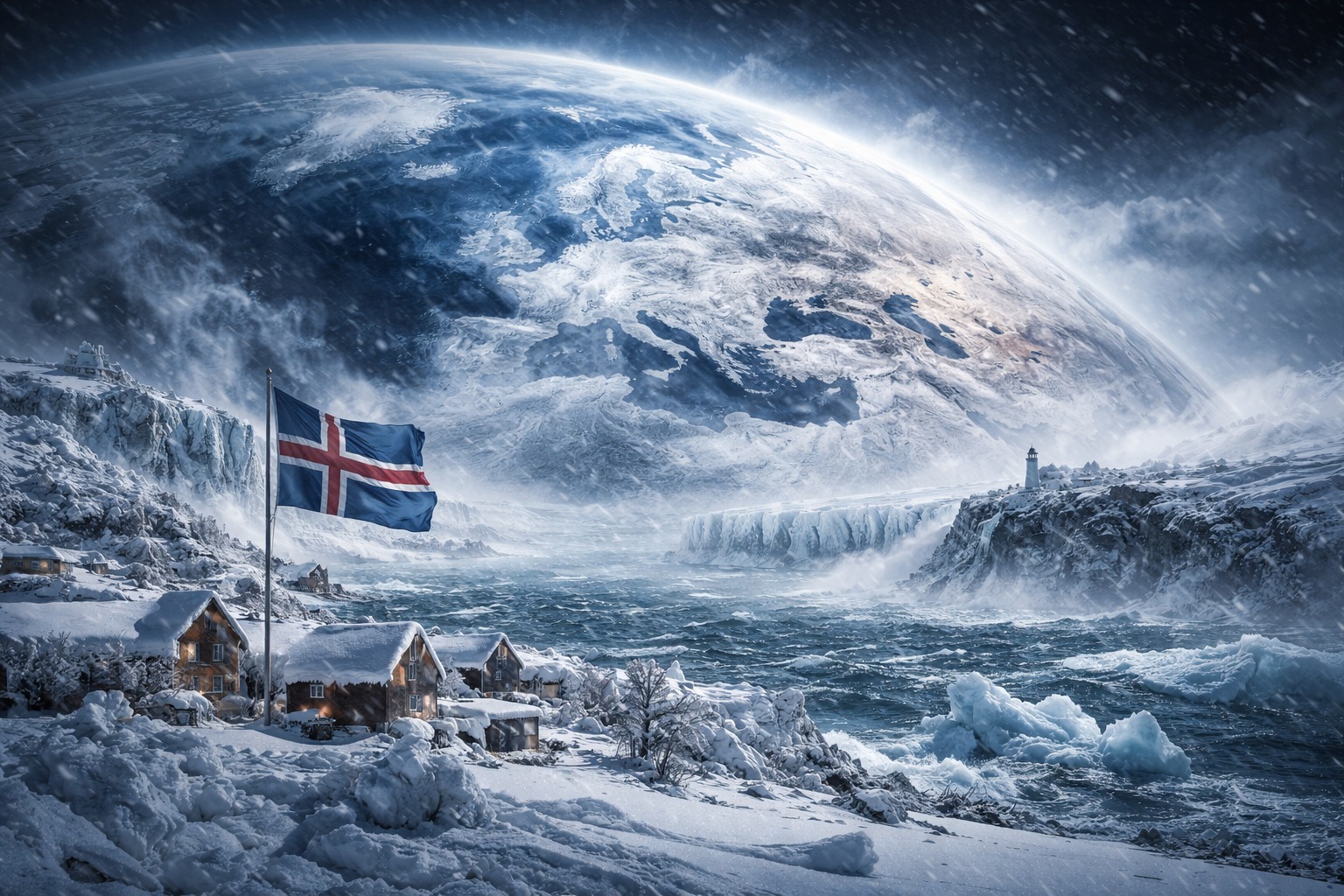


Classification of AMOC Collapse as a National Security Risk Raises Alert in Iceland, Given Projections of Current Weakening and Severe Climate Impact in the Coming Decades
The Iceland has placed the possibility of AMOC collapse at the center of its national security strategy, a system that transports heat across the Atlantic. Models indicate that, if a rupture occurs in the coming decades, the country could face winters of up to -45°C and sea ice around the island.
AMOC: The Climate Engine That Sustains Northern Europe
The Atlantic Meridional Overturning Circulation, known as AMOC, functions as a conveyor of heat that carries warm waters from the tropics to the North Atlantic.
As these waters lose heat to the atmosphere, they become denser, sink, and return at depth to lower latitudes, maintaining an active cycle for about 10,000 years.
-
Largest Known Single-Piece Meteorite, Weighing 60 Tons, Puzzles Scientists with Its Intact Fall and Lack of Visible Crater

-
Oceanographer Turns Abandoned Fishing Nets from Brazilian Waters into Bags, Creating Jobs and Earning Over $7,000 Monthly

-
Australia deploys poisoned sausages and uses traps, shooting, and fences in a battle against invasive cats that kill over 1.5 billion native animals annually, threatening more than 200 species.

-
NASA Rover Captures “Tired Face” on Mars, Highlighting Human Brain’s Tendency to See Faces in Rock Formations




This mechanism is crucial for climate balance. It helps keep Northern Europe relatively mild, even at high latitudes.
Without this central oceanic heating, Reykjavik, located at the 64ºN parallel, would have a climate similar to that of nearly uninhabited areas of Canada.
Beyond Europe, AMOC influences the monsoons in West Africa and South Asia, interferes with rainfall patterns in the Amazon, and impacts global agricultural productivity.
Therefore, the weakening of AMOC is not viewed merely as a regional phenomenon, but as a factor with potential cascading effects on food chains, extreme events, and geopolitical stability.
Growing Risk and Scientific Divergences About the Future of AMOC
In 2021, the Intergovernmental Panel on Climate Change classified a collapse of AMOC before 2100 as “very unlikely.”
However, more recent research has broadened the debate. A study published in 2024 analyzed nine climate models under high-emission scenarios.
In all, AMOC weakened significantly and was ultimately interrupted in the long term.
Even in scenarios compatible with the targets of the Paris Agreement, the authors estimated up to a 25% chance of collapse.
Oceanographer Stefan Rahmstorf, recognized as one of the leading experts on the topic, stated that the risk has been underestimated for years and warned of the possibility of the system reaching a point of no return in the coming decades.
Other researchers, on the other hand, urge caution. Recent studies indicate that stabilization mechanisms may make AMOC more resilient than previously believed.
Nonetheless, there is a consensus that circulation has been weakening since the mid-20th century, according to observational data compiled by institutions such as NOAA and the UK Met Office.
Direct Impacts for Iceland and the Role of Global Warming
The main factor for AMOC instability is the accelerated warming of the planet. The melting of Greenland releases large volumes of fresh water into the North Atlantic, altering salinity and density, essential elements for the current’s functioning.
Simultaneously, rising atmospheric temperatures reduce heat exchange between the ocean and air, hindering the process that drives the sinking of cold, salty waters.
If AMOC collapses, the planet would continue to warm on average, but parts of Europe could experience abrupt cooling.
Climate models indicate that Iceland could see winters nearing -45°C, along with the possibility of sea ice formation around the island, something that has not occurred since the beginning of human occupation in the territory.
With around 400,000 inhabitants, Iceland relies heavily on fishing and relatively stable climatic conditions. Intense cooling could jeopardize agriculture, infrastructure, and the very habitability itself.
In light of this scenario, the Icelandic government has officially classified the collapse of AMOC as a national security threat and stated that it will incorporate the risk into its planning by 2028.
In public debate, proposals have emerged for investments in geoengineering, including techniques to reflect some solar radiation and artificially reduce global temperatures. The idea divides the scientific community and faces political resistance.
Experts warn that ignoring early signs may be the greatest danger. Halldór Björnsson, a researcher at the Icelandic Meteorological Office, stated that when there is absolute certainty that AMOC has collapsed, it will likely be too late.
In a world pressured by record heat waves, prolonged droughts, and devastating floods, the possibility of crossing a tipping point amplifies global concern and reinforces the alert around AMOC as a strategic and climate factor of utmost importance.
With information from Veja.



Doesnt Iceland have more than 400 inhabitants?
The original, in Portuguese, says 400,000. Their translation software doesn’t understand numbers. I often see mistakes like this.
It would be very nice