






 Portuguese
  Spanish


European Companies Announce Strategic Alliance to Accelerate the Use of Artificial Intelligence in Naval Defense and Submarine Surveillance
Helsing, Blue Ocean Marine Tech Systems, Ocean Infinity, and QinetiQ announced a new partnership focused on the use of artificial intelligence and autonomous technologies for maritime operations. The goal is to accelerate the digitalization of the oceans, enhance maritime surveillance, and protect vessels and critical underwater infrastructure.
The initiative was announced on April 29. The four companies are working together to enhance maritime defense capabilities with a focus on security and rapid response. The central idea is to develop and deliver sovereign, scalable, and autonomous solutions.
The group acknowledges that there are persistent and emerging underwater threats in the Euro-Atlantic space. Among the most enduring risks are the elevated levels of underwater activity from potential adversaries.
-
North Korean Fiasco: Launch of the Largest Warship Ends in Sinking

-
While giant ships still burn heavy fuel and the maritime sector races against climate targets, Maersk and Vale are starting to bet on ethanol as a new route to reduce emissions at sea.

-
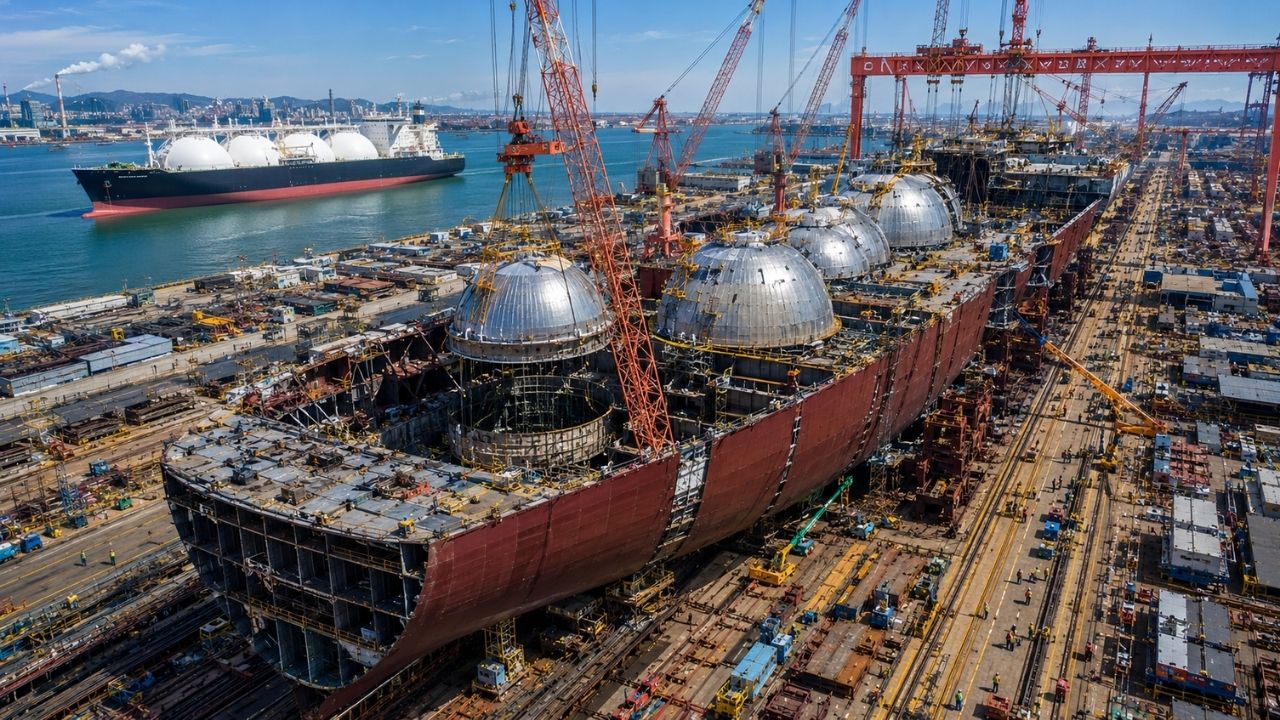
China begins construction of the world’s largest LNG ship, a 344-meter giant capable of supplying 4.7 million homes for a month, carrying 271,000 m³ of gas, and placing QatarEnergy in the largest naval order ever recorded in world history.
-
China is designing a container ship with a thorium nuclear reactor that will operate for 40 years without refueling, and the 25,000-container giant from Jiangnan Shipyard will cross oceans without emitting carbon in an industry that burns 300 million tons of fuel per year.



This reinforces the importance of a more efficient anti-submarine warfare. Emerging threats involve risks to critical underwater infrastructure, particularly in the Norwegian Sea and the Baltic Sea, with incidents recorded since 2021.
Technology to Respond to Risks
The companies believe that combating these threats requires reinforcement in intelligence, surveillance, and reconnaissance.
To achieve this, it will be necessary to integrate AI and autonomous systems with other maritime platforms, sensors, and equipment. The focus is to generate the necessary volume of data and response actions more quickly.
Helsing operates with AI-based defense. Blue Ocean Marine Tech Systems provides autonomous data collection systems.
Ocean Infinity brings its experience with robotic vehicles, unmanned surface vessels, and autonomous underwater vehicles. QinetiQ contributes with system integration and technological testing.
Current Use and Prospects
NATO navies are already using artificial intelligence solutions to address demands for surveillance, defense, and underwater security. Therefore, according to Amelia Gould, general manager of Helsing Maritime, the new partnership brings real value by consolidating knowledge and accelerating practical solutions.
For Gould, the differentiator lies in developing an AI designed from the ground up for military use. This approach includes data assurance, clear explanations, and constant adaptation to operational contexts. “It’s not just an AI ‘once and done’: it’s an AI that learns and adapts continuously,” she said.
She highlighted that the lessons learned from the war between Russia and Ukraine demonstrate the importance of iterating AI rapidly. The partnership, she said, brings together the right partners to integrate systems in the right contexts.
Practical Results Already Underway
Gould revealed that the companies are already working together on practical applications. According to her, the collaboration is more efficient than each trying to develop everything alone. The expectation is to deliver concrete results for the navies within a year.
The group’s proposal is to develop capabilities that address different situations, such as combating underwater threats, protecting infrastructure, and surveilling large areas. “We are very focused on being a mission-driven partnership,” Gould stated.
According to her, the joint effort also allows for identifying new solutions that no single company would have thought of alone. The diversity of thought and capabilities will be used to solve the current problems of the navies.
Broader Coverage with Smart Technology
The partnership is not limited to creating new autonomous equipment. The focus is also on the intelligent use of software to expand the reach of existing platforms. The combination of lightweight hardware and powerful software is central to the action plan.
For Gould, the key to scaling up is to think differently. One of the focuses is to make hardware simple and quick to produce. Complexity will be concentrated in the software, which can be rapidly replicated and adapted as necessary.
The other critical part involves so-called “smart resources,” which allow platforms to fulfill their missions autonomously. This layer of intelligence is what will provide the flexibility to deploy solutions in large numbers.
Use of Manned Platforms at Specific Times
Gould emphasized that the “smart mass” offered by autonomous platforms enables better choices about when to use manned assets. Since manned equipment has slower production rates and higher costs, they should be used at the right moments.
In contrast, autonomous platforms can be produced and deployed in larger volumes. This opens up room for strategic decisions and greater freedom of action.
Partners expect to announce new phases soon. They intend to begin deploying the new capabilities later this year.
The partnership aims to deliver operational capabilities based on artificial intelligence and autonomy within a year, reinforcing maritime security in high-risk areas like the Norwegian and Baltic Seas.
With information from Naval News.



Be the first to react!