Portuguese
  Spanish


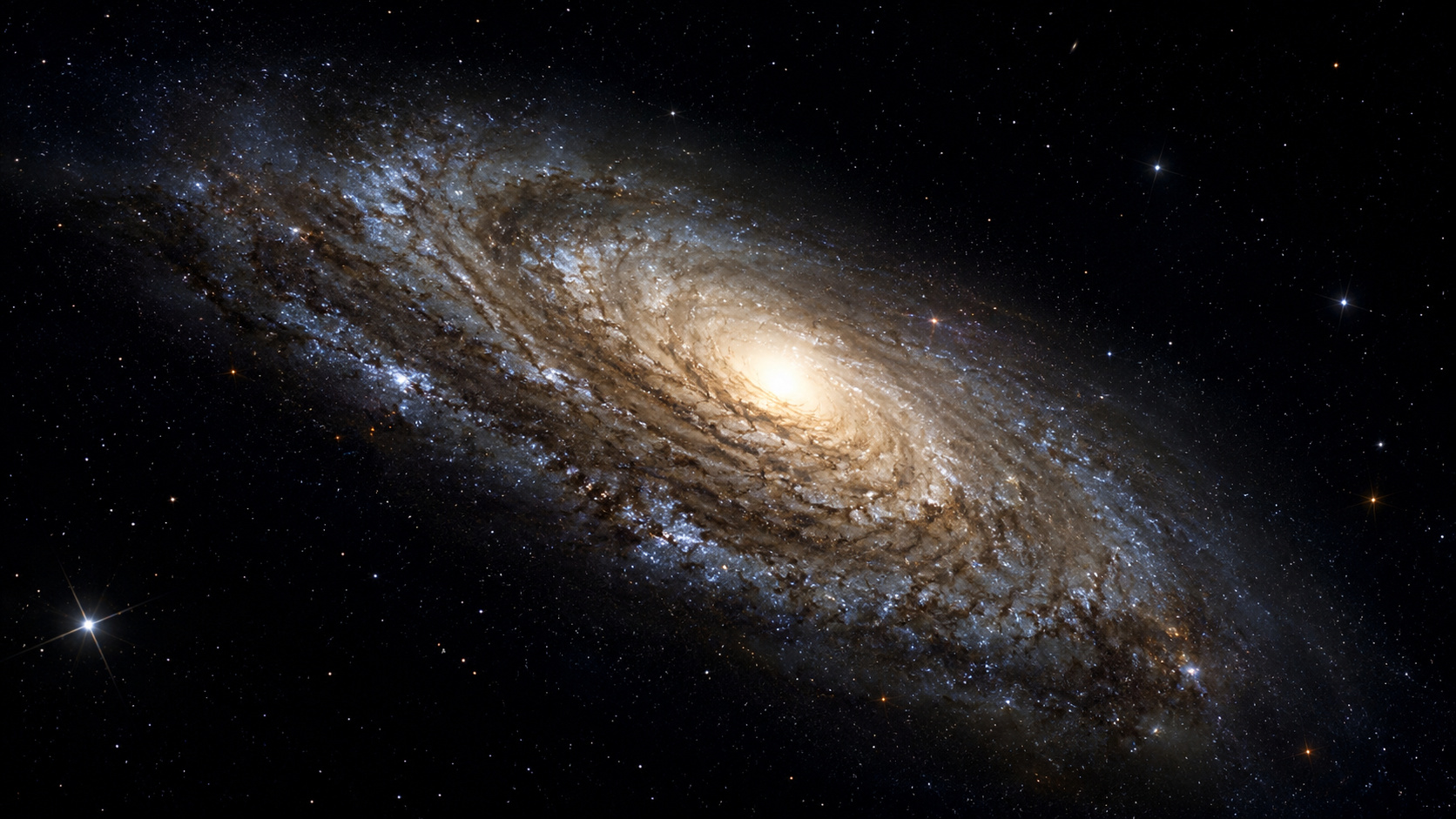

Astronomers identified neutral gas in four galaxies of the primitive universe, observed between 700 million and 800 million years after the Big Bang.
An astronomical discovery considered unprecedented was announced by an international team led by Chiba University in Japan.
Researchers identified, for the first time directly, neutral gas associated with star formation in very ancient galaxies.
The detection occurred in four galaxies observed between 700 million and 800 million years after the Big Bang, an essential phase to understand the early evolution of the universe.
-
Iraq floats and sinks under an arm of the Euphrates 10 giant concrete boxes of 46,000 tons and 125 meters each to assemble a 2.4 km submerged tunnel and open a new land route between Asia and Europe.

-
Scientists use more than 20,000 artificial birds and solar speakers to “trick” seabirds, reactivate nesting routes, and revive a colony on an island that seemed abandoned.

-
She spent 73 years breathing inside an iron lung, survived the aftereffects of polio, and became the last woman in the United States dependent on the equipment before dying at 78 years old.
-
Brazilian students created a $1 filter using pine bark, cotton, and 3D-printed parts to clean cassava wastewater, reduce the toxicity of a hazardous waste, and transform contaminated water into biofertilizer.




The results were published on June 15, 2026, in the scientific journal The Astrophysical Journal.
The observations were made with the ALMA radio telescope, installed in Chile, and complemented with data from the James Webb Space Telescope.
Discovery reveals essential fuel for new stars
Neutral gas is considered one of the main ingredients for the birth of new stars.
Its presence indicates regions where matter can concentrate and give rise to new stellar systems.
The detection of this type of gas in such distant galaxies has always been a challenge for astronomers.
The new research, therefore, represents an important advancement in understanding how the first galaxies began to form stars.
How scientists identified the neutral gas
The researchers analyzed emissions produced by oxygen and carbon atoms present in the four studied galaxies.
The comparison of these signals allowed separating the origin of the emissions recorded by the instruments.
The team concluded that a significant portion of the observed material was concentrated in regions of neutral gas.
These regions are considered important because they can gather the necessary conditions to fuel star formation.

ALMA played a decisive role in observation
The radio telescope ALMA was fundamental for the identification of star-forming gas.
The equipment allowed for more precise mapping of this material in a very remote phase of cosmic history.
The four galaxies analyzed are seen as examples of common systems responsible for intense star formation in the early universe.
The research helps to understand how ancient structures evolved shortly after the Big Bang.
James Webb helped expand the analysis
The data from the James Webb Space Telescope were used to complement the reading made by ALMA.
The combination of information allowed for a better characterization of the physical and chemical conditions of the observed galaxies.
According to Yoshinobu Fudamoto, assistant professor at Chiba University and study coordinator, this is the most distant direct record of this type in common galaxies of the early universe.
The researcher highlighted the importance of the ionized carbon spectral line, known as [C II], for studying neutral gas in ancient periods of cosmic history.
Data indicate compact and dense regions
The emissions of oxygen and carbon were also used to model the properties of the gas found.
The results indicated high densities, similar to those observed in galaxies with intense star formation.
The radiation field detected, however, was less intense than that found in extremely active systems.
This combination suggests the existence of compact, dense, and matter-rich regions.
These areas may have gathered the necessary conditions to generate new stars in the primitive universe.
Oxygen line gains prominence in astronomy
For Akio K. Inoue, from the Research Institute for Science and Engineering at Waseda University, the oxygen spectral line takes on an important role.
This line can help scientists investigate a component of the universe that remained difficult to observe.
The discovery reinforces the combined use of different chemical signals to understand ancient galaxies.
This method can expand the knowledge about the gas that fueled star formation in the first moments after the Big Bang.
Upcoming studies should analyze more galaxies
The researchers intend to increase the number of galaxies analyzed in the next stages of the research.
The goal is to build a more complete picture of the formation and evolution of these structures in the early universe.
The study shows how ALMA and James Webb can reveal details of a little-known phase of cosmic history.
The discovery also paves the way for new investigations into the role of neutral gas in the origin of the first stars.
Astronomy thus gains an important tool to understand how ancient galaxies began to transform matter into light.
What do you think this discovery can reveal about the origin of the first stars and galaxies? Share your opinion!