Portuguese
  Spanish


Certisign was born in 1996 protecting websites, has already issued 18 million digital certificates, and now invests R$ 15 million to verify if the person on the other side of the camera is a real human being
Certisign, a company that was born in 1996 selling security certificates for websites when the Brazilian internet was in its infancy, celebrates 30 years trying to reposition itself in a much broader market, that of digital trust, according to Exame, in a report from July 8. The company earned R$ 320 million in 2025 and aims for R$ 350 million this year. “Today, our main strength is identification. What we sell is trust,” says Marco Americo Deneszczuk Antonio, the company’s CEO, in the interview.
The ground for this business has never been so fertile, and for a bad reason: the percentage of Brazilians who suffered scams or attempted scams rose from 33% in September 2024 to 38% in March 2025, and banks invested about R$ 5 billion in security and fraud prevention last year, according to Febraban, in the Radar Febraban survey. The enemy of the moment has a name: deepfake.
The “epidemic” of scams: cloned card, WhatsApp, fake center, and PIX
The x-ray of the problem is in the bank federation’s survey. Among the most common scams pointed out by Brazilians, credit card cloning or card swapping leads with 40%, followed by the scam of someone posing as a known person asking for money on WhatsApp, with 28%, the fake center, with 26%, and the PIX scam, with 16%, according to Febraban. The survey, conducted between March 19 and 21, 2025, with 2,000 people in the five regions of the country, also shows that the biggest victims are men, with 44%, people aged 60 or over, with 42%, and those with higher education, with 41%.
-
Brazil’s North-South Railway to Auction Two Grain Terminals in Central Tocantins

-
Trump’s 25% Tariff Threatens Brazilian Products: WEG, Portobello, and Schaefer Lobby in the U.S. to Protect Exports and Jobs from Chinese Competition

-
Former Mastercard VP Launches “Tinder” for Small Businesses, Aiming for 6,000 Deals Worth $420 Million by 2027

-
“MasterChef” Judge Expands Handcrafted Empanada Chain to 46 Stores, Aiming for $20 Million in Franchise Revenue


“Scams and frauds, in commerce and financial and banking transactions, have become a national epidemic and digital crime is not restricted to banks alone,” says Isaac Sidney, president of Febraban, in the survey material. An interesting fact from the same survey: almost 7 out of 10 respondents, 69%, recall receiving alerts from banks or other entities against scams.
From the browser lock to e-CPF: the company that helped the internet be born secure
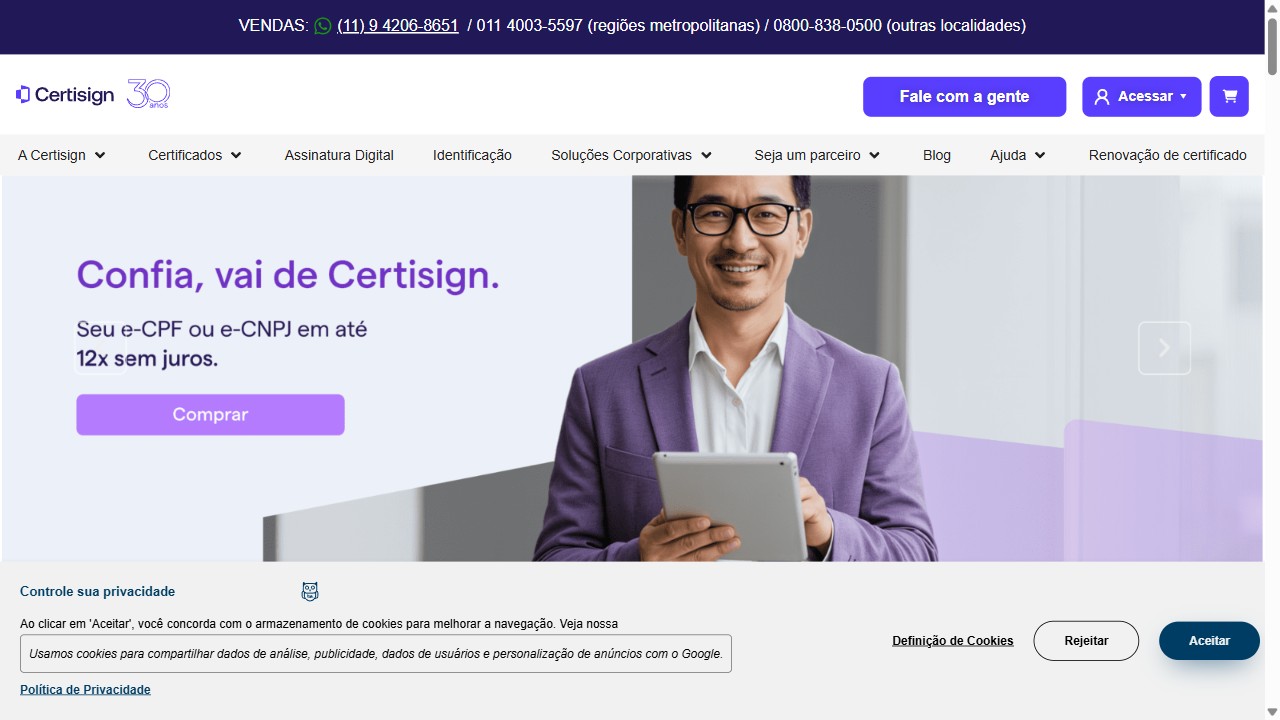
Certisign started with SSL certificates, a technology that encrypts the connection between the browser and a website, the feature that helped make internet banking and online shopping possible, according to Exame. In 2001, with the creation of the Brazilian Public Key Infrastructure, ICP-Brasil, the company began issuing digital certificates like e-CPF and e-CNPJ, electronic documents that prove the identity of a person or company in digital transactions, and today has issued more than 18 million certificates and has about 400 employees, according to Exame.
The CEO has a ready image to explain the product. “I always say that the digital certificate is like an electronic pen. And inside this pen, the ink is your identity,” says Marco to Exame. Today the company operates in three areas: digital certificates, electronic signatures, and biometric identification, the most strategic in the face of fraud with artificial intelligence.
How to block a deepfake: the three-dimensional proof of life
The explosion of digital scams, according to Exame, is linked by the executive to the digitalization of life. “Today, you practically have everything you need on your phone. You order food, transportation, have documents, make transactions in the financial market, buy tickets. Your life is basically all within the phone,” he states to Exame. To reduce the risk, Certisign uses facial biometrics, comparison with databases, and a technology called liveness 3D, the three-dimensional proof of life, which verifies if there is a real person on the other side of the camera, and not an image, recording, or avatar created by artificial intelligence, according to Exame.
“The liveness 3D identifies if the person on the other side of the camera is a human being or not. Then, we take the biometric vectors of the face and compare them with databases to understand if the person is themselves,” explains the executive in the report. The technology is used in the issuance of certificates and in processes like opening bank accounts, where biometric checking reduces fraud attempts when new clients are onboarded.
R$ 15 million in technology and validation that dropped from 30 to 10 minutes
The growth plan has earmarked investment. Certisign is investing R$ 15 million in technology this year, with a significant portion allocated to Validator 3.0, a platform that modernized the issuance of digital certificates and reduced the process from about half an hour to approximately 10 minutes, a reduction of over 40% in the average service time, according to Exame.
The issuance of a certificate requires a sort of validation ceremony: the client presents documents, undergoes facial biometrics, and in some in-person cases, fingerprint collection, in addition to document analysis to verify if the papers are genuine. “This project is to ensure that the interaction between the registration agent and the end-user is done at a much faster speed,” says Marco to Exame.
The “irrefutable” signature that shifts the burden of proof
Another branch of the business is the digital signature platform, launched between 2012 and 2013. More than 500 million documents have already been formalized on Certisign’s platform, and the differentiator is the qualified signature, made with the ICP-Brasil digital certificate, the type with the highest degree of presumption of authenticity among the three provided in Brazil, according to Exame.
Marco summarizes the legal weight of the modality in one sentence: “It is irrefutable. You cannot question that the document was signed by yourself. The burden of proof is reversed,” he tells Exame. In practice, those who sign with a qualified certificate cannot later claim they were not the author, a valuable protection in high-value contracts in an era of increasingly sophisticated digital scams.
The CEO who came from the rival: “the company to beat by DocuSign was Certisign”
The leader of the turnaround knows the opponent from the inside. Marco joined Certisign in April 2023, holds a degree in electronic engineering from Mauá, has 35 years of career with stints at Xerox, Alcatel, Diveo, and DocuSign, participated in the arrival of major commercial data centers in Brazil in the early 2000s, and helped build DocuSign’s operation in Latin America, precisely a competitor of Certisign, according to Exame.
“At that time, the company to be beaten by DocuSign was Certisign,” he says in the interview. Now on the other side of the table, the executive leads the reinvention: the company has shifted from positioning itself solely as a certifying authority to presenting itself as a technology and trust services company.
The next frontier: giving identity even to artificial intelligence robots
The future of the business may include clients that are not human. Certisign is beginning to evaluate the identification of artificial intelligence agents, issuing digital certificates that state who each robot belongs to, whom it serves, and what level of delegation it has, according to Exame. “It’s a solution for non-human identification of AI agents,” explains the CEO in the report.
The underlying bet, noted by Exame, is that the more digital the economy becomes, the greater the demand for mechanisms that prove who is on the other side of the screen. Here’s an observation from this editorial, duly noted: in a country where scams have become routine for almost 4 out of 10 people, selling trust has ceased to be a niche service and has become basic infrastructure, like electricity and water.
From website protection in 1996 to hunting deepfakes in 2026, Certisign has traversed all eras of the Brazilian internet charging for the same invisible product: the certainty that you are you.
Tell us in the comments: have you ever fallen or almost fallen for a digital scam, and do you trust facial biometrics to protect your money?