Portuguese
  Spanish


Mary Mizuno founded SoM&A, the platform that uses artificial intelligence to connect buyers and sellers of companies with revenue below R$ 50 million, a universe of 18.8 million CNPJs which she evaluates as a potential market of R$ 94 billion per year
After more than three decades in banks and payment companies, executive Mary Mizuno founded SoM&A, a platform that aims to transform the buying and selling of small and medium-sized enterprises into a process similar to a dating app, according to Exame, in a report from July 8. On SoM&A, buyers and sellers create profiles, and artificial intelligence crosses dozens of criteria to suggest the pairs with the best chance of closing a deal, digitizing practically the entire journey of a mergers and acquisitions operation, from valuation to contract signing.
The target is a little-explored ocean: Brazil gathers 25.9 million CNPJs classified as small and medium-sized enterprises, about 97% of the country’s companies, with 52% of formal jobs and approximately 30% of GDP, and 18.8 million of them have revenues of less than R$ 50 million per year, precisely the audience chosen by the startup, according to Exame. The detail that draws attention is the entry price: equivalent to 1 minimum wage per year.
From Credicard to the top of cards: the entire career before the turn
Mizuno’s trajectory passed through the biggest names in plastic money. She was the first executive promoted from Credicard to Citi, led the marketing area of Santander, took over the payment methods operation after the integration with Banespa, and ended the corporate phase as vice president of Mastercard for South America, according to Exame.
-
“MasterChef” Judge Expands Handcrafted Empanada Chain to 46 Stores, Aiming for $20 Million in Franchise Revenue

-
From a 12-square-meter room to leading a $4.8 billion fuel empire with over a thousand stations

-
El Niño Threatens Brazilian Food Production, Economists Predict Rising Prices for Coffee, Corn, and Rice
-
Brazil’s First Freight Railway Built from Scratch, EF-118 Connecting Espírito Santo to Rio de Janeiro, Goes to Auction in October Attracting Chinese Giant in Multi-Billion Dollar Bid for Southeast Rail Network




Instead of continuing in the financial sector, she decided to study innovation in Silicon Valley. Back in Brazil, she created a chatbot company for servicing large companies, including Citi, Banco PAN, Eletropaulo, and Magazine Luiza, a business that was sold years later, still according to Exame. The executive who spent her life within giant structures became a serial entrepreneur, and SoM&A is the most ambitious chapter of this second phase.
The problem she saw: company without successor dies and “only the property remains”
The idea for SoM&A was born during a certification for family business advisors, when Mizuno noticed a pattern that repeated case after case. “When a family business faces a succession problem, it often lays off employees, sells the equipment, and only the property remains,” she tells Exame. The business disappears before anyone considers buying it, even when there is no shortage of clients or revenue.
While researching international models, she found a Japanese platform that used artificial intelligence to connect buyers and sellers of small businesses, which became a unicorn, an inspiration that needed to be adapted to the Brazilian reality, according to Exame. For her, there is also a cultural barrier here: “In Brazil, selling a company still seems like a sign that the business went wrong. Abroad, it’s part of the natural cycle of a business,” she says in the interview.
How the “Tinder” for SMEs works: 1 minimum wage per year
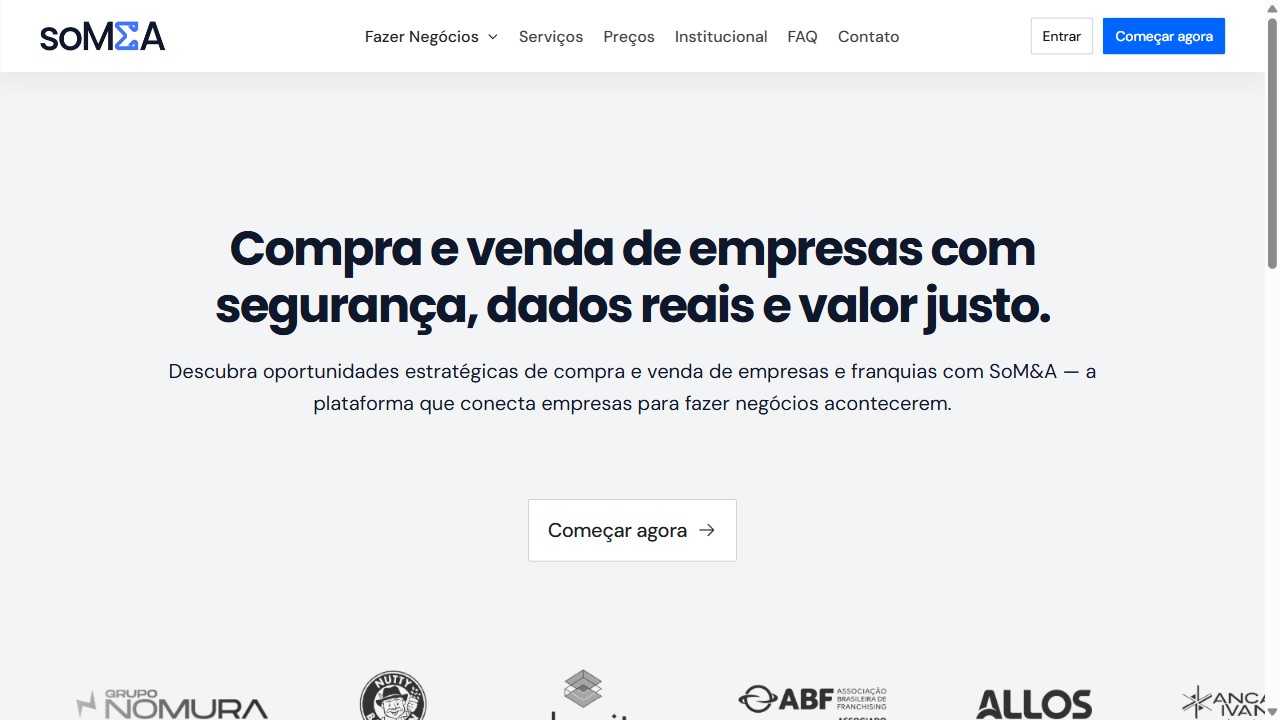
The model is subscription-based. Entrepreneurs interested in selling or buying a business pay the equivalent of a minimum wage per year and receive a preliminary valuation, credit analysis, negative certificates, due diligence, financial simulators, and access to a mechanism that suggests between 10 and 20 buyers or sellers with the highest probability of closing a deal, according to Exame. The platform connects APIs from courts, credit bureaus, and public databases to gather legal processes, labor actions, indebtedness, and other indicators, and the algorithm runs on AWS infrastructure.
SoM&A itself details the tools with proprietary names: AI Matchmaking, Deal Room, and M&A Consultant, in addition to a proprietary Risk Score that translates the company’s financial and operational situation into an objective and comparable score. According to SoM&A, the valuation uses market practices such as EBITDA multiples, revenue multiples, and discounted cash flow, and the main charge is a success fee, with “payment only upon successful transaction,” meaning the platform only truly earns when the mergers and acquisitions operation is completed.
Why the debut was through franchises
Although the goal is to serve companies from various segments, the operation started with franchising. The sector moves more than R$ 300 billion per year in Brazil and records thousands of unit transfers annually, and the platform already gathers franchise negotiations such as Lupo, Óticas Center, and GiOlaser, in addition to logistics and cybersecurity companies with revenues between R$ 5 million and R$ 15 million, according to Exame.
SoM&A confirms the focus on its pages: the platform presents itself as specialized in SMEs and franchises, with fronts for those who want to sell, buy or invest, expand a franchisor or start from scratch, under the motto of buying and selling companies “with security, real data, and fair value.” The technology, describes the same page, is natively artificial intelligence and was designed considering the specificities of the Brazilian market.
There is also a pocket argument that Mizuno uses in the conversation with Exame: buying an existing operation is usually more predictable than starting a company from scratch. The buyer finds financial history, customers at the door, trained staff, validated commercial point, and known margin, and a structured due diligence further reduces the risk of the decision. It is the same reasoning as preferring a ready house to an empty lot, applied to the world of CNPJs.
The gap in the market: M&A advisory only served those with revenues above R$ 50 million

The Brazilian mergers and acquisitions market has always revolved around the big players. The country recorded 1,581 M&A transactions in 2025, moving around R$ 51 billion, of which approximately R$ 14 billion came from the so-called middle market, companies with revenues between R$ 20 million and R$ 200 million, according to Exame. Specialized M&A boutiques usually serve companies with revenues above R$ 50 million because evaluation, auditing, and negotiation require expensive hours of specialized work, and below this line, the account simply does not close for the traditional model.
It is precisely this account that automation tries to turn around. “M&A has always been treated as an opportunity reserved for large companies,” Mizuno tells Exame. “We want to democratize this process for small and medium enterprises.” The company’s estimate, published in the same report, points to a potential market of R$ 94 billion annually.
The goal: 6 thousand operations per year and R$ 2.1 billion by the end of 2027
The numbers of ambition are on the table. The startup projects to complete 6,000 annual operations by the end of 2027 and earn R$ 2.1 billion per year in success fees from closed deals, according to Exame. All this starting from an operation that is still running in the MVP phase, developed entirely with own capital, and whose next move will be to seek investors to accelerate expansion.
“Brazil will only gain productivity when small and medium-sized enterprises gain productivity,” states the founder to Exame, summarizing the moment in three words: “We are just beginning.” The declared goal of SoM&A, recorded in the same report, is far from being just another site for advertising companies for sale: the idea is to build the infrastructure of a market that has always operated behind closed doors. “Until today, only large companies had access to this process. Technology allows us to change this logic,” says Mizuno.
Here’s the takeaway, highlighted here as an observation from this editorial: if the dating app model worked to bring people together, applying it to 18.8 million companies is a rare scale bet in the country, and the price of 1 minimum wage per year puts SoM&A within reach even for the bakery owner who never dreamed of hiring an investment bank.
From the vice-presidency of a giant in the card industry to the owner of the “Tinder” of companies, Mizuno’s story shows that a second career can aim higher than the first.
Tell us in the comments: would you sell your company through a platform with artificial intelligence, or does a deal of this size still require a handshake eye to eye?