Portuguese
  Spanish


In 1985, two brothers from Serra Gaúcha shared a rented room of about 12 square meters, with a table, a chair, and a telephone. Forty years later, this same business became Grupo Argenta, an ecosystem from Flores da Cunha (RS) that projects to earn R$ 24 billion in 2025 and already gathers more than a thousand fuel stations spread across the country.
According to Exame, what started as a wooden box transport service for wineries transformed into an ecosystem of 14 companies, with more than 6,500 employees and projected revenue 35% higher than in 2024. According to Serra em Pauta, the former SIM companies from Flores da Cunha officially became known as Argenta on April 25, 2024, in tribute to the founding brothers Deunir and Neco Argenta.
The 12-square-meter room where it all began
To understand the size of Grupo Argenta today, one must go back to 1985. In that year, Neco Argenta was only 21 years old when he decided, alongside his brother Deunir, to start a small business in the city of Flores da Cunha, in the heart of Serra Gaúcha. The starting point was extremely modest: a rented room of approximately 12 square meters, equipped only with a table, a chair, and a telephone.
The initial idea had nothing to do with fuels. The brothers organized the transport of wooden boxes used by grape producers and wineries in the region. It was a simple logistics service that involved traveling kilometers through the mountains and gaining the trust of one client at a time. That cramped room was, in practice, the first headquarters of what would become one of the largest groups in the field in Brazil.
-
El Niño Threatens Brazilian Food Production, Economists Predict Rising Prices for Coffee, Corn, and Rice

-
Brazil’s First Freight Railway Built from Scratch, EF-118 Connecting Espírito Santo to Rio de Janeiro, Goes to Auction in October Attracting Chinese Giant in Multi-Billion Dollar Bid for Southeast Rail Network

-
Audit in Rio de Janeiro’s State Government Uncovers Ghost Employees Across All 77 Departments, Leading to Over 4,000 Dismissals and Significant Cost Savings

-
Audit Reveals 80% of Ghost Employees in Rio Government Departments, Leading to Over 4,000 Dismissals and Saving the State $3.3 Million Monthly


The detail of the 12-square-meter space became a symbol. It summarizes the distance between the starting point and what Grupo Argenta represents four decades later. There was no significant capital, no fleet, no stations. There were two brothers, a city in the interior of Rio Grande do Sul, and the willingness to transform a small service into something much bigger than anyone imagined.
From box transport to the first fuel station

The leap that would change everything came in 1993. It was in that year that Neco Argenta and his brother opened the first fuel station, initiating the vocation that would define the future of Grupo Argenta. The decision to enter the fuel business was not by chance: the Serra Gaúcha was a region with a high circulation of vehicles, cargo transportation, and constant movement of wineries, industries, and tourism.
From that first fuel station onwards, the business stopped being just about box logistics and started revolving around refueling. Each new fuel station inaugurated expanded the brand’s presence on the gaucho roads and created the customer base that would support the next expansion. The operation grew organically, station by station, plaza by plaza.
Throughout the 1990s and 2000s, what was a single fuel station multiplied. The group learned to operate at scale, negotiate larger volumes, and build the structure that would later allow it to become not only an owner of stations but also a distributor.
The turning point: when Grupo Argenta decided to truly grow
If the foundation was in 1985 and the first station came in 1993, it was from 2018 that Grupo Argenta accelerated decisively. That was the moment when the company fully embraced an expansion strategy based on acquisitions and partnerships, moving away from growing only organically to incorporating networks, brands, and entire operations.
The logic was clear: in a fuel market dominated by giants, gaining scale quickly was a matter of survival and negotiation strength. Buying existing fuel station networks, forming partnerships with national brands, and integrating distribution operations allowed the group to skip stages that would take decades to overcome only with one-by-one inaugurations.
It was during this period that Grupo Argenta ceased to be a regional company and became one of the most relevant names in the fuel sector in the South of the country. With each acquisition, revenue increased, the number of stations grew, and the distributor structure gained new bases. The 12-square-meter room became increasingly distant in the rearview mirror.
SIM, Charrua, and Petronas: the brands that total more than a thousand stations
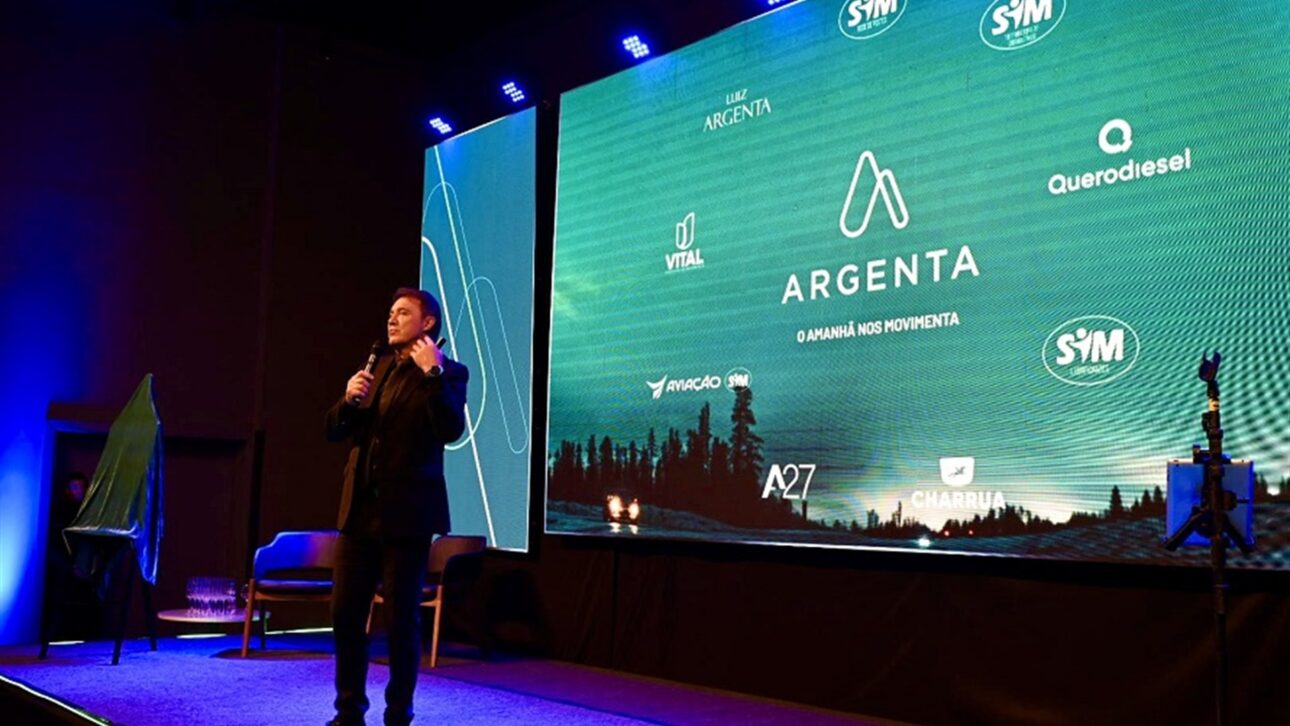
Today, Grupo Argenta supplies the country under three main brands: SIM Rede, Charrua, and Petronas. Together, they are expected to surpass the mark of a thousand fuel stations by December 2025, a number that places the group among the largest station operators in Brazil.
The SIM brand is the most traditional and carries the history of the company, with nearly 200 proprietary convenience stores spread across the stations. Charrua reinforces regional presence, while Petronas represents the most recent and ambitious branch: the group became a licensee of the Malaysian brand in Brazil and plans to reach 500 fuel stations under this brand by the end of 2025.
Each brand plays a role within the ecosystem. While one network of fuel stations serves the local public with the already known brand, another advances into new areas and markets. This combination is what allows Grupo Argenta to add more than a thousand fueling points and sell in sufficient volume to rank among the leaders in the sector.
R$ 24 billion: the numbers of the fuel empire
The current numbers of Grupo Argenta are impressive precisely because of the contrast with the beginning. The revenue projection for 2025 is R$ 24 billion, an increase of 35% compared to 2024. For comparison, in 2023 the group earned about R$ 15 billion, and the forecast for 2024 was around R$ 19 billion. The growth rate is fast and consistent.
Behind this revenue are more than 6,500 employees and an ecosystem of 14 companies that go far beyond the stations. There are branches dedicated to fuel distribution, lubricants, aviation, financial services, and even a winery, Luiz Argenta, which reconnects the group to its origins linked to the wine of Serra Gaúcha.
The leap from a 12-square-meter room to a revenue of R$ 24 billion in 40 years is the kind of rare trajectory in Brazilian entrepreneurship. It shows how Grupo Argenta transformed fueling into a billion-scale business, without leaving Flores da Cunha. For Neco Argenta, it is proof that the countryside knows how to think big.
The 4th largest fuel distributor in the South
Besides owning stations, Grupo Argenta is today the fourth largest fuel distributor in the South of Brazil. This distribution branch is what ensures the supply of its own brands and also third-party clients, moving large volumes from a robust logistics network.
To handle this volume, the group maintains more than 15 strategically spread distribution bases. Each base functions as a storage and distribution point, shortening distances and reducing costs to reach gas stations and end customers. It is this distribution engineering that supports the operation of over a thousand stations.
The role as a distributor also opened doors for significant contracts. In 2023, the distribution arm closed a deal to supply diesel with renewable content, and the group established itself as one of the leading fuel market players in the South. Being a distributor, and not just a reseller, is what sets Grupo Argenta apart from many competitors.
From SIM to Argenta: the name that became a brand
For much of its history, the group was known by the SIM companies. The identity shift came on April 25, 2024, when the SIM companies of Flores da Cunha officially became Argenta, directly referencing the surname of the founding brothers, Deunir and Neco Argenta.
The name change was not just cosmetic. It unified under one brand a set of companies that had grown rapidly and needed a common identity. The name Grupo Argenta came to represent everything at once: stations, distributor, lubricants, convenience, and the other arms of the ecosystem.
Renaming the operations also had symbolic weight. Putting the family surname on the gas station facades is publicly assuming responsibility for every liter sold. For Neco Argenta, who started at 21 years old in that small room, seeing his own name become the brand of a fuel empire is the closing of a cycle.
What sustains Grupo Argenta after 40 years
In 2025, Grupo Argenta celebrates 40 years, and the picture is of a company that knew how to grow without losing its focus. What sustains the business is not a stroke of luck, but the sum of decisions made over four decades: entering the fuel market in 1993, gaining scale from 2018, becoming a major distributor, and unifying the brand in 2024.
Neco Argenta likes to recall that the company operated for almost 40 years with a focus on expansion, and the numbers confirm the consistency. Going from a 12-square-meter room to over a thousand gas stations, 14 companies, more than 6,500 employees, and R$ 24 billion in projected revenue is the result of discipline, not chance.
The ecosystem built in Flores da Cunha shows that it’s possible to build a giant in the sector far from major centers. Grupo Argenta became a reference that the interior of Rio Grande do Sul can generate businesses of national scale, with a strong distribution operation and a network of stations spread across the country. And the story of Neco Argenta and his brother Deunir proves that a 12-square-meter space can indeed be the beginning of an empire.
If two brothers managed to transform a rented small room into a R$ 24 billion group in just four decades, what is still preventing the next big Brazilian company from being born right now in a small town that almost no one notices on the map?