






 Portuguese
  Spanish


Environmental package announced by Tarcísio de Freitas includes real-time monitoring, actions on the Pinheiros River, and new measures after recording toxic foam in Itu and Salto
The São Paulo Government announced on Wednesday (10) an environmental package with R$ 23.5 billion for the depollution of the Tietê and Pinheiros rivers by 2029.
The measure was presented by Governor Tarcísio de Freitas during an event at the Tietê Ecological Park in the eastern zone of São Paulo’s capital.
The announcement came a day after a toxic foam patch appeared on the Tietê River, near the cities of Itu and Salto, in the interior of São Paulo.
-
Brazilian Innovator Uses 3D-Printed Device to Cool Two Rooms with One Air Conditioner
-
China Uses 432 Robots to Move a 7,500-Ton Historic Building in Shanghai, Preserving Architecture While Creating Space for Underground Center
-
Dutch Initiative Swaps Cigarette Butts for Food to Clean Streets, Combat Pollution, and Turn Waste into Recycled Furniture

-
Kenyan Company Recycles Over 10 Million Flip-Flops from Indian Ocean Beaches into Elephant and Giraffe Sculptures Sold for Up to $1,200

According to the São Paulo government, the two rivers will have real-time satellite monitoring, with public data on water conditions.
Additionally, the plan includes the installation of smart buoys to monitor water quality.
Billion-dollar investment promises to change the situation of the Tietê and Pinheiros rivers in the coming years
According to Tarcísio, the goal is to transform the reality of the two São Paulo rivers in the coming years.
The governor, however, avoided giving a date for the complete depollution of the Tietê and Pinheiros.
Even so, he stated that the rivers should be “completely different” within a few years.
“Many have tried, no one went ahead. And we went and are making a difference. And in a few years, we will have a Tietê and a Pinheiros completely different from what we have today. It’s not a miracle, it’s technique,” he declared.
Furthermore, according to the state government, garbage collection on the Pinheiros River will be increased by 20%.
Pinheiros River will have R$ 24 million for bike path revitalization
In addition to the depollution package, Tarcísio also announced R$ 24 million to revitalize the Pinheiros River bike path.
The measure addresses a demand from cyclists who report safety issues, robberies, and lack of lighting during training.
According to the São Paulo government, the work will be carried out in conjunction with Emae.
The company was privatized in 2024 and, about three months before the announcement, came under the control of Sabesp.

Toxic foam in the Tietê has once again worried Itu and Salto
On Tuesday (9) and Wednesday (10), the Tietê River woke up covered by toxic foam in the Itu and Salto region.
Drone images showed the river with low water volume and a large white layer on the surface.
According to the National Center for Monitoring and Alerts of Natural Disasters (Cemaden), the lack of recent rains has worsened the problem.
With the drought, the river flow decreases.
Consequently, pollutants become more concentrated in the water.
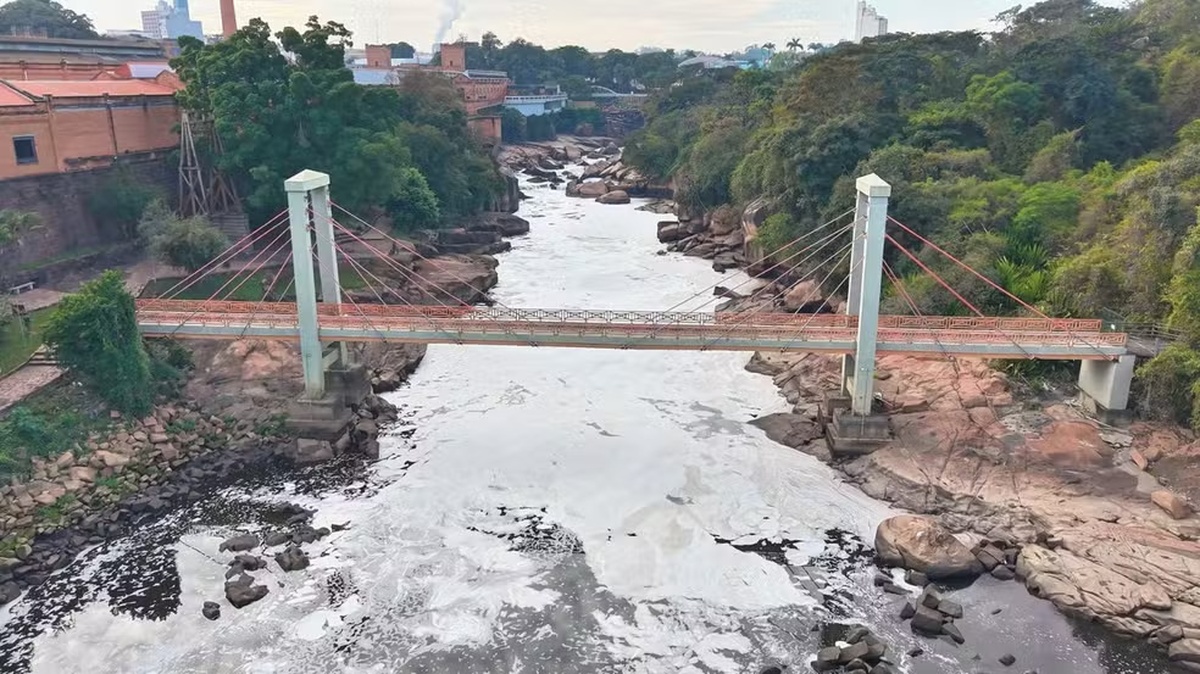
Pollution, drought, and waterfalls explain the formation of the foam
The phenomenon is considered chronic in the region and results from the combination of three main factors.
Among them are:
- Pollution from untreated domestic and industrial sewage, with phosphorus, detergents, and chemicals;
- Lack of rain, which reduces the river flow and increases the concentration of pollutants;
- Waterfalls in Itu and Salto, which agitate the water and form the foam.
In practice, the force of the water works like a “blender.”
Thus, the chemical residues are agitated and form the white layer that covers the landscape.
Civil Defense warns residents and tourists about foam risks
The last time the Tietê was completely taken over by foam was on May 13.
On that occasion, the substance remained in the river for more than two weeks, until May 29.
Despite attracting tourists to the Waterfall Complex, the foam poses risks to the population.
Therefore, the Civil Defense and the city hall recommend that residents and visitors do not approach the banks.
The warning is especially important for children.
Contact of the foam with skin and eyes can cause irritation.


