






 Portuguese
  Spanish
  5 min of reading
  0 comments


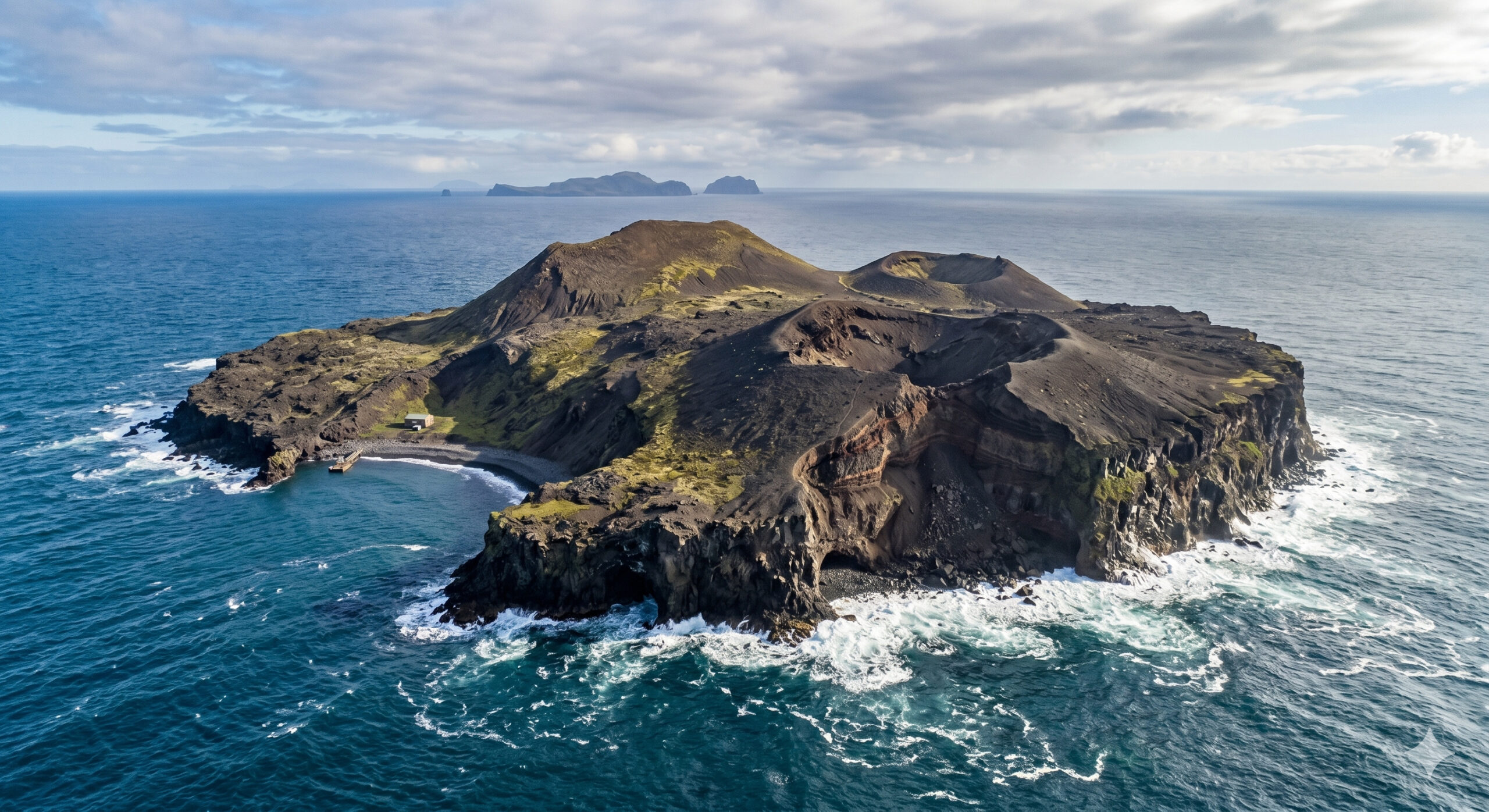
Surtsey emerged from the ocean after a volcanic eruption in Iceland and became one of the most protected natural laboratories on the planet.
In November 1963, fishermen sailing south of Iceland spotted smoke and explosions emerging from the North Atlantic. What initially seemed like a maritime anomaly quickly turned into one of the most extraordinary geological events of the 20th century: a new island was literally being born from the ocean floor. The formation was named Surtsey, in reference to Surtr, the fire giant from Norse mythology.
Located about 32 kilometers off the south coast of Iceland, Surtsey emerged after a series of underwater eruptions that continued until 1967. The case attracted worldwide attention because scientists quickly realized they were witnessing a very rare opportunity: to observe in real-time the birth of new land and see how life would begin to occupy a completely sterile environment.
More than 60 years later, the island remains one of the most restricted and protected places on the planet, with access limited to a few authorized researchers.
-
An abandoned weapons factory that still contains ammunition and military vehicles has been discovered.

-
Businessman puts modern 1,100 square meter fortress in Russia up for sale for $550,000, featuring high walls, archer towers, a 1.2-hectare plot, and an isolated location on the banks of the Don River.
-
Small shops in the interior of São Paulo have been around for up to 70 years, maintaining credit accounts, preserving artisanal preserves, and showing how small rural businesses have turned customers into friends, families, and guardians of stories that remain alive even after the advance of sugarcane, the end of coffee plantations, and the arrival of large commercial chains.

-
Chinese students build a 6.06-meter remote-controlled paper airplane, achieve a flight of almost 15 minutes, and turn a school pastime into an engineering project to attempt a world record.


The island of Surtsey emerged after gigantic underwater eruptions in the North Atlantic
The birth of Surtsey began on November 14, 1963, when an underwater volcanic eruption broke the ocean surface along the Vestmannaeyjar archipelago, in southern Iceland.
The explosions sent ash, steam, and volcanic fragments hundreds of meters high, while new layers of lava accumulated above sea level.


According to UNESCO, the eruptive activity continued until June 1967, allowing scientists to monitor the gradual formation of the island.
During this period, Surtsey reached over 2.6 km² in area, although ocean erosion has reduced part of its size in the following decades.
The phenomenon was so impressive that it quickly became a worldwide reference in volcanic geology. Unlike ancient islands already modified by thousands or millions of years of erosion and biological occupation, Surtsey offered researchers a practically “reset” surface, newly formed by volcanism.
Scientists realized that the island could reveal how life colonizes a completely new territory
Shortly after the emergence of the island, Icelandic researchers decided that Surtsey should remain isolated from common human interference. The goal was to avoid artificial contamination that could alter the natural processes of biological colonization.
The decision turned Surtsey into a gigantic natural open-air laboratory. Since then, only authorized scientists can land on the site, following strict protocols to prevent the accidental introduction of seeds, fungi, insects, or other external organisms.

UNESCO states that Surtsey has become one of the planet’s most valuable examples for studying primary ecological succession, a process in which organisms begin to occupy an environment where there was practically no terrestrial life before.
The first life arrived quickly even in an apparently hostile volcanic environment
Despite the initially extremely barren appearance, biological colonization began surprisingly quickly. A few months after the island’s formation, researchers were already identifying bacteria, fungi, and microorganisms carried by the wind and ocean currents.
The first plants began to appear a few years later, brought mainly by birds, wind, and seawater. Mosses, lichens, and small plant species started to occupy areas where the volcanic soil was slowly beginning to accumulate organic matter.
Birds played a central role in this process. Over time, marine species began to use Surtsey as a resting and breeding site. The birds’ droppings enriched the soil with nutrients, accelerating vegetation growth and making some areas more favorable for new forms of life.
The extreme isolation of the island became one of the planet’s greatest scientific experiments
One of the most unusual characteristics of Surtsey is precisely the strict control of access. The Icelandic government and scientific institutions maintain severe restrictions to preserve the natural experiment initiated in the 1960s.

Tourists cannot move freely on the island. Human presence is limited to specific scientific groups authorized by Icelandic authorities. The goal is to prevent seeds caught in clothing, equipment, or footwear from artificially altering the local ecological dynamics.
This control is taken so seriously that researchers must follow strict decontamination rules before landing. The concern exists because a simple accidental introduction of invasive species could alter decades of scientific observations on natural colonization.
Ocean erosion began to destroy parts of the island almost immediately after its birth
Although Surtsey emerged explosively, scientists quickly realized that the ocean would also start to destroy it. Strong winds, North Atlantic waves, and storms began to continuously wear down the more fragile parts of the island.
In the first decades after its formation, the total area decreased significantly. Scientific records show that Surtsey lost a significant part of its original size due to constant marine erosion.

Even so, researchers claim that the more resistant core of the island, formed by solidified lava, should survive much longer than the outer layers composed of less compact volcanic ash.
This balance between volcanic creation and oceanic destruction has turned Surtsey into a living example of how landscapes can emerge and disappear relatively quickly in geological terms.
The island became a UNESCO World Heritage Site because of its unique scientific importance
In 2008, UNESCO declared Surtsey a World Heritage Site. The organization describes the island as an exceptional natural laboratory because it allows the monitoring of ecological and geological processes that are practically impossible to reproduce artificially.
According to UNESCO, few places on the planet offer a similar opportunity to study biological colonization without significant direct human influence. The scientific value of the island lies precisely in its rarity: a new land observed since birth.
Researchers use data from Surtsey to understand everything from volcanic dynamics to seed dispersal, seabird behavior, soil formation, and ecosystem development in extreme environments.
The island has also become an important reference in studies related to astrobiology and the possibility of life colonizing hostile environments on other worlds.
The case of Surtsey shows how the Earth can still create new territories before human eyes
A large part of the Earth’s landscapes was formed long before the existence of modern civilization. Therefore, literally witnessing the birth of an island is something extremely rare on a human scale.
Surtsey became a symbol of this continuous geological force of the planet. While cities, roads, and borders seem permanent to human society, the case of the Icelandic island reminds us that the Earth continues to change constantly under oceans, volcanoes, and tectonic plates.
At the same time, the place shows how life can occupy seemingly impossible environments. What began as steaming volcanic rock surrounded by icy ocean slowly transformed into a habitat for birds, plants, fungi, and countless microscopic organisms.
More than six decades after emerging from the North Atlantic, Surtsey continues to intrigue scientists precisely because it seems like a newly created piece of the planet, isolated in the ocean and preserved almost like a capsule of the birth of terrestrial life itself.


Be the first to react!