Portuguese
  Spanish


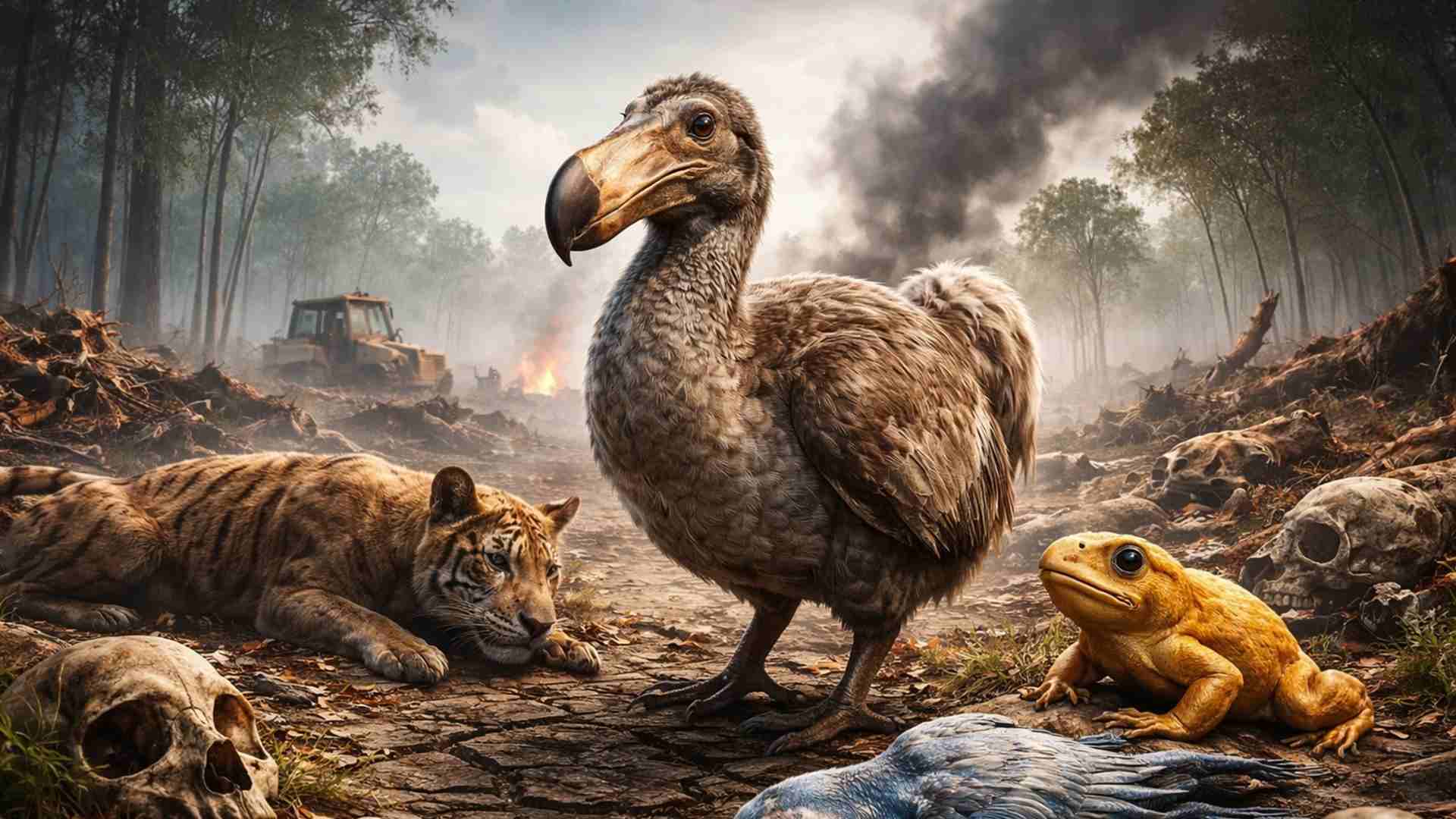


Scientific Surveys Based on Global Extinction Rates, Statistical Analyses and Gaps in Official Records Indicate That the Number of Animals Extinct Due to Human Action Since 1500 May Range From 777 Confirmed Cases to Estimates That Exceed 380 Thousand Species Over 500 Years
The animals extinct due to human action since 1500 total at least 777 confirmed cases, but scientific estimates suggest that the real number could reach hundreds of thousands, reflecting methodological uncertainties, data gaps, and the growing impact of human activities on global biodiversity.
Confirmed Extinctions and Limits of Official Records
Since the beginning of the modern era in 1500, 777 animal species have been officially classified as extinct by the International Union for Conservation of Nature’s Red List. Although some losses may have natural causes, researchers indicate that humans have contributed to nearly all of them.
The analysis focuses on the last 500 years because earlier periods lack systematic scientific observations. Even in this recent interval, uncertainty remains high, as human pressure on ecosystems has intensified particularly in recent centuries.
-
She spent 73 years breathing inside an iron lung, survived the aftereffects of polio, and became the last woman in the United States dependent on the equipment before dying at 78 years old.

-
Brazilian students created a $1 filter using pine bark, cotton, and 3D-printed parts to clean cassava wastewater, reduce the toxicity of a hazardous waste, and transform contaminated water into biofertilizer.

-
Astronaut from Artemis II steps down after mission to the Moon and decision surprises after a record of 406,771 km, a historic 10-day journey, and an unprecedented achievement for Canada.

-
A fossil kept for years in a small museum in Montreal concealed 450-million-year-old soft tissue, a discovery that has only happened once before in history.


Another critical factor is that only about 5% of known species in the world have had their extinction risk assessed. This means that many extinct animals may have never been officially recorded, creating a substantial difference between documented numbers and actual losses.
Global Estimates Suggest Hundreds of Thousands of Lost Species
A 2022 study published in the journal Biological Reviews estimated that between 150,000 and 260,000 known species may have disappeared since 1500. The numbers surprised even the lead author, Robert Cowie, a researcher at the University of Hawaii.
The method used a random sample of 200 land snails to calculate extinction rates and extrapolate them to all known species over 500 years. The procedure included reviewing previous studies and consulting experts.
The estimated rate varied from 150 to 260 extinctions per million species-year. Complementary analyses with other groups, such as birds and amphibians, produced values between 10 and 243, with a concentration around 100 E/MSY, considered a methodological equilibrium point.
Math of Extinctions and Extended Projections
Applying the rate of 100 E/MSY to the approximately 2 million known species results in an estimate of 100,000 extinct animals over the last 500 years. However, this calculation excludes species still unknown to science.
A 2011 study published in PLOS Biology estimated the existence of 7.7 million animal species. Considering this total, the rate of 100 E/MSY over 500 years, and discounting 3,850 expected natural extinctions, Live Science arrived at the approximate value of 381,150 extinctions caused by humans.
The authors themselves emphasize that this is a broad estimate, subject to high margins of error and dependent on statistical assumptions that may vary by the animal group analyzed.
Scientific Uncertainties and Methodological Challenges
According to John Alroy, a professor at Macquarie University, it is practically impossible to accurately calculate modern extinction rates. He states that reliable data on how many species exist and how many have already disappeared is lacking.
A large part of global biodiversity remains unknown and is concentrated in under-researched areas, such as tropical regions.
Insects, which form the most diverse group, are especially underrepresented in current scientific records.
Alroy suggests using museum collections to track losses in representative groups over time. Even without an exact number, he asserts that real extinctions far exceed the 777 official records.
Consensus on Human Impact on Biodiversity
Despite numerical discrepancies, all studies agree that current extinction rates are far higher than the natural background rate, estimated at 1 E/MSY.
This pattern confirms that humans have significantly accelerated biodiversity loss.
Whether 20, 100, or 200 E/MSY, the values indicate a scenario of continuous degradation. For researchers, the magnitude of losses of extinct animals is sufficient to characterize an abnormal and persistent process of extinction on a planetary scale, even in the face of the statistical and methodological uncertainties that still exist.