Portuguese
  Spanish


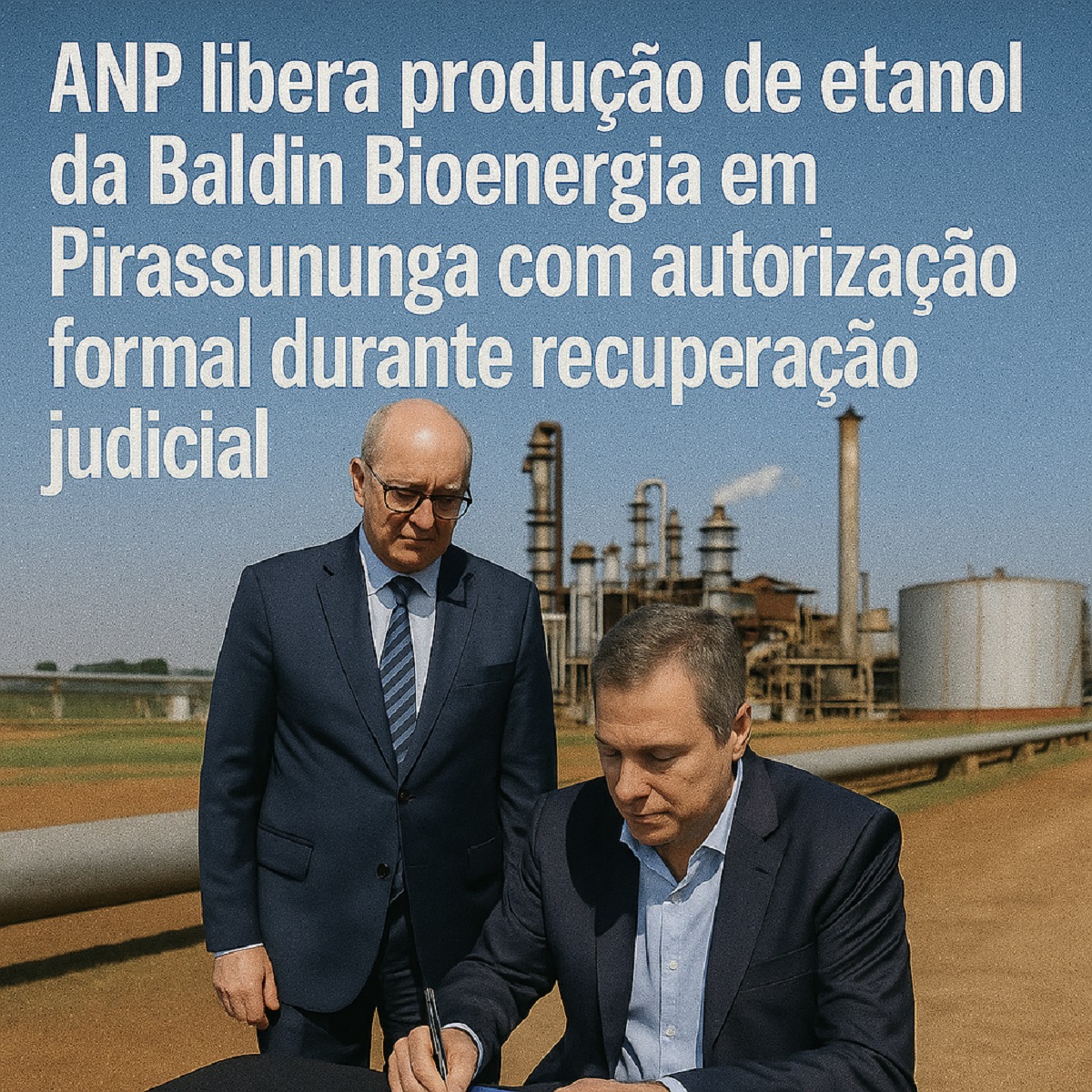

Regulatory Agency Measure Allows Return of Plant Operations Based on Technical and Legal Criteria, Without Promising Extraordinary Economic Effects
The National Agency of Petroleum, Natural Gas and Biofuels (ANP) published the formal authorization in the Official Gazette of the Union on May 6, 2025. Although Baldin Bioenergia has been in judicial recovery since June 2022, the ANP granted approval based on technical and regulatory documentation. As established by ANP Resolution No. 734/2018, the company may resume its operations, provided it meets the specific conditions required by law. For this reason, the decision does not represent a privilege, but rather compliance with valid technical, legal, and operational requirements. Thus, Baldin will be able to operate in a regularized manner, being duly monitored, without exceeding the established regulatory limits.
Plant Has Installed Capacity to Produce 460 Thousand Liters Daily
Baldin Bioenergia established its unit at kilometer 209 of the Anhanguera Highway in Pirassununga in 2010, two years after its founding in 2008. The plant has technical production capacity of up to 460 thousand liters of hydrated ethanol daily, as reported to the ANP in the authorization process. The operational resumption, therefore, follows regulatory standards, aiming to gradually contribute to the supply of ethanol according to market demand. The authority made the decision based on technical and legal criteria ANP’s decision allows Baldin Bioenergia to resume ethanol production in Pirassununga. Authorization follows legal norms and technical criteria.
Operation Resumption Follows Recovery Plan Presented to Justice
In December 2023, Baldin filed a restructuring plan noting a partial return of production in 2025, contingent upon obtaining licenses and regularizations. With ANP’s authorization now effective, the company will follow the schedule approved by the court, which includes gradual reactivation of activities and maintenance of local jobs. The specialized press and the judiciary received the data, indicating that about 200 jobs will be progressively restored.
-
Oil production grows in Rio, but reserve replacement raises a warning sign

-
Petrobras is expected to complete the drilling of the Morpho well in the Foz do Amazonas in August 2026, the first well in the Equatorial Margin, an oil frontier that the ANP estimates at more than 30 billion barrels and could redraw the map of Brazil.

-
Oil returns to the center of concerns with tension between the US and Iran

-
IEA reduces forecast for global oil demand in 2026 after impacts of the Middle East crisis



Measure Prevents Paralysis of Already Installed Production Structure
The ANP considered that keeping the plant active, even in the judicial process, would help avoid the waste of already built and technically approved infrastructure. Furthermore, the process of operational supervision and control remains in effect, according to the guidelines for safety, environmental impact, and technical regularity, with continuous monitoring by the agency. Petrobras did not disclose extraordinary production targets or projections for accelerated expansion, which preserves the technical and cautious nature of the decision.
Ethanol Remains Strategic Asset of National Energy Matrix
The Brazilian government regulates ethanol production through public policies such as RenovaBio, in effect since 2020, and the National Energy Plan 2050, coordinated by the Energy Research Company (EPE). The Ministry of Mines and Energy considers ethanol strategic for boosting the energy transition and meeting national climate goals, including under the Paris Agreement. Therefore, by allowing plants with functional structure and regular status to continue operating, the authorities maintain stability in the sector without compromising market competitive balance.
The Technical Team Will Continue Monitoring to Ensure Compliance
The ANP will permanently oversee the operations of Baldin Bioenergia, respecting existing legal milestones. If the company violates environmental, technical, or financial regulations, the agency may review the authorization. The agency emphasized that it analyzed the case individually, without creating precedents for indiscriminate concessions to other struggling companies. Finally, the episode highlights that stable and transparent regulatory policies are essential for preserving economic activity within legal limits.