Portuguese
  Spanish


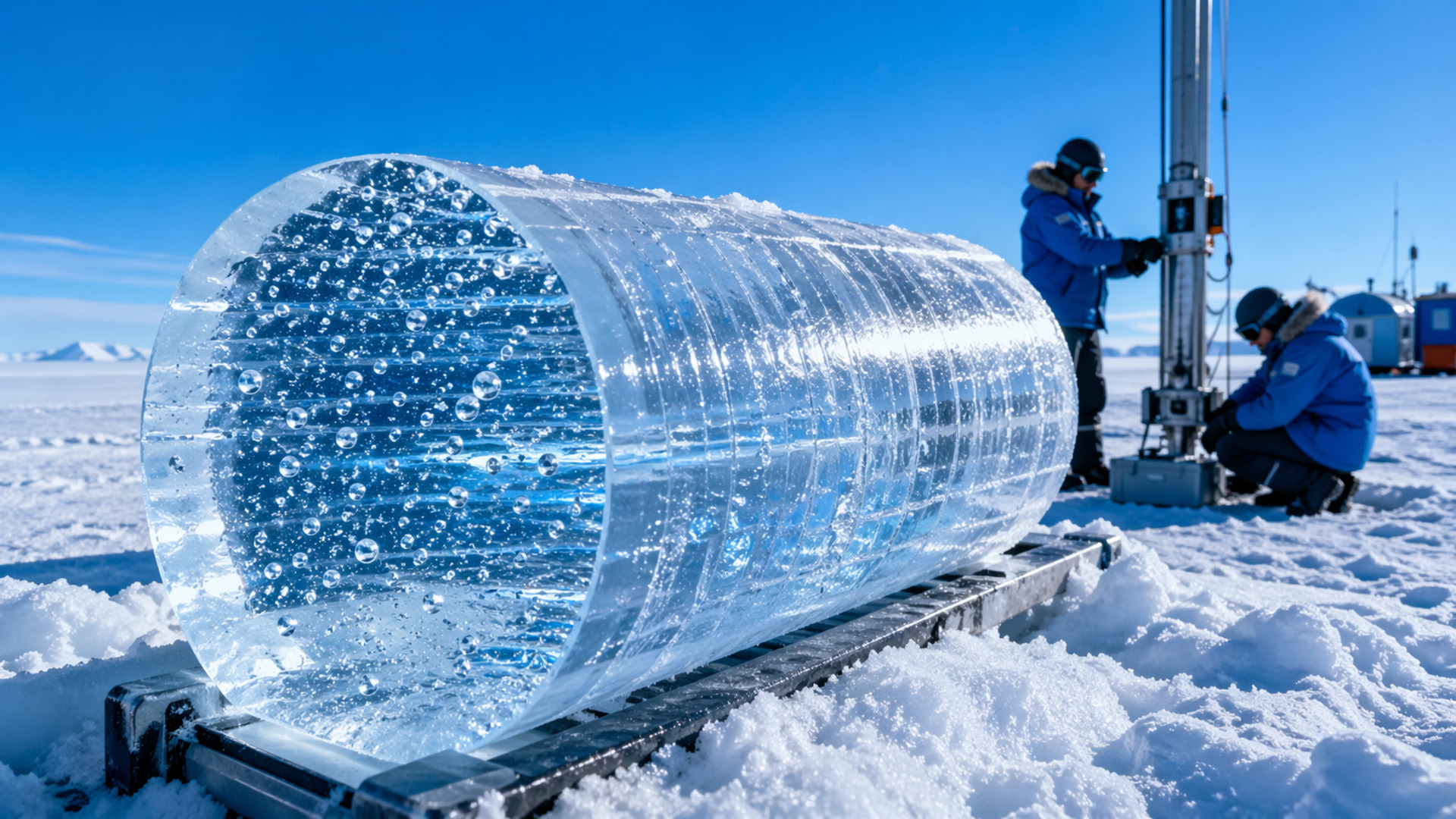


Antarctic ice analyzed in Allan Hills preserved air bubbles and rare gases that allowed the reconstruction of parts of Earth’s climate over the last 3 million years, revealing strong ocean cooling, a small drop in greenhouse gases, and new questions about the planet’s climatic evolution.
Antarctic ice has revealed new details about a 3-million-year-old climate mystery: Earth cooled significantly during this period, especially in the oceans, while levels of carbon dioxide and methane dropped only modestly. The discovery appears in two studies published in the journal Nature and extends the direct record of ancient climate conditions preserved in ice samples.
The research analyzed both ancient ice and tiny air bubbles trapped within it. These records allowed for an unexpected difference to be observed between the planet’s cooling and the variation of the main greenhouse gases.
Antarctic Ice Extends Ancient Climate Record
The work was developed within the scope of the National Science Foundation Center for Oldest Ice Exploration, known as COLDEX, a collaborative effort led by Oregon State University. The group works on locating and analyzing some of the oldest ice on Earth.
-
Tesla injected an additional $250 million into the German factory, doubled the battery cell target, and opened its own production line for startups.

-
No more TV stuck on the wall: Samsung The Freestyle+, the new projector with over 400 lumens projects on walls, floors, and ceilings, bringing cinema to any corner of the house.

-
A Japanese governor single-handedly stalled the construction of the world’s fastest train for nine years, and only now has he agreed to allow a tunnel excavated at a depth of 1,400 meters.
-
Almost 1 billion euros, two gigafactories, and a million-dollar public investment, Chinese company aims to turn Spanish city into Europe’s new battery hub.


The studies were led by Julia Marks-Peterson, a doctoral student at Oregon State University, and Sarah Shackleton, who conducted the work as a postdoctoral researcher at Princeton University and is now a professor at the Woods Hole Oceanographic Institution. The samples came from Allan Hills, a region located on the edge of the East Antarctic ice sheet.
The Allan Hills area has a different characteristic from traditional ice core drilling sites. There, the ice has been pushed upward and distorted by the movement of the sheet, which breaks the original sequence of layers and provides “snapshots” of different moments in the climatic past.
Planet Was Warmer 3 Million Years Ago
The existence of a warmer climate about 3 million years ago has been known to scientists for over a century. Evidence includes fossils of temperate and subtropical forests in regions like Alaska and Greenland, as well as ancient coastlines on the East Coast of the United States, between Georgia and Virginia, indicating much higher sea levels.
The reason for this warm period and subsequent cooling remained unclear. One of the difficulties was accurately reconstructing, for such an ancient interval, both global temperatures and greenhouse gas levels.
The Antarctic ice analyzed now extends this direct record and offers new points of comparison. The samples do not form a continuous line in time, but they help broaden the understanding of different phases of Earth’s climatic evolution.
Oceans Cooled by up to 2.5 °C
One of the studies used measurements of noble gases preserved in air bubbles trapped in the ice. These gases offer a global signal of ocean conditions and allowed for the estimation of changes in ocean temperature over time.
The results show that average ocean temperatures dropped by about 2 °C to 2.5 °C over the last 3 million years. Previous research had already identified cooling in the ocean surface, but the new study showed that the timing of cooling differed between surface waters and deeper layers.
Much of the overall cooling occurred early, starting around 3 million years ago and progressing for about 1 million years. This period coincides with the formation of large ice sheets in the Northern Hemisphere, while ocean surface temperatures decreased more gradually until about 1 million years ago.
CO₂ and Methane Had Modest Decline
With the same Antarctic ice samples, Marks-Peterson and his team produced the first direct measurements of carbon dioxide and methane covering the last 3 million years. The results show that CO₂ generally remained below 300 parts per million during this period.
Around 2.7 million years ago, carbon dioxide levels were about 250 parts per million. They then fell slightly, by approximately 20 parts per million, until 1 million years ago.
Methane remained stable at about 500 parts per billion. In contrast, current levels are much higher: carbon dioxide averaged 425 parts per million in 2025, while methane reached 1,935 parts per billion, according to data from the National Oceanic and Atmospheric Administration cited in the research.
Other factors helped shape the climate
The results indicate that greenhouse gases alone do not explain the entire long-term cooling trend. Changes in Earth’s reflectivity, variations in vegetation and ice cover, as well as alterations in ocean circulation, also appear as relevant factors.
The difference between the strong cooling and the modest drop in gases opens new questions about the interaction between the components of the Earth system. Antarctic ice now plays a central role in this investigation by preserving direct records of ancient air and past environmental conditions.
Research continues with the search for even older ice. COLDEX scientists recently identified ice that may be up to 6 million years old at the base of a core and are already analyzing these samples.
New drilling is also underway to locate other ancient ice deposits. The work includes refining methods to reconstruct carbon dioxide levels, studying other gases trapped in the ice, and better understanding how such ancient samples are preserved.
With information from ScienceDaily