






 Portuguese
  Spanish


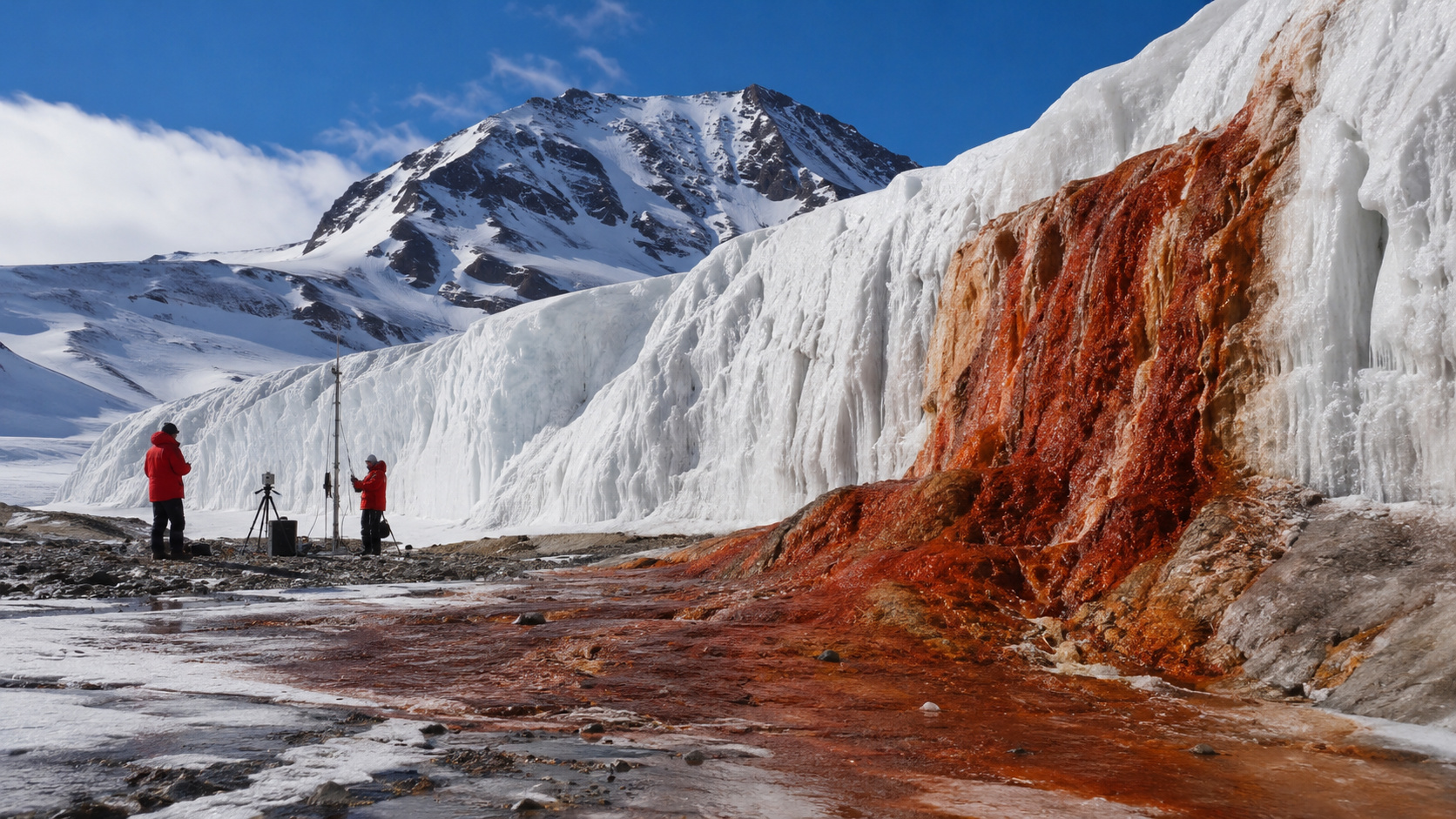

Recent research reveals that the mysterious Blood Falls in Antarctica not only hide extremely salty water trapped under the ice for about 1.5 million years, but also a unique microbial ecosystem that has never had contact with sunlight, offering valuable clues about life in extreme environments on Earth and even other worlds.
Imagine a river of intense red color slowly flowing over a completely white landscape, surrounded by ice and snow. At first glance, the scene seems straight out of a science fiction movie or an inexplicable natural phenomenon. However, this spectacle truly exists and has intrigued scientists from different fields for over a century.
Known as Blood Falls, these formations located on the Taylor Glacier in Antarctica continue to surprise the scientific community. According to a report published by the site ScienceAlert and based on a study released in 2026 in the scientific journal Antarctic Science, new discoveries help explain how this reddish flow breaks the ice surface and reveal impressive details about an environment completely isolated from the rest of the planet.
Far beyond the unusual appearance, the Blood Falls represent a true natural laboratory for research on glaciology, microbiology, climate change, and astrobiology.
-
Mati Carbon Wins $50 Million Prize for Boosting Harvests and Capturing Carbon by Distributing Free Basalt Dust to Small Farmers in India and Africa

-
Human Waste in Kenya is Solar-Treated and Turned into Fuel Briquettes, Tackling Open Sewage, Charcoal Use, and Deforestation

-
Bolivian Teen Builds Functional Robots from Scrap Materials in High-Altitude Rural Town
-
Student Creates 3D-Printed Prosthetics from Recycled Plastic, Turning Waste into Affordable Custom Arms




The phenomenon that has intrigued scientists for over 100 years


The Blood Falls were first observed in 1911, when Australian geologist Griffith Taylor was exploring the glacier region that would later bear his name.
At the time, Taylor believed that the red coloration was caused by algae present in the water. The hypothesis seemed plausible, but decades of research demonstrated that the explanation was completely mistaken.
In reality, the water that emerges from the glacier has an extremely high concentration of dissolved iron and salt. It is a very ancient brine, trapped under hundreds of meters of ice since a pocket of seawater was isolated during the glacier’s advance approximately 1.5 million years ago.
Over this enormous span of time, evaporation and geological processes have made this water progressively saltier. The salt concentration has become so high that the liquid remains fluid even at temperatures well below the normal freezing point.
When it finally reaches the surface, the water comes into contact with atmospheric oxygen. At this moment, the oxidation of iron occurs, exactly as happens with rust on metal objects, producing the intense red coloration that has made the location famous worldwide.
For decades, however, one question remained unanswered: how could this water travel hundreds of meters through an extremely cold glacier to emerge at the surface?
Radar revealed the secret path hidden beneath the glacier
This mystery began to be solved in 2017, when researchers led by the University of Alaska Fairbanks used radar equipment capable of seeing inside the glacier.
The scientists managed to map an underground path approximately 300 meters long, revealing a complex network of pressurized channels invisible under the ice.
The discovery also solved another enigma considered even more intriguing: how can liquid water circulate in such a cold environment?
The answer lies precisely in the composition of the brine.
The high salt concentration significantly lowers the freezing point of the water. Furthermore, whenever small portions begin to freeze, heat is released during the physical process, warming the surrounding ice and preventing the entire channel from being blocked.
This mechanism creates a kind of natural balance that keeps the flow active for long periods.
At the time of the discovery, glaciologist Erin Pettit explained that, although it seems contradictory, water releases heat when it freezes, warming the colder surrounding ice and favoring the maintenance of these internal channels.
As a result, the Taylor Glacier came to be considered the coldest glacier ever identified with a persistent flow of liquid water.
An ecosystem that has never received sunlight
If the geological dynamics of the Blood Falls already impressed researchers, the greatest surprise was hidden much deeper.
Hundreds of meters below the surface exists an entire community of microorganisms that has remained completely isolated from the rest of the planet for more than a million years.
Without sunlight.
Without oxygen.
Without any contact with the Earth’s atmosphere.
These bacteria survived by using sulfate-rich compounds as their main energy source, adapting to an environment considered extreme even by current scientific standards.
This isolation makes the ecosystem one of the most extraordinary ever found on Earth.
Microbiologist Jill Mikucki, currently affiliated with the University of Tennessee, took several years to collect adequate samples of the water trapped under the glacier.
When she finally obtained enough material for analysis, the results surprised the scientific community.
Instead of a practically sterile environment, researchers found an active and diverse microbial community, capable of surviving without relying on photosynthesis, a process used by most organisms living on the planet’s surface.

New study shows how the Blood Falls “breathe” under the ice
Although the origin of the iron-rich water was already known, one of the biggest mysteries remained unanswered: what caused this liquid to periodically escape from the glacier?
The answer began to emerge thanks to a set of observations made in September 2018, but only understood years later. As published by the journal Antarctic Science, in a study led by scientist Peter Doran, from Louisiana State University (LSU), three devices simultaneously recorded a rare event of brine release trapped under the Taylor Glacier.
Almost by chance, the researchers had a GPS station monitoring the glacier’s movements, a time-lapse camera recording the Blood Falls daily, and temperature sensors installed in Lake Bonney.
The combination of these devices allowed the entire sequence of the phenomenon to be observed for the first time.
Over a few weeks, the glacier’s surface sank about 15 millimeters, while its movement speed decreased by approximately 10%.
During the same period, the sensors detected a cold water anomaly in the lake, while the images showed new reddish stains appearing almost every day on the icy surface.
In practice, the scientists witnessed the glacier deforming as the brine escaped from its interior.
According to the study’s authors, the pressure slowly increases under the ice until it reaches a critical limit. When this happens, the extremely salty water finds an escape route through the glacier’s internal channels, being expelled in pulses.
After each discharge, the pressure temporarily decreases, the ice surface settles, and the process gradually restarts, functioning as a natural cycle of pressurization and relief.
A natural laboratory to study life beyond Earth
The Blood Falls spark interest not only among glaciologists.
The site has become one of the main natural environments used by researchers in astrobiology, a field dedicated to studying the possibilities of life existence on other celestial bodies.
This is because the environment beneath the glacier presents characteristics considered similar to those found on icy worlds in the Solar System, such as Europa, Jupiter’s moon, and Enceladus, Saturn’s natural satellite.
The absence of sunlight, the scarcity of oxygen, the extremely low temperatures, and the presence of liquid water trapped under thick layers of ice make the environment an excellent model to understand how microscopic organisms could survive on other planets or moons.
Moreover, understanding the dynamics of these underground channels can help scientists monitor internal changes in Antarctic glaciers, providing important information about environmental changes and the evolution of glacial systems over time.
The researchers themselves highlight that continuous monitoring could indicate whether these discharge episodes are becoming more frequent or intense, turning the Blood Falls into an important natural indicator of the transformations occurring inside the Taylor Glacier.
Far beyond the impressive red coloration, the Blood Falls represent a window into a world practically untouched for over a million years. Each new discovery broadens the understanding of the limits of life on Earth and reinforces that there are still environments capable of surprising even modern science.
The research was published in the scientific journal Antarctic Science, while the report that gathered and contextualized the discoveries was released by ScienceAlert.


