






 Portuguese
  Spanish
  4 min of reading
  2 comments


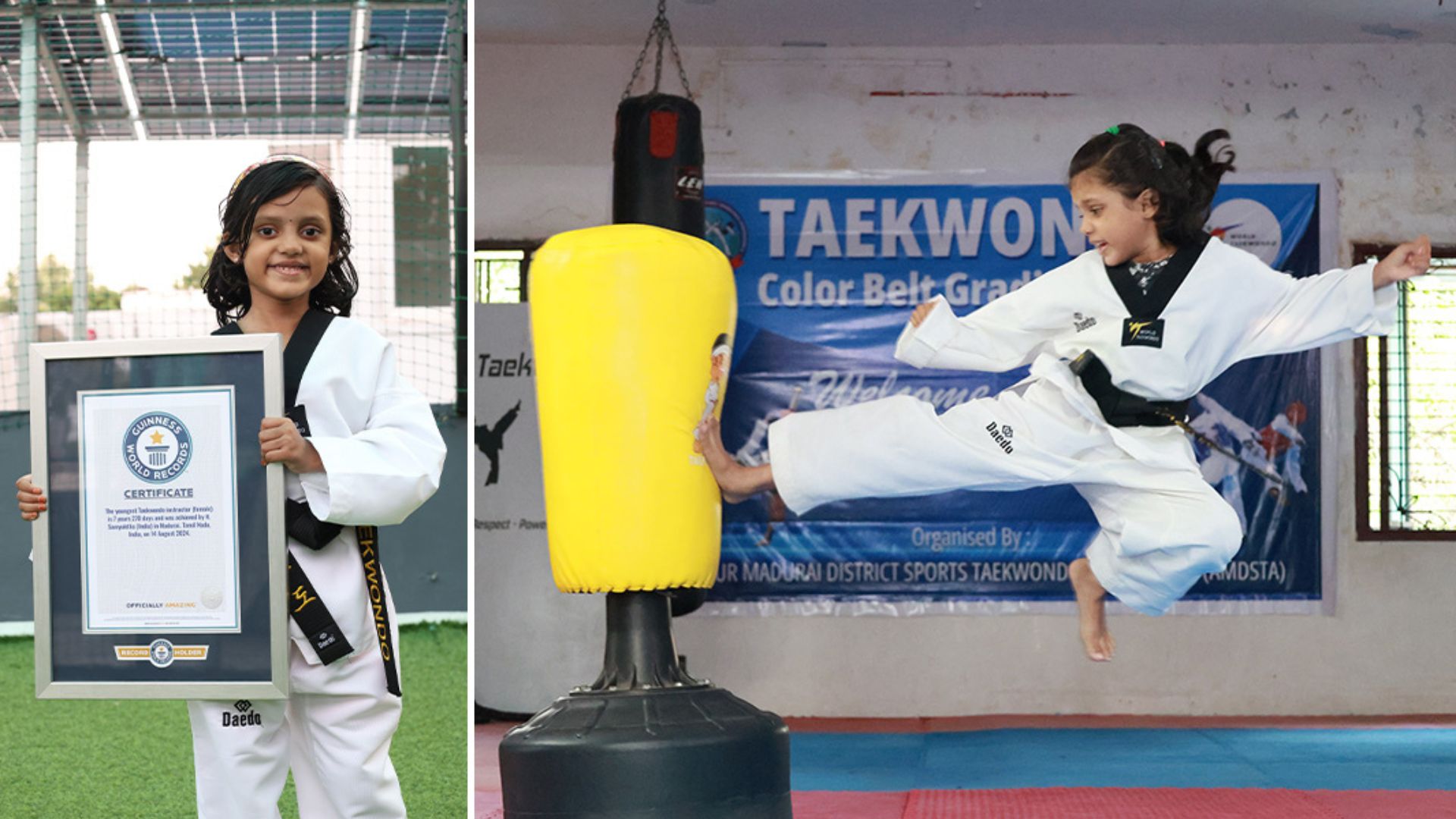


International Recognition Transforms Dojo Routine Into Record Story and Raises Discussion About Childhood, Training, and Public Exposure in Sports.
A girl from Madurai, in southern India, has been recognized by the Guinness World Records as the youngest taekwondo instructor in the world after taking classes at her family’s gym at the age of 7 years and 270 days, after achieving a black belt.
The record registered by Guinness is attributed to August 14, 2024 and states that Samyuktha Narayanan began training at the age of 3, progressed through the belt ranks, and as a child, was already guiding mainly other small students in the dojo run by her parents.
Guinness Record and Public Validation
Unlike stories that circulate only on social media, the record carries weight because it depends on criteria and documentation, and Guinness details the exact age and location where her role as an instructor took place, anchoring the achievement in Madurai.
-
Far beyond simple shocks: scientists highlight how electric fish from the Amazon use complex bioelectric mechanisms to generate up to 860 volts, a natural evolutionary innovation that ensures an absolute advantage in dark and challenging ecosystems.

-
Embrapa takes cashew, peanuts, and sesame to the world’s largest seed bank in Norway, where Brazil has already stored more than 8,000 samples since 2012 against pests and climate change.

-
Almost 1 km beneath Albania, miners find an underground “jacuzzi” of nearly pure hydrogen, with bubbles emerging from a pool inside a chrome mine and the potential to reveal a rare natural reservoir beneath Europe.

-
After working as a waiter for ten years, he borrowed R$ 500 from his brother, created 40-minute lines with an açaí cart on the street, and today runs a farm with 600,000 trees in Pará and a network worth R$ 45 million.



In addition to the role of teaching, the official report associates the achievement with typical requirements of more advanced ranks, such as following a training plan, learning taekwondo content, and completing a 5 km run as part of the process.

The publication also situates her journey within the family environment by registering that Shruthy and Narayanan run the Madurai Taekwondo Academy and have had other titles related to Guinness, which helps explain the child’s familiarity with the training routine.
In this context, the term “instructor” becomes the centerpiece of the headline because it suggests authority and responsibility, while the contrast with age creates a shortcut for understanding for those unfamiliar with the sport, the school, or the city.
Black Belt in Taekwondo and Training Routine
In the Guinness text, the progression to the black belt appears as a five-year journey, from white belt to black, and the narrative describes the girl training daily while incorporating teaching into her school schedule.
When recounting how she was motivated, Samyuktha stated that she was inspired by the certificates she saw at home and wanted to earn a title of her own to put on the same wall, reinforcing the symbolic weight of the record for the family.
Her father, Narayanan, was quoted saying he was happy to see his daughter’s progress and that after becoming an instructor, she had become more responsible and disciplined, attributing part of her motivation to the presence of Guinness.
This combination of institutional certification, training images, and a position typically associated with adults helps explain why the story transcended the local context and gained traction in Indian media, such as The Economic Times.
Sport in Childhood, Overtraining, and Risk of Injuries
At the same time, very early sports achievements often open a parallel conversation, not about the record itself, but about how to balance encouragement, exposure, and training load when children become public references.

The American Academy of Pediatrics updated a clinical report on overuse injuries, overtraining, and burnout in young athletes, discussing risk factors, warning signs, and prevention methods, especially when the routine becomes too intense.
In the sports realm, the International Olympic Committee gathered evidence and principles in a consensus on youth athletic development, advocating for pathways that consider health, maturation, supervision, and long-term aligned training decisions.
There are also documents discussing early specialization, such as the AOSSM consensus, which points to a lack of evidence of benefit in most sports and relates intense concentration on one sport to a higher risk of overuse injuries and burnout.
These references do not describe Samyuktha’s case, but they help explain why records involving children generate reactions on two levels: curiosity about the achievement and, on the other hand, concern about the environment that sustains performance.
Public Exposure and Pressure in Childhood Records
In taekwondo, the visual dimension amplifies the repercussion, with uniforms, belts, and demonstrations being easy to circulate, while Guinness reinforces that her role took place in her family dojo and that she taught primarily other children, within a supervised space.
Still, the existence of a global seal often stimulates comparisons and external expectations, especially when photos and videos begin to be reproduced by the press and television, as the girl herself reported to Guinness while commenting on the attention she received.
With a record of this type, the story shifts from being merely a training routine to becoming an international showcase, leading to the inevitable question of how to protect childhood when a certified and celebrated sports achievement becomes a model for other families.
What type of public and private care should accompany records in childhood so that the pursuit of excellence does not turn training, exposure, and pressure into rules that define the daily lives of those who are still growing?






A. Corredora de 100m. Shakir que foi treinada desde pequena e HOJE é a melhor do mundo ! O corpo vai se adpitando
Uma dúvida: Em qual órgão ela está registrada? Pq acreditava que pelos órgãos oficiais ela deveria mesmo atingindo a preta. Se manter na faixa poom ( vermelha e preta) até completar a idade mínima exigida.