Portuguese
  Spanish


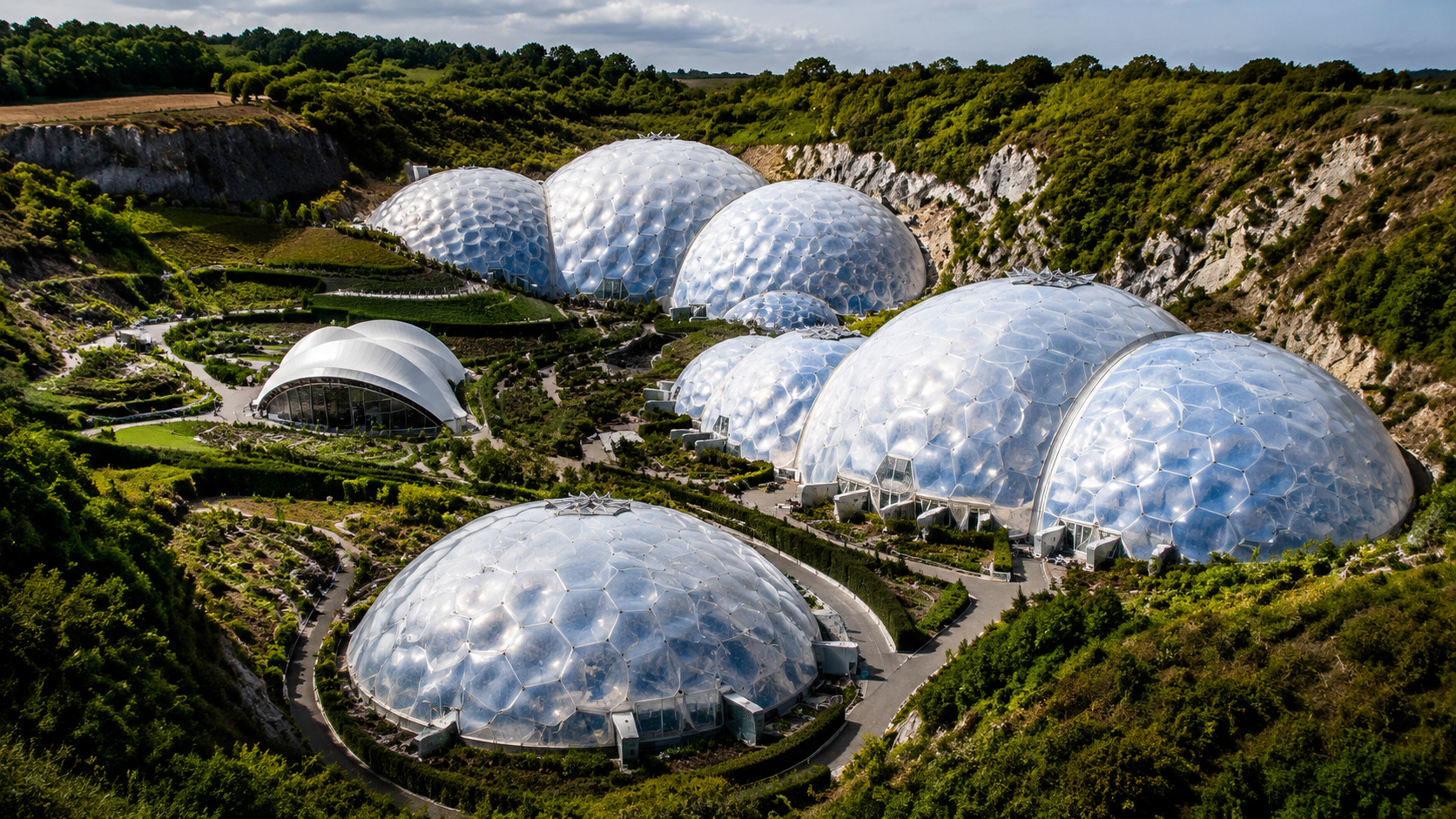


The Eden Project in Cornwall transforms an old mine into giant geodesic biomes, with hexagonal structures and triangles that combine lightness, transparency, and innovation in sustainable architecture, attracting tourists and engineers from all over the world
The Eden Project in Cornwall transformed an old clay mine into a set of impressive geodesic biomes, composed of hexagons up to 11 meters and triangles that form light and transparent domes. The structure combines steel and ETFE cushions, a material lighter than the air contained inside, giving the impression that the domes float above the crater. The work stands out for its innovation, aesthetics, and tourist impact.
Each biome maintains ideal conditions for tropical and Mediterranean plants, allowing visitors to walk among the domes while observing the structural complexity that maintains the balance of the set. The project combines advanced engineering, reuse of degraded space, and educational experience, showing that abandoned mines can become world references in sustainable architecture.
The information was released by Eden Project, a British organization dedicated to environmental and educational projects, detailing the geometry and lightness of the structure that keeps the biomes safe and functional.
-
At 17, she hand-painted her first watercolor design for school uniforms; her brand grew without investors, sold 135,000 pieces, and aims for $3 million in revenue by 2026.

-
Shell Discovers Intact Early 19th-Century Wooden Shipwreck in the Gulf of Mexico at Over 1,300 Meters Deep
-
Brazilian Entrepreneur Turns Door-to-Door Jewelry Sales into a Family Business Empire with Over 70 Stores

-
$75 Million Bridge in Brazil Opens to Connect Cities, Create Jobs, and Cut Travel Time from 30 to 2 Minutes; Spanning 1.24 km, It’s Among the Country’s Largest and Ends Decades of Ferry Queues.




How a clay pit became a tourist attraction
The former clay mine was utilized to create habitable and educational domes, using the uneven terrain as a base for distinct microclimates. Each dome is supported on carefully calculated foundations, ensuring wind resistance and stability even with the lightness of the material.

The Eden Project, a British organization dedicated to environmental and educational projects, detailed that the crater was adapted to house different ecosystems, allowing plants from diverse regions to coexist in a single space, providing learning and contemplation for visitors.
Why hexagons make the structure so light
The combination of hexagons and triangles distributes the weight of the steel and ETFE, ensuring rigidity and stability without requiring heavy materials. The external hexagons reach up to 11 meters in width, while the internal triangles maintain the shape and increase the safety of the construction.
The spatial geometry reduces stress on the material, allowing the domes to appear to float, attracting the attention of visitors and engineering experts from around the world.

What is ETFE and how it replaces glass
ETFE is a transparent polymer that covers the domes’ cushions. It is extremely lightweight, impact-resistant, and durable, allowing large surfaces without compromising the structure. Unlike glass, ETFE maintains controlled temperature and lighting, facilitates maintenance, and is self-cleaning, ensuring safety and practicality in large-scale biomes.
Why biomes need to be anchored
Despite the lightness of the structure, each dome is firmly anchored to the foundations, preventing displacement by the wind. The engineering combines precise calculations of weight, pressure, and resistance, allowing the domes to maintain shape and safety, even in extreme weather conditions.
The information was disclosed by Ingenia, a technical engineering magazine, explaining that the anchoring and spatial geometry make the biomes safe, while also providing lightness and a unique aesthetic.
What this work teaches about reusing degraded areas
The project demonstrates that abandoned industrial areas can become educational and tourist spaces. The former clay mine has become a world reference in environmental reuse, uniting architecture, engineering, and scientific education. The Eden Project shows that creativity and technology can revitalize degraded landscapes in a functional and sustainable way.

The example of the Eden Project inspires similar projects, proving that abandoned spaces can be reinvented with innovative design and positive social impact.
The Eden Project is proof that engineering, geometry, and sustainability can transform an abandoned site into a world reference, attracting visitors and promoting environmental education in a practical and visually impactful way.
Were you surprised by the transformation of the mine into geodesic biomes, or do you know another project that combines architecture and the reuse of degraded areas? Share your opinion in the comments.