






 Portuguese
  Spanish


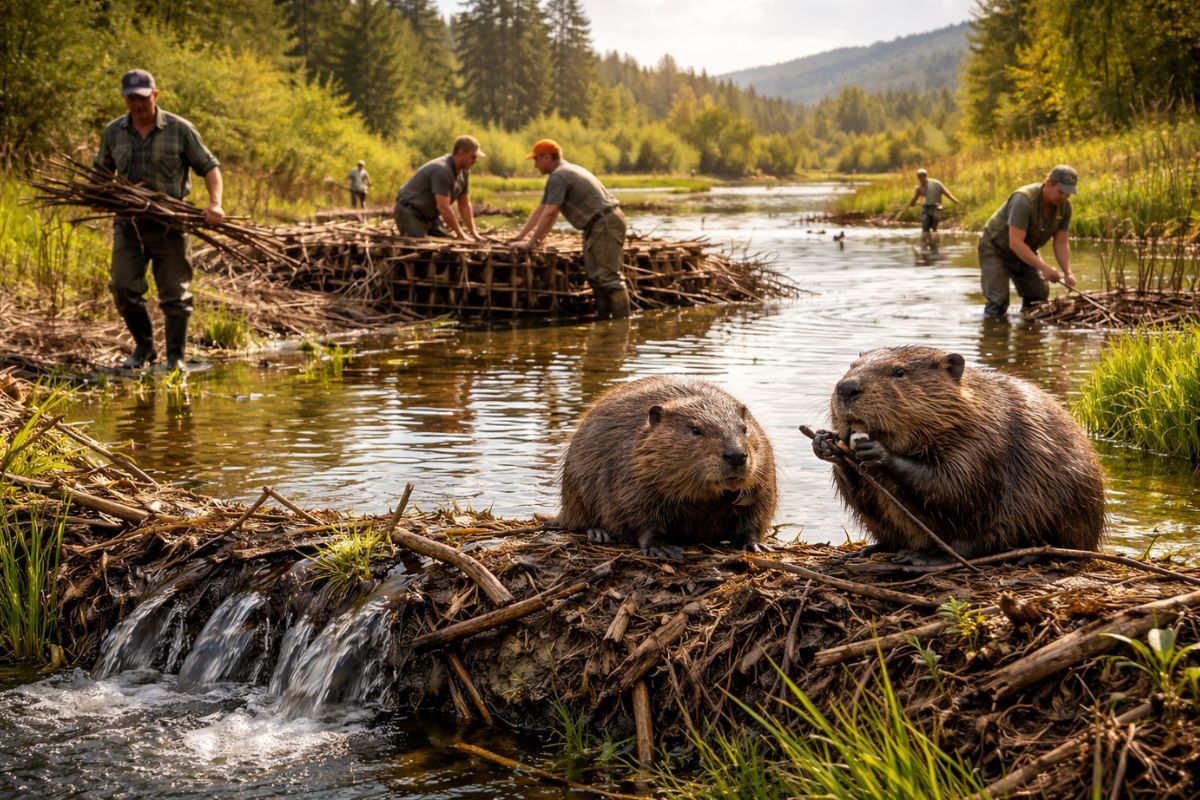
After Losing All the Water of a Lake in Hole Acre Wood, on the Mapperton Estate Located in Southwest England Due to Dam Breach, Volunteers Rebuilt Banks, Installed Permeable Dams, Reinforced Fences, and Reorganized the Stream Flow So That Beavers Could Return Safely and Resume Their Natural Role in Transforming the Restored Wetland.
The beavers are back in a swamp that had to be literally rebuilt after a leak led to the complete drainage of the lake. Without accumulated water, the habitat ceased to provide shelter and safety, requiring a task force of volunteers to rebuild dams, contain leaks, and restore the water balance.
Now, with the return of the beavers, the site functions again as a living system where these nature engineers play the main role in reshaping the landscape, continuously controlling water, vegetation, and terrain structure.
The Lake That Disappeared After the Breach

The critical point began when a series of heavy rains raised the water volume behind the old dams.
-
Smart Glass Revolutionizes Privacy: Touch-Activated Opacity Transforms Windows into Connected Home Features with App and Voice Control

-
Young Innovators from Brazil Turn Discarded Plastic into Eco-Friendly Bricks Using Coconut Fiber, Offering a Sustainable Alternative for Construction
-
Brazilian Scientists Among Team Proposing to Turn Ocean Depths into Giant Gravity Battery Using Cargo Ships and Subsea Cranes

-
Chile’s Plan for a 20,000 km Undersea Cable to Hong Kong Halted by U.S. Pressure, Highlighting the Silent Data Control Battle in Latin America




The pressure was great enough to breach the previously constructed natural structure, releasing all the accumulated water.
The lake located in Mapperton and known as the “beaver lake,” located in the county of Dorset, England, drained and the water flowed away through the downstream river system.
Without the lake, the space ceased to be suitable for the beavers.
Without enough standing water, they lose protection from predators and cannot maintain their natural activities, such as building shelters and managing branches and trunks.
The Challenge of Recreating a Swamp From Scratch

With the lake dry, the work had to start from scratch. It was necessary to address two problems at the same time: getting water back into the system and preventing it from escaping through existing leaks in the banks.
The volunteers identified spots where water was passing under the old barriers, circumventing sides and draining quickly.
Sandbags were initially used, but they degraded over time and could not withstand the force of the water. It became clear that a more robust solution integrated into the terrain was needed.
Blocking Leaks and Rebuilding Banks

The new strategy combined clay, logs, and sandbags to seal the escape points. The clay was used as an internal lining for the new structure, helping to reduce seepage.
Logs were positioned to provide support, while the sandbags served as temporary containment until the structure stabilized.
The result was the gradual formation of a new body of water, visible a few days after the interventions, showing that the flow was being retained more efficiently.
Reopening the Waterway
In addition to holding the water, it was necessary to ensure that it reached the site. The stream that feeds the area splits at one point, forming a natural diversion. Part of the flow had been blocked to reduce excess input in the past, but now the goal was the opposite.
Logs and barriers were removed to release more water toward the old lake. With heavy rains predicted, the volunteers knew that the increased flow would help quickly test the efficiency of the new structures.
Permeable Dams to Reduce the Force of Flash Floods
Further up the valley, structures resembling natural dams were installed, made with wood positioned at an angle. They do not completely block the water but slow down the current, retaining branches, leaves, and sediment.
These dams reduce the direct impact of flash floods on the main area, preventing large volumes of water from hitting the reconstructed point with enough force to cause new breaches.
Reinforced Fences to Prevent New Leaks
Another critical point was physical containment. In previous leaks, the force of the water carried logs and stones against the lower grid of the fence, opening a passage. Now, the bases of the fences have been reinforced with more durable materials and better ground anchoring.
The inspection included checking for gaps, loose parts, or areas where water could return to cause structural damage. The goal is to prevent the beavers from finding an escape route again.
The Return of the Beavers to the Restored Habitat

With water accumulating again and the structures reinforced, in 2023 two new beavers were introduced to the site. They arrived with similar weight and age, ready to take on the natural task of maintaining and expanding the dams.
As soon as they were released, they sought shelter in the vegetation and began to explore logs and banks. The immediate behavior was one of territory reconnaissance and the beginning of typical construction activities, a sign that the environment already offers minimal conditions for their permanence.
Now the Work Passes to Nature’s Engineers
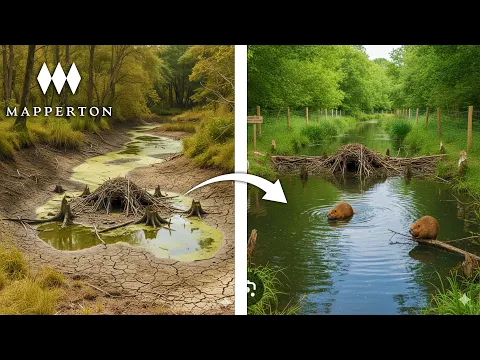

The entire reconstruction was designed as a starting point. The expectation is that the beavers will reinforce dams, expand flooded areas, and adjust the water flow according to their needs. They use branches, mud, and vegetation to seal leaks that humans have difficulty controlling.
Over time, the swamp is expected to become more stable, with permanent flooded zones, vegetation adapted to humidity, and greater diversity of microhabitats.
After all the human effort to bring the water back, now it is the beavers who take charge of the landscape.
Do you think nature, with the help of beavers, can keep this swamp stable in the long run?






-

1 person reacted to this.