Portuguese
  Spanish


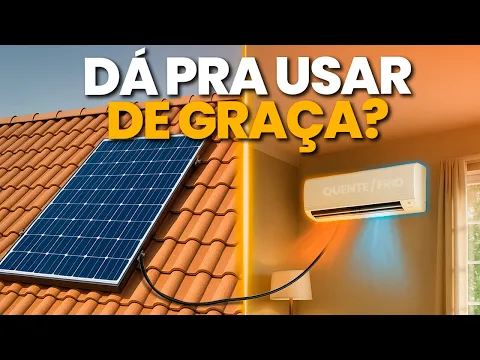
In The Midst Of The Rise In Energy Bills, Curiosity Grows About The Real Capacity Of Solar Panels. Many Wonder If Just One Panel Would Be Sufficient To Sustain A Hot And Cold Air Conditioner For Several Hours.
Can just one solar panel keep a air conditioner running all day?
The answer requires simple calculations and some technical parameters. The channel E4 Renewable Energies provided a brief explanation on the topic.
To organize the explanation, the process was divided into three steps: equipment consumption, solar panel generation, and possible operating time.
-
China Develops Custom 140-Ton Electric Mining Truck with 770 kWh Swappable Battery, Deploys 290 Units in Xinjiang’s Largest Zinc Mine

-
Meta to Launch Arena, a New Prediction App Targeting 3.56 Billion Users, Competing with Polymarket and Kalshi

-
Scientist Challenges Famous Human Evolution Theory, Argues Homo Sapiens Evolved Gradually Over Thousands of Years
-
15-Year-Old American Builds Ocean Generator with PVC Pipe and 3D-Printed Propeller for $12, Wins National Prize, Presents at White House, and Makes Forbes 30 Under 30 List




Air Conditioner Consumption
The starting point is to understand how much a 12,000 BTU air conditioner consumes in an hour. The example used is a hot and cold model from LG, sold on Amazon for R$ 2,649.
The Inmetro label shows the average annual consumption of this device: 484.6 kWh. Since the methodology change, the calculation considers usage for 2,080 hours per year.
Therefore, just divide the annual consumption by the testing hours. The result is 0.23 kWh consumed for each hour of operation.
This value is an average. Actual consumption may vary depending on the chosen temperature, the environment, and the time it is on.
Thus, the first step shows that the air conditioner consumes 0.23 kWh per hour, considering the official measurement parameters.
Energy Generated By The Solar Panel
The second step is to find out how much energy a solar panel can generate per day.
For this, it is necessary to consider three points: module power, solar irradiation of the city, and system efficiency.
In the Brazilian market, there are already high-power panels available. The calculation uses a model of 665 W, among the largest available. The chosen reference city is Belo Horizonte, which has an average irradiation of 5.36 kWh/m² per day.
Another factor is system efficiency, as there are losses in any electrical installation. Dirt, incorrect inclination, and cables cause reductions. An average of 25% loss is widely accepted in the industry. Thus, the efficiency considered is 75% or 0.75.
Example: A 665-watt panel installed in an area where the average daily irradiation is 5.36 kWh per square meter. If the system has 75% efficiency, the calculation is: 665 times 5.36 times 0.75, divided by 1000. The result is approximately 2.67 kWh of energy generated per day.
The result is 2.67 kWh per day.
Thus, a 665 W panel generates an average of 2.67 kWh per day in Belo Horizonte.
How Long Can The Air Conditioner Be On
With the consumption of the air conditioner and the generation from the solar panel defined, the third step is to calculate the possible operating time.
If the air conditioner consumes 0.23 kWh in one hour, and the panel generates 2.67 kWh in a day, just divide one value by the other. The calculation results in 11.6 hours, which is approximately 11 hours and 36 minutes.
This means that a single 665 W solar panel is enough to keep the device running for nearly half the day, with no additional cost of energy.
It is an impressive result, as it shows the feasibility of combining efficient equipment with renewable energy.
Important Observations
It is worth highlighting an essential detail. The calculation was made considering an on-grid system. In this model, the utility’s electrical grid works alongside the panels. When there is excess generation, the energy is fed back into the grid.
Because of this, it does not matter if the air conditioner requires more power at certain moments. The electrical grid complements the instantaneous demand. What matters is the final balance between the device’s consumption and the generated energy.
In off-grid systems that use batteries, the situation changes. In this case, it is necessary to consider storage capacity and discharge limitations. The base material itself indicates that there is a separate video with specific calculations regarding lithium batteries.
Therefore, the analysis presented shows the equivalence between air conditioner consumption and panel generation in a grid-connected system.
Based on the calculations, it is possible to affirm that a single 665 W solar panel can generate enough energy to keep a 12,000 BTU air conditioner running for more than 11 hours per day.
This does not mean complete independence, as the electrical grid is still necessary for simultaneous operation and to cover variations. However, it proves that solar energy can meet the consumption of such equipment with remarkable efficiency.
Thus, the idea of using just one solar panel to power a hot and cold air conditioner is not only possible in calculations. It proves to be practical and viable in grid-connected systems, provided that sizing is done correctly.