





 Portuguese
  English
  Spanish
  3 min of reading
  0 comments



The Innovation Of Swiss Scientists May Put An End To The Annoying Noise Of Air Conditioning! Learn How This Revolutionary Material Can Reduce Noise To Almost Zero And Transform The Comfort Experience In Any Environment!
Imagine a world where the constant noise of trains, the annoying buzz of compressors, and even the sound of air conditioning are reduced to nearly imperceptible levels.
This future is closer than ever, thanks to Swiss scientists who are developing a revolutionary material. Recently, a team from ETH Zurich created an innovative compound that promises to transform the way we deal with noise pollution, drastically reducing noise in our environment.
Noise and vibrations, besides being annoying, can damage equipment and even harm our health. Traditionally, to mitigate these effects, engineers used damping materials such as foams and rubbers. However, these materials often increase both the volume and cost of applications, limiting their use on a large scale.
-
Four Turkish students use ultrafiltration tubes, charcoal, and washing machines to create a device that reuses up to 90% of laundry water and wins a global prize of $100,000.

-
In Brazil, students from IFRN create a mini-plant that crushes construction debris, transforms construction waste into cement blocks, and wins an international prize from Samsung with a sustainable solution in the interior of Rio Grande do Norte.

-
Scientists mixed hydrocarbons with a gold leaf, subjected them to pressure greater than that of the Earth’s mantle and heat above 1,900 °C, and ended up accidentally discovering a new compound of gold and hydrogen.

-
Scientists discover a giant crocodile that lived millions of years ago, measuring over 8 meters, which reigned in the rivers of ancient Kenya and could hunt early humans near the water.



However, the team at ETH Zurich took a step further by creating a new type of material that combines stiffness and a strong damping capacity, two characteristics that rarely coexist.

The new material is composed of thin layers of rigid materials, such as glass or silicon, interspersed with ultrathin layers of a polymer similar to rubber. This unique combination is comparable to a “mille-feuille,” with the rigid layers representing the mass and the polymer, the filling that absorbs vibrations.
The Development Process And The First Results – Silent Air Conditioning
The creation of this material began with a series of calculations performed by PhD student Ioanna Tsimouri. Using computer models, Tsimouri determined that the polymer layers should account for less than 1% of the total volume of the material to achieve the desired properties.
Based on these calculations, the team created different variations of the compound in the lab, using glass similar to that found in smartphones and a mixture of PDMS polymer for the damping layers.
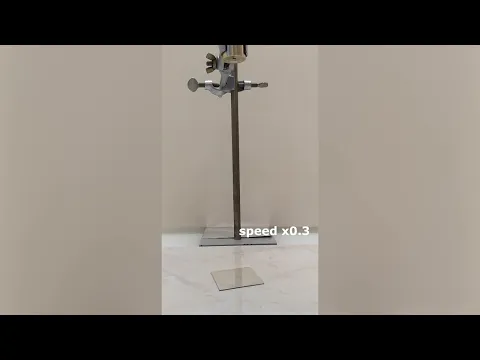
The test results were impressive. A plate made with the new material, when dropped onto a table, produced significantly less noise compared to a regular glass plate and did not bounce. “When I first experienced the drop, I was impressed by the difference. The contrast between the deafening sound of the glass and the muffled sound of our material was striking,” said Tsimouri.
Future Applications And Large-Scale Production

The potential of the new material is vast. It can be used in a wide range of applications, such as windows, machine enclosures, automotive parts, aerospace technology, and even sensors.
In addition, it stands out for being resistant to a wide range of temperatures, making it suitable for various industries and environments. Another positive point is the possibility of recycling, which further enhances its sustainable appeal.
According to Professor Walter Caseri, who also participated in the development, the industrial production of this material on a large scale is feasible. He explains that panels of several square meters could be manufactured with the right machines.
Although controlling the thickness of the layers is still a challenge, the results obtained so far are extremely promising.
With large-scale production, this innovative material could significantly reduce noise and vibration pollution in urban and industrial environments, improving quality of life and the durability of equipment.
The innovation developed by the team from ETH Zurich may be closer than we think to revolutionizing our sound environment.








Be the first to react!