






 Portuguese
  Spanish
  3 min of reading
  0 comments


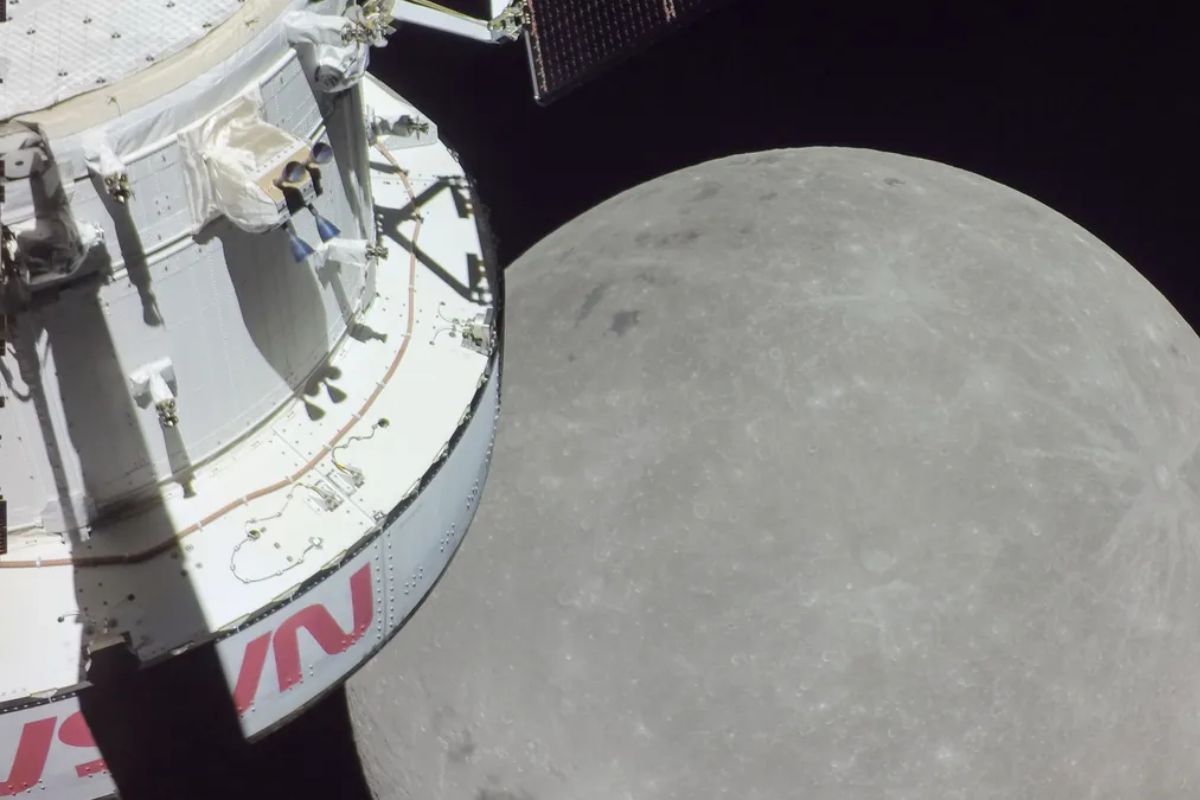
A device created by researchers from the University of São Paulo was used by NASA during the Artemis II mission, which took four astronauts around the Moon between April 1 and 10, 2026. The equipment, called actigraph, was used on the wrists of the astronauts throughout the mission to monitor sleep patterns, activity levels, and light exposure, data considered essential to understand how the human body reacts in deep space. This is the first time that Brazilian technology participates in a crewed flight to the Moon.
Artemis II, conducted by NASA, was the first crewed mission to the Moon in 53 years, since Apollo 17 in 1972. The Orion capsule carried American astronauts Reid Wiseman, Victor Glover, and Christina Koch, along with Canadian Jeremy Hansen, to a record distance of 406,771 kilometers from Earth, surpassing the previous Apollo 13 record by 6,600 km. The four passed the far side of the Moon, photographed craters never seen by human eyes live, and throughout this journey, they had a watch made at a Brazilian public university on their wrists.
The actigraph was developed at the School of Arts, Sciences, and Humanities of USP (EACH), under the coordination of Professor Mario Pedrazzoli, a specialist in chronobiology. The device measures body movement, light intensity, and spectral composition of light, including the so-called blue light, which regulates the sleep-wake cycle. In space, where there is no natural day and night, the human body loses fundamental biological references and sleep becomes one of the most critical factors for the performance and safety of astronauts.
How did a watch from USP get to the wrists of NASA astronauts?

The journey began years before the launch.
-
A doctor from Minas Gerais warns that sleeping with the fan pointed at the body all night is not as harmless as you think; it dries out the respiratory tract, causes mucus buildup, spreads dust mites, and can even irritate the cornea of the eyes.

-
Ecuadorian volcano at 6,268 meters is more than 2,000 meters closer to space than Everest, which is 8,848 meters, because the Earth is wider at the equator.
-
Public school students in the hinterlands of Maranhão create a bioinsecticide with neem and castor to protect corn crops, transform rural waste into biogas and biofertilizer, and bring sustainable technology to producers at ExpoSertão.

-
Ötzi, the 5,300-year-old mummy found in the Alps, reveals a still active microbiome, and the Iceman’s yeast points to an energy-saving fermentation.


Professor Pedrazzoli’s research group developed the actigraph for studies of sleep disorders in Brazilian populations.
The device caught NASA’s attention for its precision in collecting light and movement data in controlled environments, exactly the type of monitoring needed for long-duration missions outside Earth’s orbit.
The American space agency tested the equipment and decided to include it in the Artemis II protocol.
The device appears in official NASA images on the wrists of the four astronauts, which EACH-USP highlighted as a historic achievement for the Brazilian public university.
For the institution, the use of the device in a mission of this scale demonstrates that Brazilian scientific research has the capacity to compete and contribute at the highest level of space exploration.
The collaboration also opens doors for future partnerships between Brazil and international space programs, especially considering that NASA plans to land astronauts on the lunar surface starting in 2028 with the Artemis III mission.
What the actigraph revealed and why it matters beyond space?
The data collected during the 10-day mission is still being analyzed by NASA and the USP team.
But continuous monitoring of sleep in extreme space environments has direct applications on Earth.
The same rigor used to protect astronauts can guide diagnoses of sleep disorders, create protocols for professionals working irregular shifts, such as doctors, pilots, and military personnel, and assist in the formulation of public health policies.
The reentry of the Orion capsule into the Earth’s atmosphere on April 10 generated temperatures of 2,760°C on the outside, with a 13-minute plunge that cut off all radio communications.
The four astronauts safely landed in the Pacific Ocean, off the coast of California, with the Brazilian technology intact on their wrists.
Commander Reid Wiseman described the mission as “the most special thing that has ever happened in my life.”
The Artemis II mission covered a total of 1,117,515 kilometers, in two Earth orbits and one lunar flyby, validating systems that will be used in the planned lunar landing for 2028.
And in every kilometer of that, Brazil was present.
Technology from a Brazilian public university monitored astronauts on the Moon. Comment below: did you know that Brazil participated in Artemis II?




-

1 person reacted to this.