Portuguese
  Spanish


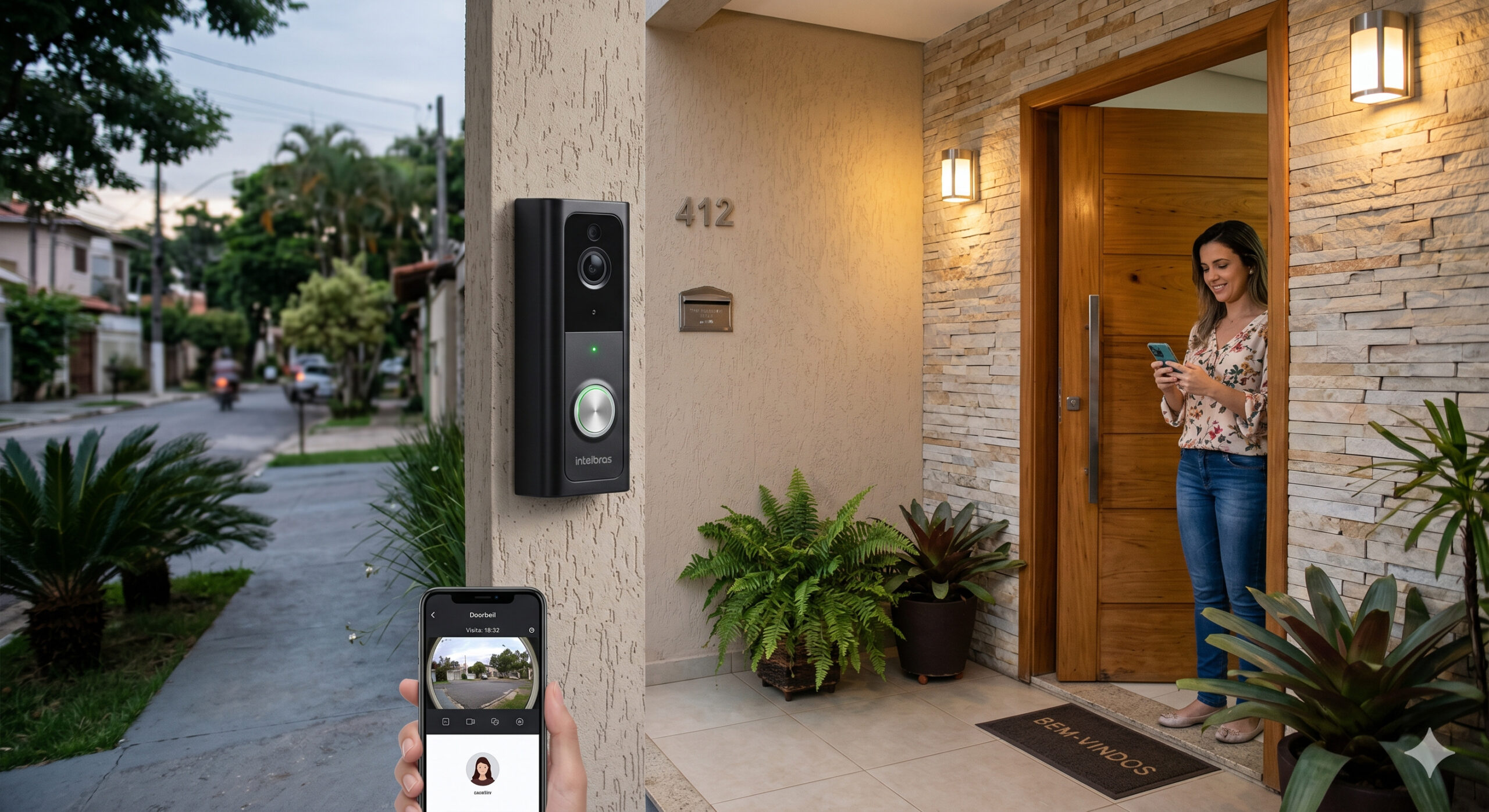

Smart intercoms arrive in Brazil with wide vision, mobile alerts, and up to 3 months of autonomy, changing residential access control.
In 2026, the advancement of the connected home in Brazil began to reach one of the most traditional elements of residential security: the intercom. Rather than stating a total replacement, the safer formulation is to say that it now shares space with smart video intercoms, devices that combine camera, remote communication, and app monitoring. In an article published on July 20, 2021 by Positivo Casa Inteligente and on the official page of Smart Video Intercom, the company describes this type of solution as an alternative capable of enhancing access control with digital resources and smartphone operation.
Among the features reported by the manufacturer are 120° field of view, night vision, motion sensor, two-way audio, real-time notifications on the mobile phone, and battery autonomy of up to 3 months, depending on usage patterns. In practice, these devices allow the resident to see who is at the door, converse from a distance, and automatically record events even when away from home, relying on Wi-Fi connection and integration with a mobile app, without solely depending on a fixed central unit inside the residence.
The central point of this transformation is straightforward: access to the residence no longer depends on a fixed and limited device and is now managed remotely, with image, history, and real-time control.
-
The industrial waste that even recyclers didn’t want has gained value in the interior of Bahia: two entrepreneurs invested R$ 2.8 million to transform 350 tons per year of foam, rubber, and plastic into boards that can replace wood and MDF.

-
What is a red flashlight used for, after all? See why it is so commonly used at night.

-
He has never read a line of code, but he already knows how to work: the French company UMA presented in Paris the Northstar, its first AI-powered humanoid robot designed for factories and warehouses, capable of copying tasks just by observing an employee in action.

-
A young Kenyan engineer collects plastic waste from the streets and transforms it into robots that translate physics lessons into sign language in real-time, a machine made with old bottles that teaches what was missing to deaf children left out of science.




Traditional intercom loses relevance due to operational limitations
For decades, the conventional intercom was the main communication tool between the interior of the residence and the entrance of the property. However, this model has always presented clear limitations. The system depends on the physical presence of the resident to answer calls, does not offer event recording, and lacks any type of visualization or history.


This limitation becomes more evident in a context where people’s routines involve greater mobility and less time spent at home. The traditional intercom does not keep up with this dynamic, creating gaps in access control.
The lack of mobility and recording transforms the intercom into a functional system, yet limited in the face of new demands for security and practicality.
Integration with app transforms the phone into the home access center
The main change introduced by smart video intercoms is the centralization of control on the smartphone. When receiving a call, the resident can view the image in real-time, interact via audio, and decide on access release directly through the app.
This model eliminates the dependence on a fixed point within the residence and allows control to be exercised from anywhere with internet access. Additionally, the system can send notifications whenever there is movement or activation of the device.
The mobile phone ceases to be just a means of communication and starts to function as a residential security hub.
Expanded field of vision reduces blind spots at the entrance of the residence
The smart video intercoms available in Brazil already operate with a field of vision that can reach about 120 degrees, allowing for a wider area to be captured in front of the door. This feature reduces blind spots and increases the ability to identify people and movements around the entrance.

The expansion of the field of vision is especially relevant in residences with more open entrances or in condominiums where there is frequent circulation of people.
The entrance of the house ceases to be a limited observation point and starts to offer broader visual coverage.
Motion sensor activates automatic recording and notification
Another significant advancement of these devices is the presence of motion sensors. When movement is detected, the system can automatically start recording and send an alert to the user.
This allows events to be recorded even without direct interaction with the device, creating a history that can be consulted later.
Security no longer depends solely on visitor interaction and starts to respond automatically to the environment.
Night vision maintains continuous operation even in low light
The models available in the Brazilian market also incorporate night vision systems, allowing the camera to continue operating in environments with little or no lighting.
This feature ensures that the identification of people and events is not compromised during the night, enhancing the system’s effectiveness throughout the day. Surveillance is no longer limited by lighting and operates continuously.
Battery autonomy allows installation without complex wiring
One of the features that favor the adoption of these devices is battery autonomy, which can last up to 3 months, depending on usage frequency and the number of recorded events.
This model eliminates the need for dedicated electrical wiring, allowing installation in locations where there is no prior infrastructure. This expands the reach of the technology to different types of residences, including rental properties.
The installation ceases to be a technical process and becomes a simple and accessible operation.
Event registration creates a history of movement at the home entrance
Unlike traditional intercoms, which do not record interactions, smart video doorbells store information about detected events, including activations and movements.
This history can be accessed by the user at any time, allowing them to check past occurrences and identify movement patterns. The home entrance ceases to be a point without memory and starts generating data that can be analyzed.

Smart video doorbells can be integrated with other devices in the connected home, such as indoor cameras, sensors, and lighting systems. This allows for automated responses to certain events, such as turning on lights when motion is detected or activating recording in other areas of the residence.
This integration enhances the level of automation and transforms access control into part of a broader system of security and home management. The technology stops functioning in isolation and becomes part of an integrated ecosystem.
Growth of the connected home in Brazil sustains the expansion of these devices
The adoption of smart video doorbells is directly related to the growth of the connected device market in Brazil. The increase in internet penetration, combined with the popularization of applications and mobile devices, creates favorable conditions for the expansion of this type of solution.
Manufacturers have expanded their product lines, offering different levels of functionality and prices, which contributes to the dissemination of technology. Home security now accompanies the digital evolution of Brazilian homes.
Transition indicates structural change in residential access control
The gradual replacement of traditional intercoms by smart systems indicates a structural change in access control to residences. The fixed, limited, and unrecorded model gives way to a mobile, integrated, and data-driven solution.
This transformation accompanies a broader trend of digitization in the home environment, where different functions are becoming centralized on digital platforms.
Access to the home ceases to be an isolated act and becomes part of a continuous system of monitoring and control.