






 Portuguese
  Spanish
  4 min of reading
  0 comments


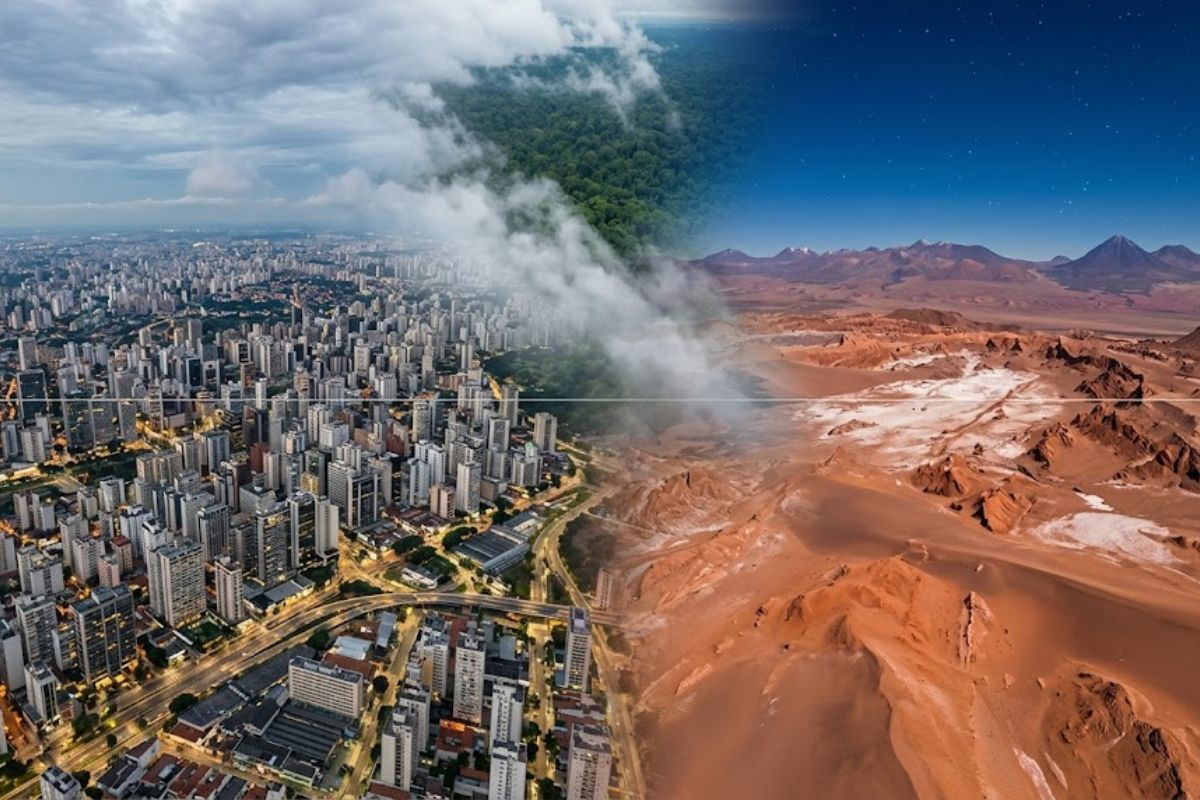
If geography decided on its own, São Paulo, Rio de Janeiro, and Belo Horizonte would be in the middle of a desert. The Brazilian Southeast is located between latitudes 15° and 30° South, the same band of the planet where the Atacama Desert in Chile, the Kalahari in Botswana, and Namibia in Africa are found. In this band, high atmospheric pressure systems cause the air to descend, preventing cloud formation and blocking rainfall. This is how deserts are formed. But the Southeast of Brazil is green, humid, and full of rivers. The reason lies more than 3,000 kilometers away: in the Amazon rainforest.
The Amazon acts like a giant moisture pump, and it is what prevents the Southeast from becoming a desert. The process, referred to by scientists as the “biotic pump,” begins with the trade winds, which bring moist air from the Atlantic Ocean into the forest. The trees absorb this water from the soil and return it to the atmosphere through transpiration, forming what researchers call “flying rivers”: masses of vapor that carry moisture thousands of kilometers to the Southeast and the Midwest. Without this transport, the rains that supply water reservoirs, power hydroelectric plants, and irrigate agriculture simply would not arrive.
Researcher Antônio Donato Nobre from the National Institute for Space Research (INPE) is one of the scientists who has studied this phenomenon the most. According to him, the Amazon produces about 20 billion tons of water vapor per day, more than the Amazon River itself discharges into the ocean. This volume is what keeps the rainfall regime of the Southeast functioning. “Without the great Amazon Rainforest, São Paulo’s climatic fate is a desert,” Nobre stated in studies published on the subject.
Deforestation is already reducing rainfall in the Southeast

The problem is that this pump is being dismantled. By 2013, the accumulated deforestation in the Amazon had already eliminated 779,930 km², an area equivalent to France and Germany combined.
-
He started with a jigsaw, his father’s screwdriver, and many drawings made during classes; years later, the young man who built a roller coaster in his own backyard went viral on the internet, was hired by Cacau Park, and now coordinates Brazilian and foreign professionals in the installation of an attraction weighing 737 tons, 55 meters high, one kilometer long, featuring moments of zero gravity and a speed of 120 km/h, in a journey that turned curiosity, calculations, and persistence into a professional career.

-
Between Egypt and Sudan, Bir Tawil is no man’s land that neither country wants on paper, but in practice has gold mining, nomadic tribes, and even fake “kings.”

-
Swimming champion Shavarsh Karapetyan dove about 40 times into a frozen lake in Armenia to rescue a sunken bus, saved 20 lives, and lost his career because of it.
-
Júlia Pimentel, an 11-year-old from Minas Gerais, independently invented a new formula to calculate the square root using simple addition and multiplication, and her method was published in one of the most important mathematical scientific journals in Brazil.


In the last 32 years, researchers from INPE have observed a decline in rainfall volume in the Southeast directly related to the loss of vegetation cover in the Amazon.
When the forest is cut down, what migrates to the Southeast is no longer moisture, but rather smoke from the fires, particles that actually prevent the formation of rain.
A study published in the journal Nature in 2024 estimated that 47% of the Amazon Rainforest could enter “water stress” in the coming decades.
Researcher Bernardo Flores, one of the authors, warned that the collapse may be closer than previously thought.
The most pessimistic scenario points to widespread degradation by 2050, which would irreversibly affect the rainfall cycle across the entire continent.
What happens to Brazil if the pump stops?

The consequences would be catastrophic. The Brazilian hydropower system depends on rain to fill the reservoirs, and the Southeast hosts the largest power plants in the country.
Without rain, there is no energy. The water supply in São Paulo, which already faced a severe water crisis in 2014-2015, would be permanently compromised.
Agriculture in the Midwest, which depends on the same flying rivers, would lose productivity.
Geologist Paulo Roberto Martini from INPE was straightforward: “The soil in the South and Southeast region has enormous potential to become a desert.
It just needs to stop raining regularly.” Geomorphological investigations show that Brazilian territory has had desert-like characteristics in the geological past, over 100 million years ago.
The abundance of water in the Southeast is not a guarantee from nature; it is the result of a fragile balance that depends on a forest that is being destroyed.
The Andes Mountains also play a fundamental role: they block moist winds and redirect them south, acting as a wall that pushes rain towards Brazil.
Without the forest to produce moisture and without the Andes to direct it, the Southeast would have the same climatic fate as its latitude neighbors.
São Paulo is at the same latitude as the Atacama. What prevents 22 million people from living in a desert is a forest that loses an area the size of a football field every minute.
Comment below: how long will this balance last?


Be the first to react!