






 Portuguese
  Spanish


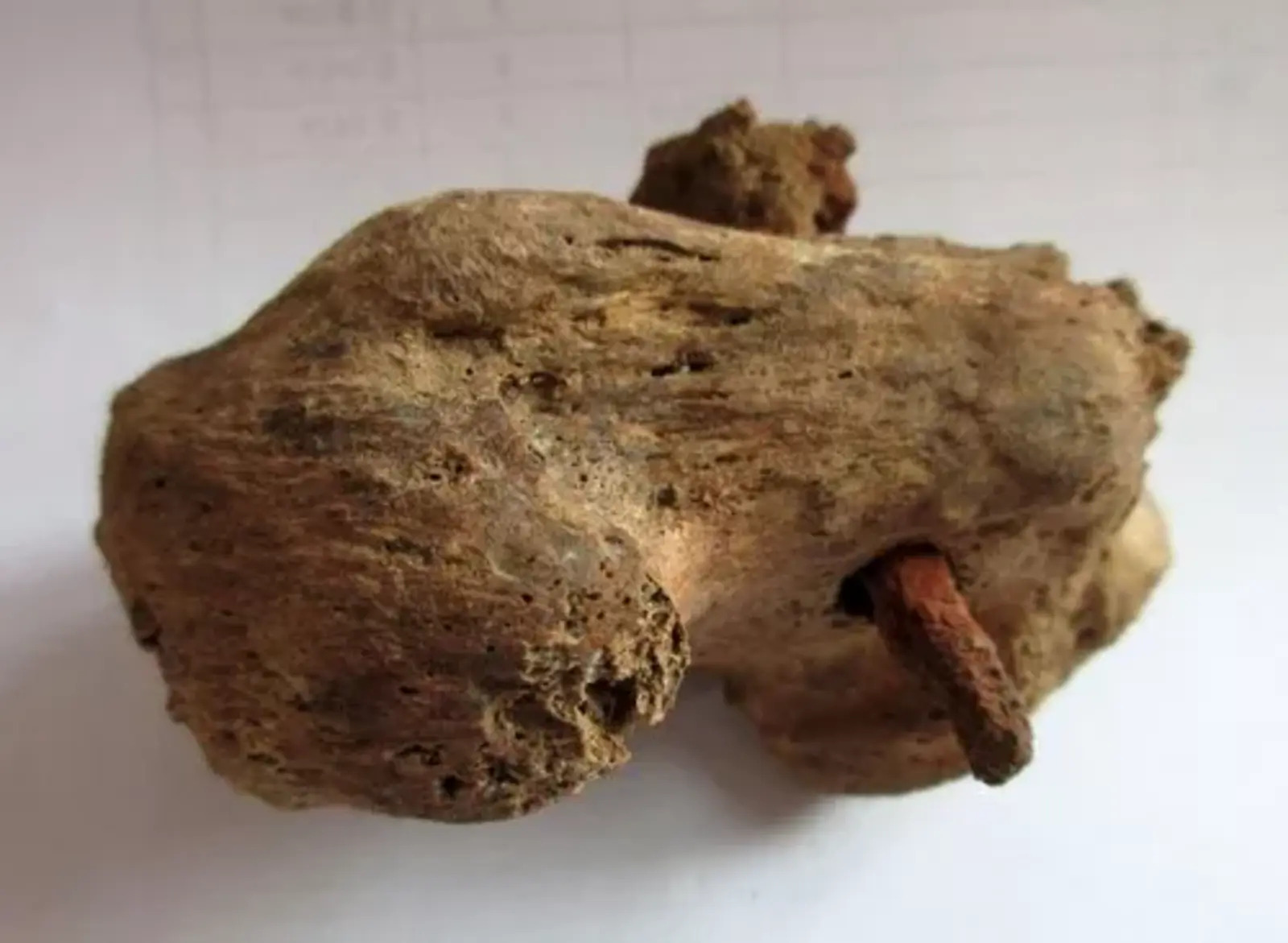

Discovery in Fenstanton reveals Roman skeleton with indications of crucifixion, first recorded case in the United Kingdom and Northern Europe
It has been a few years, but it is worth recalling this incredible find. Archaeologists excavating a 6-hectare settlement in Fenstanton, England, found a skeleton with indications of crucifixion, the first evidence of its kind in the United Kingdom and Northern Europe, in a find that expands the record of the practice.
Roman settlement
The team was working at a site along the Via Devana, a road that connected Roman cities to Cambridge and Godmanchester, when they located a settlement identified in 2017 and marked by five cemeteries, a common configuration in that region.
The central part of the area was preserved. The excavation focused on the edges of the site, away from the domestic space. Still, the researchers found traces of a wooden building and stone streets.
-
China Develops Custom 140-Ton Electric Mining Truck with 770 kWh Swappable Battery, Deploys 290 Units in Xinjiang’s Largest Zinc Mine

-
Meta to Launch Arena, a New Prediction App Targeting 3.56 Billion Users, Competing with Polymarket and Kalshi

-
Scientist Challenges Famous Human Evolution Theory, Argues Homo Sapiens Evolved Gradually Over Thousands of Years
-
15-Year-Old American Builds Ocean Generator with PVC Pipe and 3D-Printed Propeller for $12, Wins National Prize, Presents at White House, and Makes Forbes 30 Under 30 List




Cemeteries and population
The fieldwork revealed several Roman tombs, generally grouped in small cemeteries, with dimensions similar to those of a domestic plot.
DNA analyses allowed the recognition of some family groups among the people buried in that settlement.
Upon examining the skeletons, the specialists concluded that part of the adult population showed many injuries and diseases.
The situation observed in Fenstanton showed physical conditions marked by wear and recurring problems among the residents buried there.
Skeleton with nail
No grave immediately caught attention. It was only in laboratory activities that the archaeologists identified a skeleton with a nail fixed in the heel.
The team estimated that the body belonged to a man between 25 and 35 years old.
The individual had deteriorated dental health and arthritis, characteristics also seen in other people buried in Fenstanton.
There were also signs of thinning in the lower legs, possibly linked to infection, inflammation, or irritation caused by binding or shackling.
Twelve nails found on the rest of the skeleton suggest that it was not placed in a coffin, but on a board or support. The 13th was embedded horizontally in the man’s right heel.
Evidence of crucifixion
In Roman times, crucifixion was relatively common, but victims were usually tied to the cross, not nailed.
When nails were used, they were often removed afterward. Therefore, the preservation of this archaeological indication is considered extremely rare.
The archaeologists assess it is unlikely that the metal accidentally penetrated the bone during the assembly of the wooden support.
There are also signs of an additional hole, interpreted as a first failed attempt to nail the body.
The authors state that, although the discovery is not indisputable proof, crucifixion is the only plausible explanation.
Thus, the case of Fenstanton becomes the fourth worldwide record of crucifixion identified by archaeological evidence.
Formal burial and industrial activity
For the researchers, the striking aspect of the skeleton is not only the crucifixion but the fact that the body was recovered after death and received a formal burial, alongside the other burials at the site.
In addition to the unusual case, the team found a volume of animal bones in one area. Based on the arrangement of the material, the archaeologists believe that cattle fat was used in the large-scale production of soap or candles there.
With information from Revista Galileu.





