Portuguese
  Spanish


Submerged discovery in the Baltic Sea reignites debate on the organization of Stone Age groups and how landscapes now covered by water preserve traces of ancient human societies.
A row of stones almost a kilometer long, now submerged 21 meters deep in the Baltic Sea, has been identified by researchers as a probable structure built by human groups approximately 11,000 years ago.
The finding was named Blinkerwall and is located in Mecklenburg Bay, northern Germany, in an area near the coastal city of Rerik.
The structure measures approximately 970 meters in length and comprises about 1,500 stones, according to the University of Kiel.
-
World Cup Ball Chip Uses Technology to Detect Invisible Touches, Confirms Offside, Secures Portugal’s Victory Over Croatia

-
36-Meter Hydrogen-Powered Superyacht Arrives in Brazil to Debut German Engines and Showcase Future of Clean Navigation

-
Indian Students from Jaipur Win Top Prize at World’s Largest Science Fair with EcoFog, an Affordable Mesh to Harvest Fog Water Without Energy

-
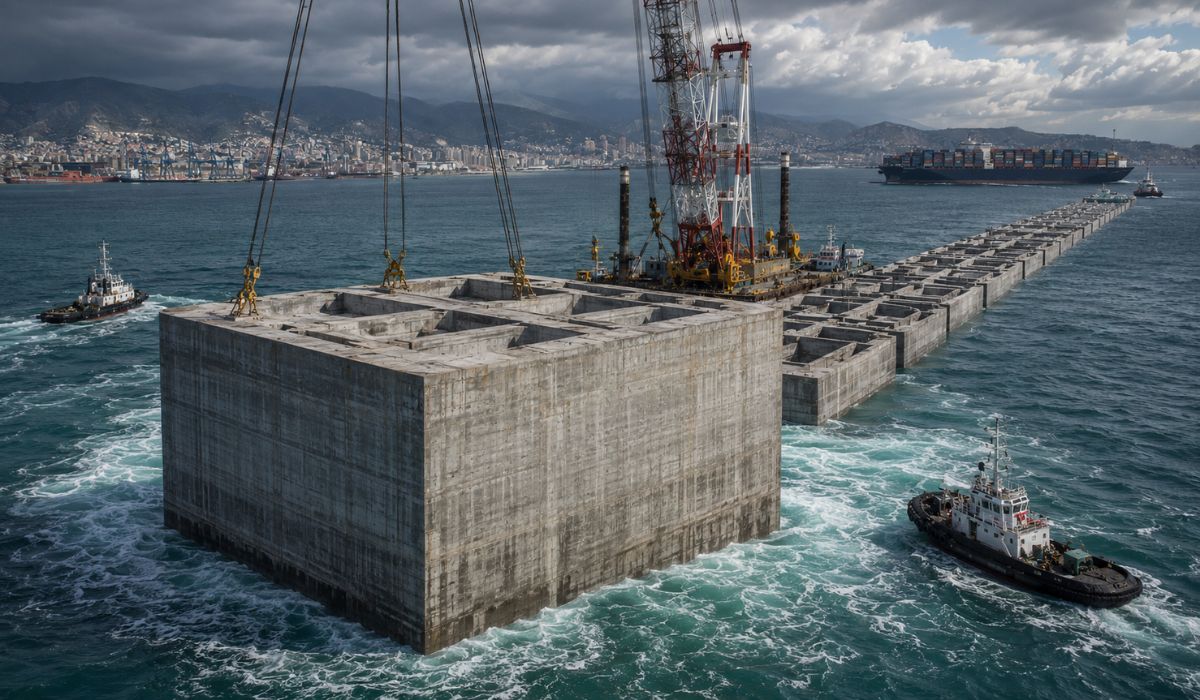
Italy Sinks Massive 11-Story Concrete Structures in the Ligurian Sea to Create a 6.2 km Barrier, Clearing the Way for 400-Meter Ships in Genoa



For the researchers responsible for the study, the regular alignment of the blocks does not match the patterns expected in known natural formations in that seafloor region.
The study was published in the scientific journal Proceedings of the National Academy of Sciences, PNAS.
The research combines sonar data, optical images, sediment samples, and underwater surveys used to reconstruct part of the landscape that existed before sea level rise.
The main interpretation presented by the authors is that Blinkerwall may have functioned as a hunting structure.
In this interpretation, the row of stones would have helped groups of hunter-gatherers guide reindeer into narrower areas, where the animals would be more vulnerable during movements across the post-glacial landscape.
How the submerged wall was identified in the Baltic Sea
The discovery occurred in the autumn of 2021, during an expedition by researchers and students from the University of Kiel.
The group was investigating manganese crusts on a glacial sediment elevation when the multibeam sonar registered a linear sequence of stones on the seafloor.
The site is located about 10 kilometers from Rerik, in the German state of Mecklenburg-Western Pomerania.
After the initial recording, new analyses were conducted using underwater vehicles, high-resolution hydroacoustic measurements, and images of the site.
These data indicated that small stones connect larger blocks along almost the entire length of the structure.
According to the researchers, several of these large blocks were likely already in place, while smaller stones would have been positioned to form a continuous line.
The interpretation of human origin is precisely supported by this combination.
Instead of moving very heavy rocks over long distances, the builders would have utilized natural elements of the landscape and filled the spaces between them.
For the team, this pattern reduces the likelihood that the formation was produced solely by ice, waves, or other geological processes.

Why scientists link the structure to reindeer hunting
The hypothesis of its use in hunting is linked to the ancient landscape of the region.
When Blinkerwall would have been built, the area was not yet submerged and was likely part of a terrestrial environment, with lake shores, wetlands, and corridors used by animals.
According to the University of Kiel, reindeer were among the important animals for the subsistence of human groups occupying northern Europe after the last glaciation.
The structure, according to the study’s authors, could have guided herds to a narrower passage point, facilitating the hunters’ action.
This explanation also considers the wall’s positioning in relation to the ancient topography.
The alignment is located near the edge of a paleolake or a wetland area now buried and submerged.
In this scenario, animals could be directed between the stone barrier and the natural water boundary.
Researchers compare the case to hunting structures already documented in other archaeological contexts.
In Lake Huron, North America, for example, submerged stone formations have been associated with the capture of caribou, animals similar to reindeer.
The comparison does not, by itself, confirm the function of the Blinkerwall, but it helps explain why the hunting hypothesis is considered consistent by the team.
However, there is no definitive conclusion yet on the use of the structure.
New searches for artifacts, animal remains, and other traces in the surroundings may indicate more precisely how the site was used by the human groups who lived in that landscape.
How a Stone Age construction ended up at the bottom of the sea
The presence of the wall at the bottom of the Baltic Sea is related to environmental changes that occurred after the end of the last Ice Age.
During that period, parts of the current seabed were dry areas or wetlands accessible to humans and animals.
With the warming climate and melting glaciers, sea levels gradually rose and covered stretches of the coastal landscape.
According to researchers, the Blinkerwall region was flooded thousands of years after the structure’s probable construction.


Dating is done through the relationship between the find, the ancient nearby shoreline, and the environmental history of the region.
The study indicates that the structure must predate the definitive advance of waters over that area and may have been built in an interval associated with the end of the Pleistocene and the beginning of the Holocene.
Another element considered by scientists is the presence of reindeer at that latitude.
As these animals left the region when the climate became warmer and forests expanded, the proposed function for the wall helps to place the find in a period prior to this ecological change.
What the Blinkerwall indicates about Stone Age groups
For the study’s authors, the Blinkerwall shows that hunter-gatherer groups could modify the landscape in a planned way to meet subsistence needs.
The construction of a stone line of this size would require observation of the terrain, knowledge of animal behavior, and collective action.
Kiel University states that the find is among the largest known Stone Age structures in Europe.
The site is also described by researchers as one of the oldest pieces of evidence of hunting architecture associated with human groups on the continent.
The discovery does not mean that these groups had cities, agriculture, or permanent occupation in the area.
What the study indicates is the existence of organized strategies to take advantage of animal routes and natural terrain elements, even in hunter-gatherer societies.
This point is relevant because some of the known great prehistoric works are usually associated with more sedentary societies.
In the case of the Blinkerwall, the researchers’ interpretation suggests a form of infrastructure linked to mobility, hunting, and seasonal use of the landscape.

Research continues in the western Baltic
The find also served as a basis for new investigations in the Baltic Sea.
In May 2025, the Leibniz Institute for Baltic Sea Research Warnemünde announced the SEASCAPE project, aimed at studying possible submerged megastructures in the western Baltic.
The initiative brings together experts in geophysics, archaeology, geology, and paleoenvironment.
Among the objectives are mapping similar structures, reconstructing currently submerged landscapes, and evaluating the human origin and possible function of these remains.
Researchers also intend to analyze old hydroacoustic records that indicate little-studied formations in areas such as the Flensburg Fjord and the Fehmarn Belt.
These surveys may show whether Blinkerwall is an isolated case or part of a larger set of structures preserved on the seabed.
The study of these submerged landscapes can help understand how human groups occupied coastal regions before sea level rise.
In the case of Blinkerwall, each new research stage seeks to clarify who built the structure, how it was used, and for how long it remained active before being covered by water.