Portuguese
  Spanish


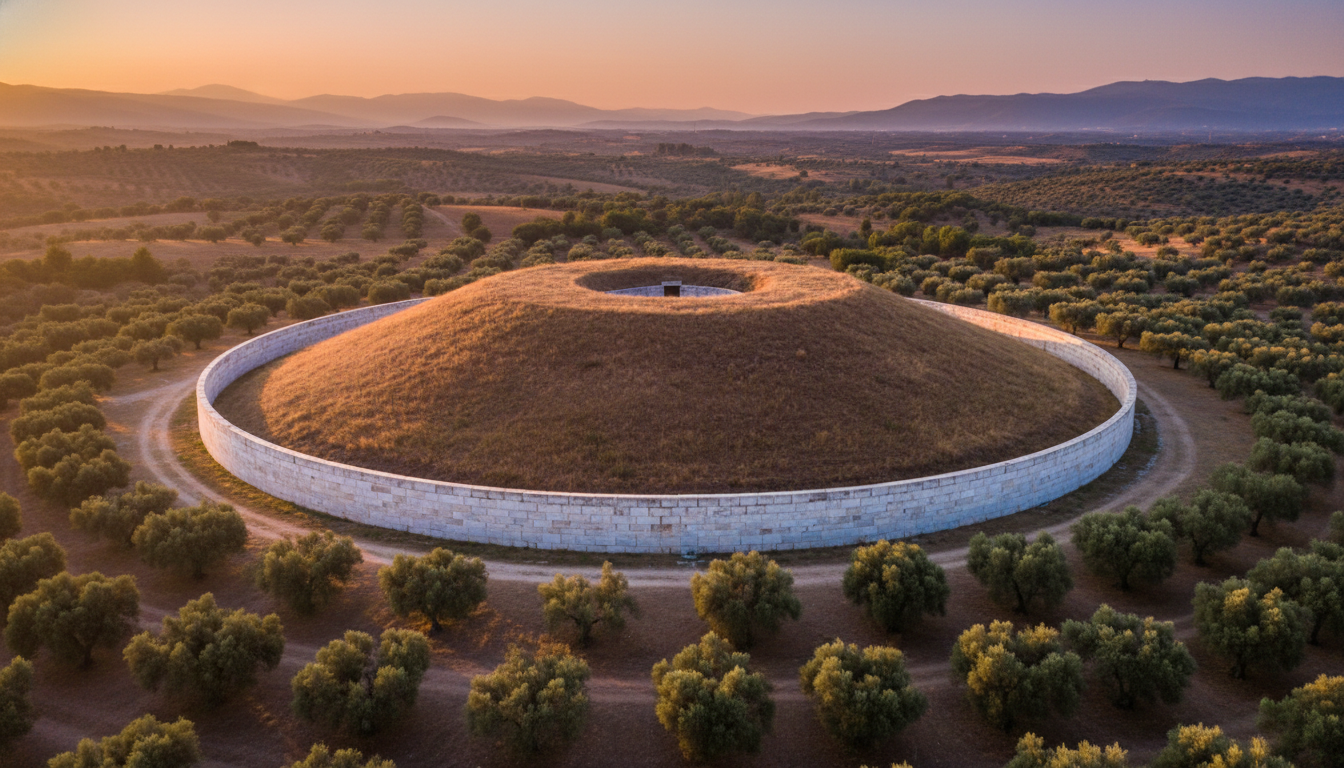


Kasta Tomb in Amphipolis reveals 140 meters in diameter and about 497 meters of intact marble
In May 2026, Greek archaeologists released the first results of the complete excavation of the Kasta Tomb in Amphipolis, northern Greece.
As reported by Heritage Daily, it is the largest tomb ever found in ancient Macedonia.
The monument is over 140 meters in diameter. In comparison, the famous tomb of Aigai (associated with Philip II) measures 110 meters.
-
Driver Crosses 100-Year-Old Railway Bridge Over Uruguay River, Encounters Rural Couple Preserving Traditional Farming Methods

-
Rural Producer Returns to Brazilian Farmland, Builds Family Agricultural Business with Children’s Support and Industry Backing
-
Goiás Couple Boosts Artisan Cheese Production from 25 to 70 Kilos Daily with Technical Support, Transforming Family Life in Rural Brazil
-
13-Year-Old Discovers Ancient Roman Ring Near Mount Carmel, Now Set for Display in Jerusalem


According to the archaeological team, the complete marble perimeter reaches 497 meters. It is the largest funerary structure ever erected by the Macedonian civilization.
Kasta Tomb surpasses Philip II’s in diameter and reveals the scale of power post-Alexander the Great
The Macedonian tomb dates from the late 4th century BC. On the other hand, experts still debate the exact identity of the occupant.
The dates match the period immediately following the death of Alexander the Great in 323 BC.
As detailed by the restoration team to Archaeology Magazine, hypotheses include Hephaestion (a general close to Alexander), Roxana (wife), or Olympias (mother).
In other words, the site may house remains of a central figure in the Macedonian circle. At that time, the empire was fragmenting among the Diadochi, successor generals.
497-meter wall of white marble from Mount Pangeon was fully revealed

The peribolos is the circular wall that surrounds the tumulus. As the study points out, the structure uses white marble blocks extracted from nearby Mount Pangeon.
In fact, the conservation team has already reconstructed 105 meters of the southern wall. The work uses original blocks recovered during the excavation.
Furthermore, conservators add artificial stone only when structural support requires it. Consequently, the result maintains maximum historical authenticity.
Two marble sphinxes guard the main entrance of the funerary monument
At the main entrance, there are two sphinxes sculpted in marble. According to the archaeological record, the figures were partially destroyed when discovered in 2014.
On the other hand, parts of the heads and wings were located inside the third chamber of the tomb. Next, the team intends to reinstall the sphinxes at the original entrance.
Similarly, the Amphipolis lion (a separate marble sculpture that decorated the top) will be repositioned over the tumulus.
At that time, the ensemble will recover the approximate appearance of the 4th century BC.
- Diameter: more than 140 meters
- Marble perimeter: 497 meters
- Reconstructed: 105 meters of the southern wall
- Date: late 4th century BC
- Sphinxes: 2 at the main entrance (partially recovered)
- Investment: more than €15 million
Restoration costs €15 million and reopening to the public is scheduled for 2028

The total project budget exceeds €15 million. According to Greek City Times, the funding combines resources from the European Union and the Greek government.
In comparison, other European archaeological sites rely mainly on private sponsorship. Therefore, the case of the Kasta Tomb serves as a model for future interventions in the Mediterranean.
According to the Greek Ministry of Culture, the opening to the public is scheduled for early 2028.
Similarly, part of the original pieces will return to the site after restoration at the Archaeological Museum of Amphipolis.
Amphipolis was a strategic Greek colony on the Strymon River controlling trade routes
Amphipolis is located in northern Greece, near the border with North Macedonia. According to historical records, the city was founded as an Athenian colony in 437 BC.
At that time, it controlled trade routes and gold and silver mines of Mount Pangeon. On the other hand, the city came under Macedonian rule in 357 BC, conquered by Philip II.
In other words, Amphipolis became a regional seat of power at the height of Alexander’s empire. Therefore, the presence of such a large funerary monument at the site is justified.
Brazilian researchers have limited access to sites of ancient Macedonia

Brazil maintains international archaeological partnerships through the National Museum of UFRJ and MAE-USP.
In comparison, access to sites in Macedonia depends on specific scholarships from the Greek government.
According to Brazilian institutions, there are few national researchers active in classical Greek archaeology.
In comparison, countries like the United States, the United Kingdom, and Germany have maintained permanent archaeological schools in Greece for over a century, with annual teams at sites like Olympia, Delphi, and Corinth.
Therefore, the Kasta Tomb attracts excavators from more than a dozen nationalities. At that time, the site functions as a training hub for archaeologists from Eastern Europe and the Mediterranean.
Similarly, projects like the use of 3D photogrammetry, geophysical magnetic resonance, and LiDAR modeling are gaining ground in Amphipolis. Consequently, new technologies allow mapping internal areas without destructive excavation.
Other recent global discoveries include the discovery of hidden pyramids in the Bolivian Amazon, mapped with LiDAR. Similarly, the Saqqara tumulus in Egypt was recently opened for the first time in 2,300 years.
Similarly, Brazil has a stronger tradition in pre-colonial South American archaeology. Therefore, university exchanges and sandwich doctorates remain the main access channel.
Next steps: marble door returns to place and sphinx head is restored
The next phase of the project involves the reinstallation of the double marble door. Next, it will be the turn of the missing head of one of the sphinxes.
According to the coordination, the recovery adds pieces carved in similar stone when the original fragment was not located.
At that time, the criterion is to restore the ensemble without masking what is ancient from what is modern.
Consequently, the team intends to open the site in guided circuits starting in 2028.
According to the Greek Ministry’s estimate, the Kasta Tomb could attract more than 200,000 visitors a year in the first five years.
There are recognized limitations. The identity of the occupant remains unknown despite decades of research.
Will new DNA analyses of the bones found in the burial chamber one day reveal who was buried in this 140-meter tomb in Amphipolis?